


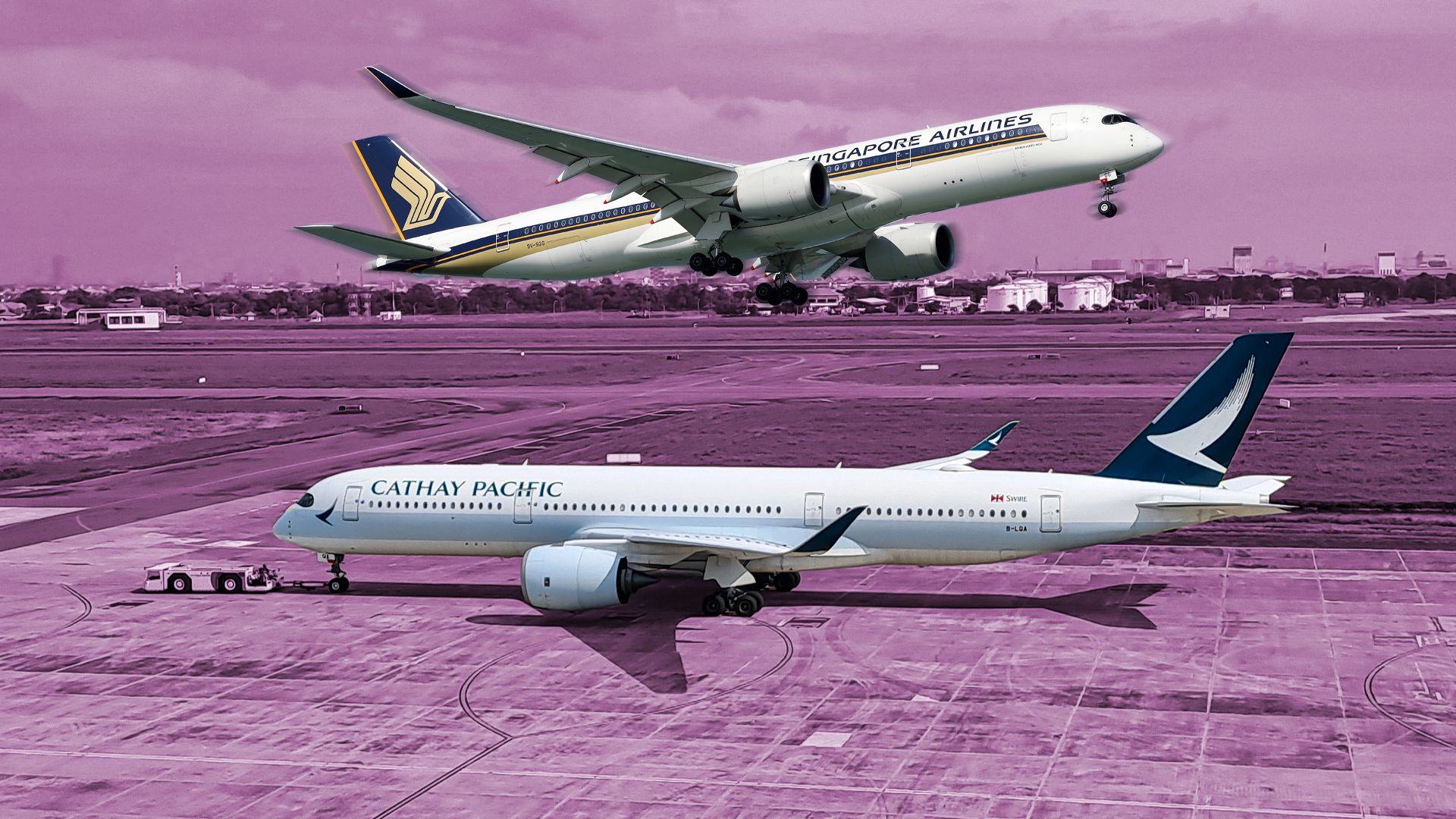
When it comes to flying in comfort from the Americas to East Asia, two airlines stand out at the forefront. The duo in focus is  Singapore Airlines and Cathay Pacific, but the question is which one of these two world-class airlines comes out on top? Using data from Cirium for November 2025, we will analyze routes, schedules, as well as each airline’s fleet serving this niche market.
It has been an exceptional year of record for tourism and air travel to Asia in 2025. Not only does the volume of flyers reach record levels in the wake of the resurgent demand for travel in the Years following the COVID-19 lockdown, but demand for premium products is higher than ever.
Singapore Airlines and Cathay Pacific are both renowned for their high-quality service both in the air and on the ground. As they are each well known for being juggernauts in their market segments of air travel, both international and domestic service to and from the region.
The bottom line is, in terms of volume, Cathay Pacific flies over double the total number of flights that Singapore Airlines operates: 884 compared to 370, respectively. This month, Cathay’s widebody fleet will offer just under 300,000 seats between different hubs across the Pacific, whereas Singapore can only muster a total just shy of 80,000 seats.

Singapore Airlines is frequently heralded as one of the best in the world and often receives accolades such as “World’s Best Cabin Crew” and “World’s Best First Class.” Cathay Pacific, however, is not far behind, receiving exceptional praise, especially for value and all-around quality of service, and even earning the title of “World’s Best Economy Class Airline” in the Skytrax awards.
Cathay Pacific operates a mixed fleet of Airbus A350 “extra wide body” jets as well as Boeing 777-300ER (77W) long-haul airliners. The airline has 30 examples of the A350-900 (359), 18 larger A350-1000s (351), and 35 777-300ER in its inventory, as Planespotters.net data shows. Singapore Airlines has a similarly mixed fleet to Cathay Pacific, with 22 Boeing 777-300ERs and an impressive 65 jets from the A350-900 series, including the rare -900ULR (Ultra Long Range) variant.
Singapore Airlines is the sole operator of the A350-900ULR variant, which is specifically configured without an economy class cabin, featuring only business and premium economy seats to maximize comfort on ultra-long-haul journeys. Singapore operates its unique -900ULR jets on select flights between Singapore (SIN), Los Angeles (LAX), and San Francisco (SFO), as well as two of the longest routes in the world, from SIN to New York (JFK) and Newark (EWR).
Cathay Pacific’s Portfolio

The top itinerary for Cafe Pacific’s Transpacific service is between Los Angeles and Hong Kong (HKG). The second most frequent itinerary is between Hong Kong and Toronto (YYZ). The next most popular route also departs from Hong Kong, this time bound for Vancouver (YVR) on Canada’s West Coast. San Francisco takes fourth place, and New York JFK comes in at fifth, both connecting to Hong Kong on the other end of the flight plan.
|
Origin |
Destination |
Aircraft |
Round Trips (November 2025) |
Seats |
|---|---|---|---|---|
|
HKG |
LAX |
77W |
77 |
50,900 |
|
HKG |
YYZ |
351 |
54 |
36,072 |
|
HKG |
YVR |
77W |
48 |
34,992 |
|
HKG |
SFO |
359 |
47 |
26,320 |
|
HKG |
JFK |
351 |
35 |
23,380 |
That’s not it for the airline, though, as Cathay Pacific’s full month of long-haul traffic across the Pacific Ocean will offer nearly 2.2 million available seat miles (ASMs). That figure represents the miles per passenger seat on all aircraft that will operate the 884 flights for the month, with a combined total of 288,864 seats offered.
Singapore Airlines’ Docket

Singapore Airlines actually only has five different itineraries that qualify as Transpacific routes. Those flight plans all originate or terminate in Singapore and include connections to: San Francisco, Los Angeles, Newark, New York’s JFK, or Seattle’s SeaTac Airport (SEA).
Naturally, with fewer destination options and fewer aircraft operating in the segment, Singapore loses out in the contest for traffic volume. The total number of seats that will be available on aircraft crossing the Pacific is 77,050. The available seat miles (ASM) will reach nearly 700,000 for the 370 flights operated by the airline.
|
Origin |
Destination |
Aircraft |
Round Trips (November 2025) |
Seats |
|---|---|---|---|---|
|
SIN |
SFO |
359 |
60 |
24,480 |
|
SIN |
LAX |
359 |
43 |
21,758 |
|
SIN |
EWR |
359 |
30 |
9,660 |
|
SIN |
JFK |
359 |
30 |
9,660 |
|
SIN |
SEA |
359 |
22 |
11,132 |
Flights from Singapore to New York or Newark can be as long as 19 hours nonstop. Depending on the prevailing winds in the jet stream, pilots have a choice between eastbound or westbound before they circle half of the globe on the record-breaking journey.
Airbus’ Extra Widebody

Qatar Airways received the first -900 in 2015, but since then, over 600 have been delivered to global customers. The original, clean-sheet extra widebody was a direct response to the 787 Dreamliner made by Boeing when it threatened to surpass the A330 widebody in terms of efficiency and technology. The A350 sits higher in the widebody chain for capacity between the Dreamliner and forthcoming 777X, making it a competitor for both.
Using carbon-fiber reinforced polymer (CFRP) composites and other weight-saving methods, Airbus says the A350 reduced its weight by 1.2 metric tons compared to traditional materials. This regimen of weight loss was also made possible by the reduction of the aircraft’s systems, structures, and installation design. That composite also made its wing remarkably strong and flexible, which helps the A350 fly fast but use less power.
|
Specification |
|
|---|---|
|
Max Pax seating |
440 seats |
|
Typical 3-class configuration |
332-352 seats |
|
Range |
8,500 nautical miles (15,750 kilometers) |
|
Cruise Mach |
0.85 |
|
Overall length |
219 feet 2 inches (66.80 meters) |
|
Cabin length |
167 feet 5 inches (51.04 meters) |
|
Wing span (geometric) |
212 feet 5 inches (64.75 meters) |
|
Height |
55 feet 11 inches (17.05 meters) |
Inside the cabin, passengers enjoy higher humidity and pressurization level that’s been brought down to 6,000 feet, as opposed to the more common 8,000 feet. These changes reduce dehydration and fatigue on extended flights. Crews report feeling noticeably fresher at the end of their duty periods, which also serves to improve operational safety.
The Incredible A350-1000

The Airbus A350-1000 is unique in that it combines low structural weight, ultra-long-haul capabilities, and a passenger-centric “airspace” interior. It blends in almost imperceptibly with the gates and airport slots already occupied by previous twinjets, thanks to its carefully tailored dimensions. More than two-thirds of its structure, like fuselage skins, spars, stringers, and even the wing’s 32-meter one-piece upper cover, is made from carbon-fiber–reinforced plastic.
This yields an airframe that is lighter, corrosion-free, and with fatigue timelines that run far more slowly than those of an aluminum equivalent. That allows airlines to fly longer blocks between intensive checks and reduces inspection hours.
|
Specification |
|
|---|---|
|
Max Pax seating |
480 seats |
|
Typical 3-class configuration |
375-400 seats |
|
Range |
9,000 nautical miles (16,700 kilometers) |
|
Overall length |
242 feet (73.78 meters) |
|
Wing span (geometric) |
212 feet 5 inches (64.75 meters) |
|
Height |
56 feet 4 inches (17.08 meters) |
A high-aspect-ratio wing with smoothly curved sharklets and droop-nose devices to maximize airflow at low speed is supported by that lightweight framework. The design enables the A350-1000 to travel approximately 13,500 kilometers (9,000 nautical miles) while using about a quarter less fuel than the four-engine types it is replacing..
The Rolls-Royce Trent XWB-97 engines are currently the most efficient large turbofans in commercial service. At hubs like Heathrow and JFK that are sensitive to noise, lower thrust levels on climb and cruise also result in noticeably quieter departures, which is advantageous for compliance and operational flexibility.
Boeing 777-300ER By The Numbers

The 777-200LR and the 777-300ER (extended range) were developed concurrently as part of the Worldliner program and share a strong engineering commonality. Both aircraft were equipped with the same General Electric GE90-115B engines, which allowed for their incredible payload and range capacities.
The highest capacity of the triple sevens, the – 300ER featured several innovative new technologies when it first debuted in the 2000s. From the very beginning, the aircraft is already groundbreaking as it would be the very first commercial airplane engineered entirely using computer-aided design (CAD).
The engine is officially rated to produce 115,000 pounds-force (lbf) of thrust. During certification testing in 2002, the engine reached a world record of 127,900 lbf (568.9 kN) of thrust, which has only recently been surpassed by the GE9X designed for the 777X.
|
Specification |
|
|---|---|
|
Seats (2-class) |
392 |
|
Range |
7,370 nautical miles (13649 kilometers) |
|
Length |
73.9 meters (242 feet 4 inches) |
|
Wingspan |
64.8 meters (212 feet 7 inches) |
|
Height |
18.5 meters (60 feet 8 inches) |
|
Engine |
GE90-115B |
The Boeing 777 family was instrumental in advancing safety and engineering progress that has given rise to large, long-range twinjets replacing legacy quadjet aircraft on international routes. The four-engined, iconic 747 jumbo jet and Airbus A380 super jumbo have been progressively falling to the wayside as airlines favor modern two-engined widebodies.
