



By Tom Batchelor. Feb. 13, 2026, © Leeham News:
Safran enjoyed an “outstanding” 2025 with a record number of LEAP engine deliveries, a thriving aftermarket and significant growth across its defense activities, CEO Olivier Andriès said on Friday as he announced the French aerospace group’s full year results.

Describing its “all-time high financial performance,” Andriès noted that Safran had delivered more than 1,800 LEAP engines, up 28% versus 2024, and 49% higher year-on-year in Q4 – and said the aviation, defense and space group was preparing to meet Airbus’ targeted production capability of 75 A320 Family aircraft per month in 2027.
For the full-year period ended December 31, 2025, revenue stood at €31.33 billion ($37.14 billion), with a recurring operating income of €5.2 billion and free cash flow of €3.92 billion.
This compares with revenue of €27.32 billion (up by 14.7%), recurring operating income of €4.12 billion (a 26.2% year-on-year increase) and free cash flow of €3.12 billion in 2024. Safran’s operating margin stood at 16.6% of revenue, up from 15.1% in 2024.
Revenues up across the board
Broken down by division, Propulsion revenue was up by 17.6%, with aftermarket revenue up by 21% and OE sales up by 12.1%.
Equipment & Defense revenue was up by 11.4%, with aftermarket services increasing by 12.2%, notably helped by landing gear for the A350, A320, A330 and 787, nacelles for the A320neo and A380), and evacuation slide systems. OE sales also grew by 11%.
Aircraft Interiors saw a 14.2% revenue growth, aftermarket activities in this segment increased by 13.5%, and OE sales grew by 14.7%.
Safran is proposing a dividend per share of €3.35 for the fiscal year 2025, paid in 2026, representing a 40% payout ratio on adjusted net income.
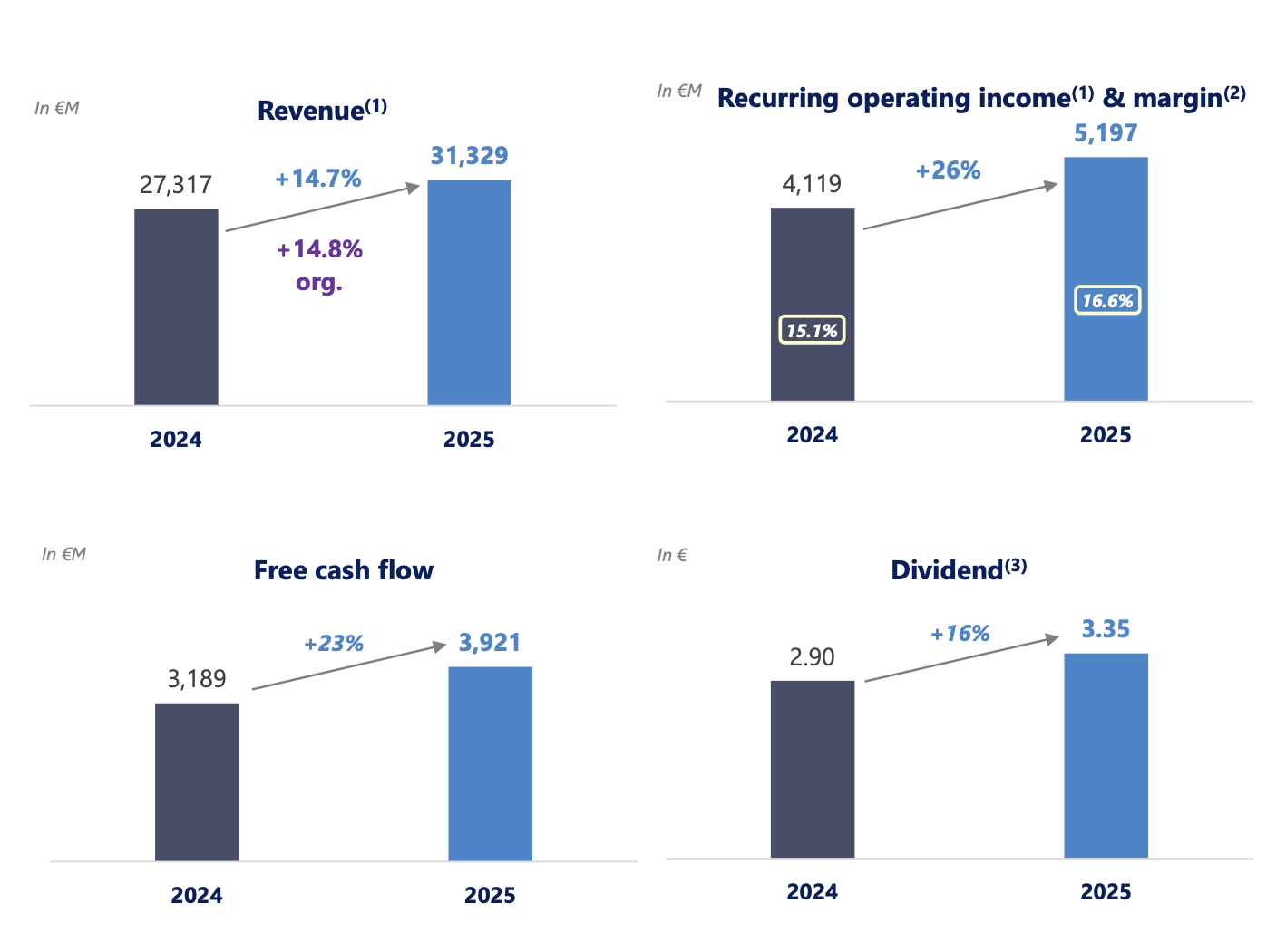
Safran’s revenue, income, free cash flow and dividend for 2025. Credit: Safran
Improvements in LEAP production
The strong figures were underpinned by improvements in the supply chain, and efforts to improve resiliency within the troubled LEAP production line.
More than 1,450 of the high-pressure turbine hardware durability kits for the CFM LEAP-1A engines that power Airbus A320neo family aircraft have now been produced. This upgrade can more than double time on wing in harsh environments, and Andriès said this was bringing shop visit intervals in line with the CFM56.
Around half of the LEAP 1-A fleet is also now equipped with the reverse bleed system which reduces on wing fuel nozzle maintenance.
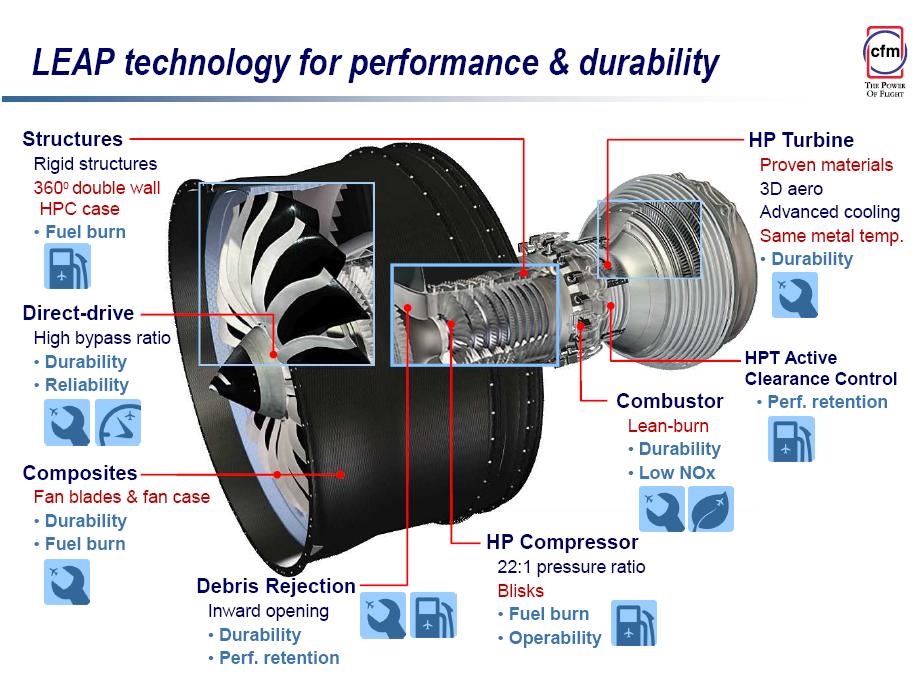
For the LEAP-1B, both the reverse bleed system and the HPT blade upgrades are expected to be certified in the first half of 2026, delivering the same durability improvements to 737 MAX operators.
This week, Ryanair and CFM announced a long-term material services agreement to support Ryanair’s entire fleet of about 2,000 CFM56 and LEAP engines powering its Boeing 737 aircraft.
Safran, one of CFM’s two parent companies, will help cover the provision of spare parts and parts repair from CFM for the two new engine MRO shops that Ryanair plans to establish in Europe from 2029.
CFM will also support Ryanair with a services agreement for both CFM56 and LEAP engines, until the Ryanair MRO facilities are fully operational.
For the CFM56, Andriès highlighted a strengthening afterservice market driven by high MRO demand and resulting low retirement levels, with around 2,300-2,400 shop visits per year from 2025 to 2028, more than 750 additional shop visits over the period than previously forecast.
This chimes with Bernstein’s analysis, that retirements were around 1% of the total fleet in 2025, “significantly below industry normal, due to the shortage of new planes.”
Safran said shop visits were expected to start declining from 2029, however Bernstein said this was “difficult to believe” given the strength of demand. “That is
the key driver behind our bullish stance on Safran,” they said in a January 22 analysis.
Strengthening defense portfolio
Growing momentum within Safran’s defense activities is also sustaining this rosy picture for the Paris-based corporation.
Safran has accelerated production of the M88 powering the Dassault Aviation Rafale fighter jet, recently announced a new MRO shop dedicated to the M88 engine in India, and has secured a new Rafale export contract with the Indian Navy.
Safran Aircraft Engines also announced a project to expand its Le Creusot facility, which specializes in machining complex rotating parts. The Le Creusot site currently exclusively produces low-pressure turbine disks for the LEAP and CFM56 engines, but the expansion will add production lines for complex rotating parts for the M88 as well as the GE90 engines, which power the Boeing 777 .
In defense electronics, the order intake reached a record level, with 1.6 book to bill ratio. “Momentum remains extraordinarily strong in defense,” Andriès told investors on Friday’s earnings call.
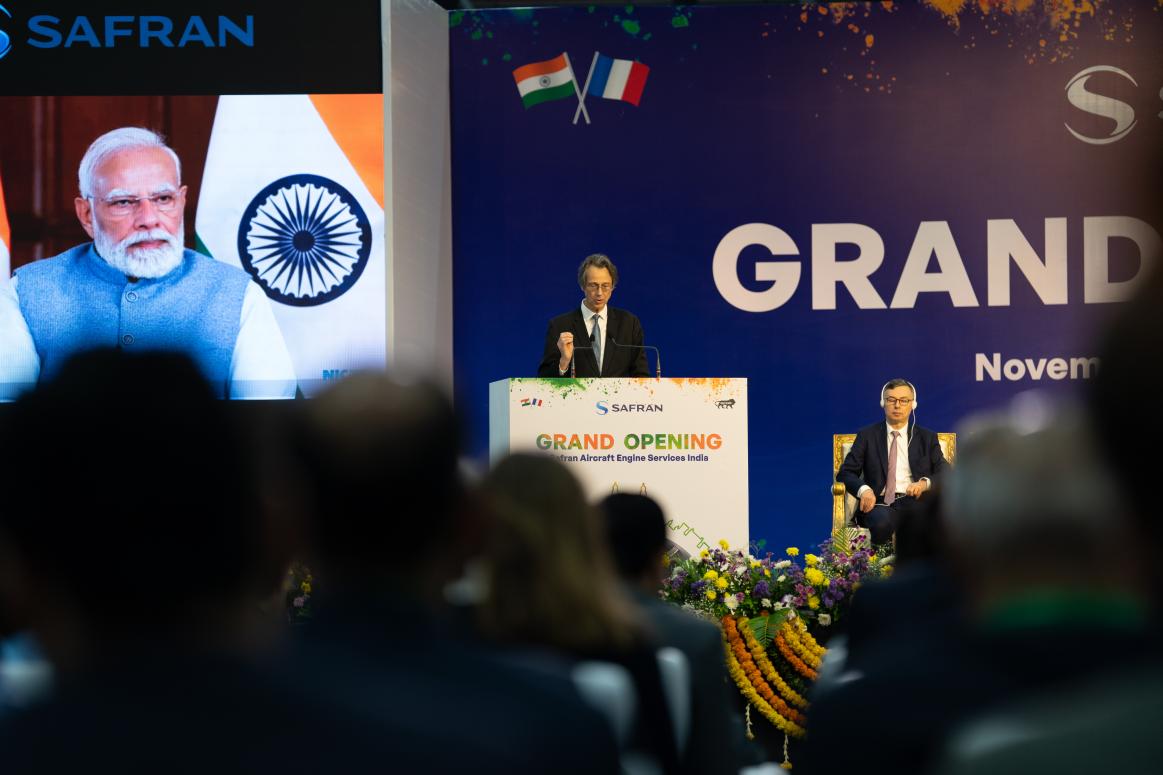
At a ceremony in Hyderabad, attended by Narendra Modi and Olivier Andriès, Safran inaugurated its largest MRO center dedicated to the CFM International LEAP engine. Credit: Safran
On the portfolio management side, Andriès said the integration of Collins actuation activities was “progressing well”, while Safran is also moving ahead with the divestment of two non core activities. The sale of Safran Passenger Innovations, Safran’s in-flight entertainment and connectivity solutions division, was completed last month.
The deal for Safran to sell its 50% stake in EZAir, a 50/50 joint venture that manufactures Embraer’s interiors in Chihuahua, Mexico, along with associated aftermarket activities, to partner Embraer, is expected to close by the middle of the year.
More growth to come in 2026
For 2026, Safran expects revenue to increase by the low to mid-teens percentage points, while recurring operating income is forecast to reach €6.1 to €6.2 billion with free cash flow projected to sit between €4.4 and €4.6 billion. LEAP deliveries are expected to increase by around 15% over the year.
The French corporate surtax on large companies’ profits, which is set to be maintained in 2026, is expected to knock €470 million off its free cash flow (the figure reached €377 million in 2025).
The positive results have pushed medium term forecasts higher, with Safran forecasting that recurring operating income in 2028 should now land somewhere between €7 and €7.5 billion, up from the €6 to €6.5 billion listed at the capital markets day in 2024.
Meeting the Airbus rate 75
Safran is betting on further growth in line with Airbus’ ambition for the A320neo family delivery rate of 75/mo by 2027.
The group has taken the decision to invest to be ready for Rate 75. “We acknowledge that the demand has been there for some time so it is worth investing,” Andriès told investors. The target production rate was a catalyst for the new assembly line in Morocco, and Andriès teased future investments to help meet that 75 figure.
“We are just getting prepared, we have to be realistic it does not happen over night but we getting prepared and we are investing,” he said.
Related
