



Ryanair and CFM International executives have met to sign a Memorandum of Understanding (MoU) that will see the engine manufacturer supply the low-cost carrier’s new in-house engine MRO shops.
On February 10, 2026, Ryanair said the two companies had agreed in principle to a multi-year, multi-billion-dollar engine material services contract under which CFM will support Ryanair’s engine maintenance program.
The agreement forms part of Ryanair’s plans published last year to open two in-house engine MRO Shop so it can carry out its own engine maintenance moving forward.
The MoU sees Ryanair commit to purchase all its engine spare parts directly from CFM as the carrier’s fleet grows to 800 Boeing 737 family aircraft, and over 2,000 CFM engines.
CFM has maintained Ryanair’s CFM56 engines for the past 30 years, but the airline expects to take this over when it opens two engine MRO Shops in Europe from 2029.
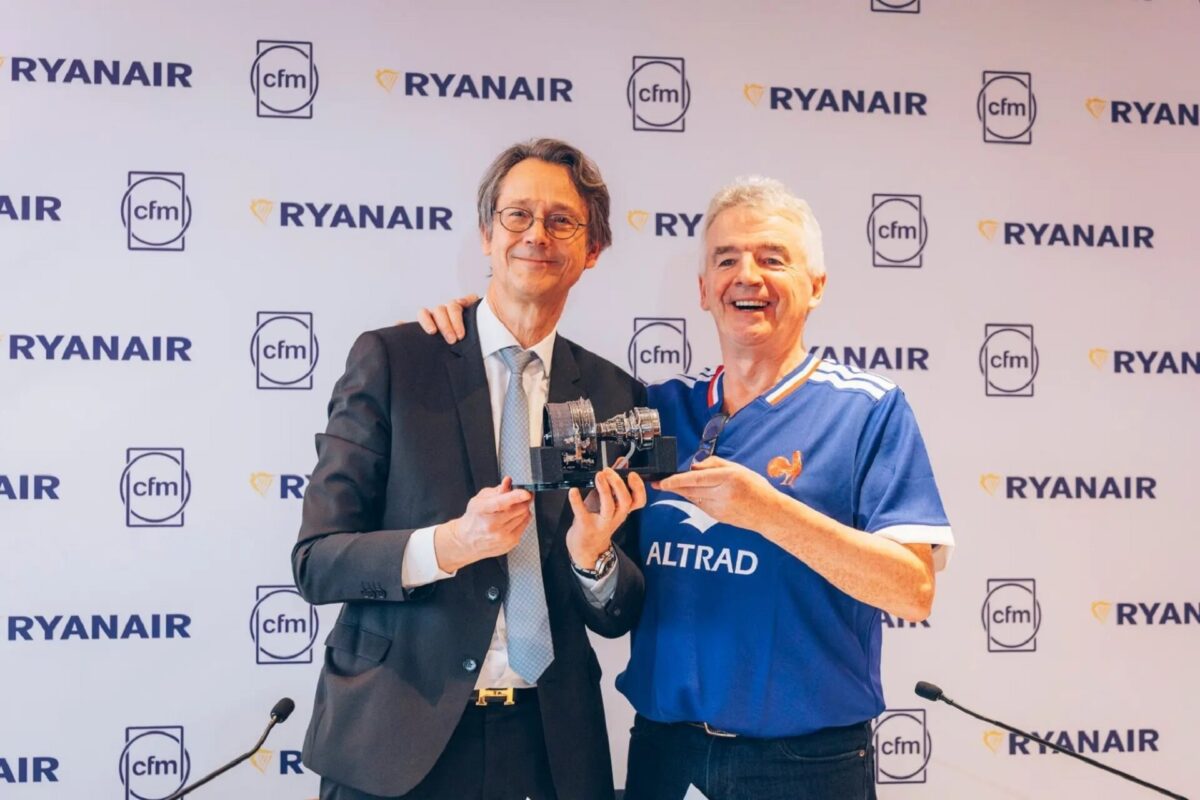
“Ryanair will place substantial orders for initial spare parts provisioning with CFM to support the opening of each of these two Ryanair engine maintenance facilities,” said Michael O’Leary, Ryanair’s CEO.
The CFM contract will support Ryanair’s existing and future CFM56-7B and LEAP-1B engine which power Boeing 737 NG and 737 MAX aircraft. CFM services will also provide MRO services for Ryanair’s engines during the airline’s MRO shop ramp‑up.
“When Ryanair takes over all its engine maintenance in-house, we expect this contract will be worth in excess of $1bn annually to CFM in spare engines and spare parts supplies,” added O’Leary.
CFM is jointly owned by French firm Safran and the US company GE Aerospace.
Commenting on the agreement Olivier Andriès, CEO of Safran, said: “This new major milestone further strengthens the strategic relationship we have built with Ryanair over the past three decades, and we are proud to support their continued growth through this comprehensive MRO services offering.”
H. Lawrence Culp, Jr., Chairman and CEO of GE Aerospace, added: “Ryanair is one of our largest customers, and we value the opportunity to work with them on solutions to increase capacity and reduce turnaround time. This MoU demonstrates our commitment to an open MRO ecosystem that supports growing demand while reducing cost of ownership.”
