


Pratt & Whitney is considered to be one of the most well-known names in the aviation industry. The company was first founded in 1925, and it is currently part of RTX, formerly Raytheon Technologies. The Connecticut-based engine manufacturer has spent nearly a decade at the forefront of aviation engine technology. Over the years, the company has been responsible for propulsion systems that have powered aircraft ranging from the Douglas DC-3 and the Boeing 707 to the Lockheed Martin F-35 Lightning.
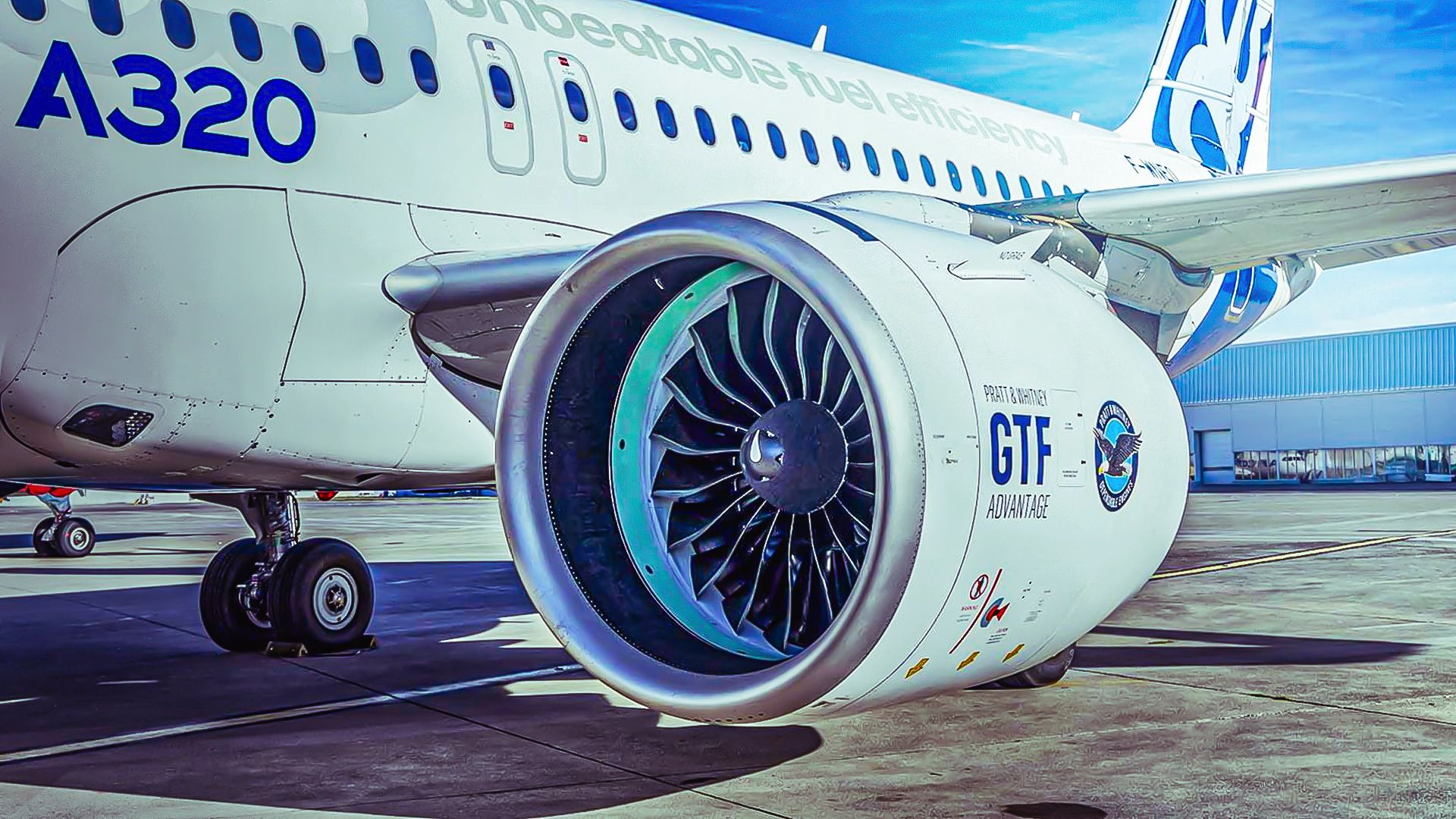
The company is responsible for consistent innovations in the propulsion space. In recent years, this has included the introduction of the Geared Turbofan Engine (GTF) family, also known as the PW1000G series. This engine was first introduced in the early 2010s and incorporated several innovative technologies to transform the propulsion industry. These improvements helped to improve fuel efficiency, cut CO2 emissions, and reduce the noise footprint of the engine. Let’s take a closer look at this powerful propulsion system, as well as some of the most recent developments in the engine family.
What Are The Latest Developments Of The GTF Engine?

Although the Pratt & Whitney GTF engine was first introduced in the early 2010s, the company has constantly been upgrading the powerful platform. Most recently, earlier this year, Pratt & Whitney achieved a major milestone for its latest development in the GTF family. In December 2024, the Federal Aviation Administration (FAA) granted certification for the PW1100G-JM engine variant. The European Union Aviation Safety Agency (EASA) followed suit by granting certification for the engine in February 2025.
The PW1100G-JM engine is utilized on the Airbus A321XLR aircraft, one of the most advanced narrowbody platforms ever developed. Because of this, operators were able to soon take delivery of this legendary aircraft. The first Airbus A321XLR was introduced into commercial service in late 2024 by  Iberia, although it utilized the CFM International LEAP-1A. The first A321XLR powered by the PW1100G-JM was delivered to Wizz Air in May 2025, although it has yet to begin commercial service.
Beyond the latest GTF engine, Pratt & Whitney has also upgraded several other platforms. In February 2025, the company announced the FAA type certification of a new version of the GTF, branded the “GTF Advantage.” This engine upgrade included improved thrust, better durability, and lower fuel consumption.
What Spurred The GTF Engine Program?

Overall, the Pratt & Whitney GTF engine is loosely based on the company’s popular PW6000 offering. This high-bypass turbofan engine was designed for the Airbus A318, although it did not see significant commercial success. However, in the late 1990s, Pratt & Whitney attempted to build a production geared turbofan engine based on the PW6000, although it replaced the fan section with a gearbox and a single-stage fan.
Over the next few years, Pratt & Whitney spent hundreds of millions of dollars on improving this design. The company was focused on developing a geared turbofan engine to power the next generation of narrowbody airliners. The first ground test of its most prominent demonstrator occurred in November 2007.
In late 2007, the engine was selected to power the Mitsubishi Regional Jet (MRJ). Because of this, it began flight testing in mid-2008, while installed on the Pratt & Whitney Boeing 747 flight test vehicle. Eventually, the first GTF engine, the PW1500G, achieved certification from Transport Canada in February 2013.
When Was The First GTF Engine Introduced?

Shortly after the PW1500G achieved type certification, it was installed on a production airframe, a Bombardier CSeries aircraft, later known as the Airbus A220. The first CSeries aircraft using this engine conducted its maiden flight on September 16, 2013.
Later that year, the PW1500G became the first GTF engine to be certified by the FAA, marking a historic milestone for Pratt & Whitney and for the industry as a whole. The engine entered commercial service in 2016 with SWISS, powering the first CS100, later the Airbus A220-100, becoming the first GTF engine to enter commercial service. Overall, the PW1500G allowed the Airbus A220 series to achieve the following performance specifications:
|
Specification |
A220-100 |
A220-300 |
|---|---|---|
|
Length |
114 feet ten inches |
127 feet |
|
Height |
37 feet nine inches |
37 feet nine inches |
|
Wingspan |
115 feet two inches |
115 feet two inches |
|
Maximum takeoff weight (MTOW) |
139,000 pounds |
156,000 pounds |
|
Typical cruise speed |
483 knots (556 miles per hour) |
483 knots (556 miles per hour) |
|
Range |
3,600 nautical miles (4,200 miles) |
3,400 nautical miles (3,900 miles) |
|
Service ceiling |
41,000 feet |
41,000 feet |
Additionally, Pratt & Whitney was simultaneously developing an engine variant to be used on the Airbus A320 series. This engine would later be designated as the PW1100G, and made its first static engine test run in November 2012. The PW1100G began flight testing in September 2014 and achieved type certification in December of the same year.
The PW1100G-JM variant was certified shortly after. This allowed the engine to begin being installed on the Airbus A320, later designated the Airbus A320neo series. The first aircraft utilizing a Pratt & Whitney GTF engine entered service in January 2016 with an Airbus A320neo operated by Lufthansa.
What Engines Fall In The GTF Family?

The Pratt & Whitney PW1000G series has evolved into a versatile family of engines that powers a variety of aircraft. Because of this, several different variants were created over the years. According to Pratt & Whitney, this includes the following engine variants:
|
Engine Variant |
Max Thrust |
Primary Application |
|---|---|---|
|
PW1500G |
23,000 pounds |
Airbus A220 series |
|
PW1100G-JM |
33,000 pounds |
Airbus A320neo series |
|
PW1100G-JM (GTF Advantage) |
34,000 pounds |
Airbus A320neo series |
|
PW1900G |
23,000 pounds |
Embraer E2 series |
|
PW1700G |
17,000 pounds |
Embraer E175-E2 |
|
PW1200G |
17,000 pounds |
Mitsubishi Regional Jet (MRJ) |
The foundation of the Pratt & Whitney GTF program is the PW1500G. This engine was originally developed for the Bombardier CSeries program, later known as the Airbus A220 family. It was the first engine to enter service in 2016. The PW1500G also proved the GTF’s abilities as a commercial propulsion system, and later proved the scalability of the design, paving the way for its adoption by larger aircraft platforms.
The most widely used variant in the GTF family is the PW1100G-JM. This aircraft was designed for the Airbus A320neo family, which includes the A319neo, the A320neo, the A321neo, and the recently-certified A321XLR. This engine variant can deliver over 33,000 pounds of thrust with an extremely high efficiency compared to earlier engines. Because of this, the PW1100G-JM powers hundreds of aircraft, and it has been the chosen engine option for more than 50 airlines. This includes major carriers such as JetBlue Airways, LATAM, Lufthansa, and Wizz Air.
What Are The Design Features And Performance Specifications Of The GTF Engine?

The Pratt & Whitney GTF engine introduced several revolutionary technologies as improvements upon earlier engine variants. The biggest design change introduced was an idea that allowed the fan and the low-pressure turbine to rotate at different speeds. Traditionally, the fan and low-pressure turbine were linked together on a single shaft. However, Pratt & Whitney solved this issue by introducing a reduction gearbox, which breaks up the two engine compartments and allows each to spin at its optimal rate.
The front fan in a Pratt & Whitney GTF engine rotates at approximately 3,000 revolutions per minute. Additionally, the low-pressure turbine located behind the front fan can reach speeds of nearly 10,000 revolutions per minute. This impressive difference is impossible to achieve in conventional designs. This helps the engine to achieve a lower fuel burn, reduced carbon emissions, and an impressive noise reduction compared to previous engines.
The reduction gearbox within the engine is another innovative piece of technology. It measures less than a foot across, but it has the ability to transmit over 30,000 horsepower. Pratt & Whitney utilized advanced materials to create a near-frictionless operation. The manufacturer also incorporated a modular core architecture into the GTF design, which allows it to scale the same concept across different aircraft classes. Overall, the GTF family can achieve the following performance specifications:
|
Specification |
PW1100G |
PW1200G |
PW1500G |
PW1700G |
PW1900G |
|---|---|---|---|---|---|
|
Fan diameter |
81 inches |
56 inches |
73 inches |
56 inches |
73 inches |
|
Engine length |
134 inches |
114 inches |
125 inches |
114 inches |
125 inches |
|
Maximum thrust |
33,110 pounds |
19,190 pounds |
24,400 pounds |
19,190 pounds |
23,815 pounds |
|
Weight |
6,300 pounds |
3,800 pounds |
4,800 pounds |
3,800 pounds |
4,800 pounds |
|
Thrust-to-weight ratio |
5.26 |
5.05 |
5.08 |
5.05 |
4.96 |
Which Commercial Aircraft Use A GTF Engine?

The PW1000G series has become one of the most versatile commercial aircraft propulsion systems on the market. The Bombardier CSeries, later known as the Airbus A220 family, was the first commercial aircraft to utilize this aircraft. Both the A220-100 and the A220-300 utilize the PW1500G. Popular operators of this aircraft include airBaltic, JetBlue,  Delta Air Lines, and SWISS, among others.
However, the aircraft series that adopted the GTF engine the most is the A320neo family. This series includes the A319neo, A320neo, A321neo, and the long-range A321XLR. The aircraft family is either powered by the Pratt & Whitney GTF or the CFM International LEAP-1A. However, popular operators that chose the Pratt & Whitney option include  Lufthansa, JetBlue, and Wizz Air.
Other applications of the GTF program come in the regional jet segment. The Embraer E-Jet E2 family is powered by the GTF series. The E190-E2 and the E195-E2 use the PW1900G, while the smaller E175-E2 utilizes the PW1700G. Popular operators of the GTF in the regional jet market include Helvetic Airways, Porter Airlines, and KLM Cityhopper.
