


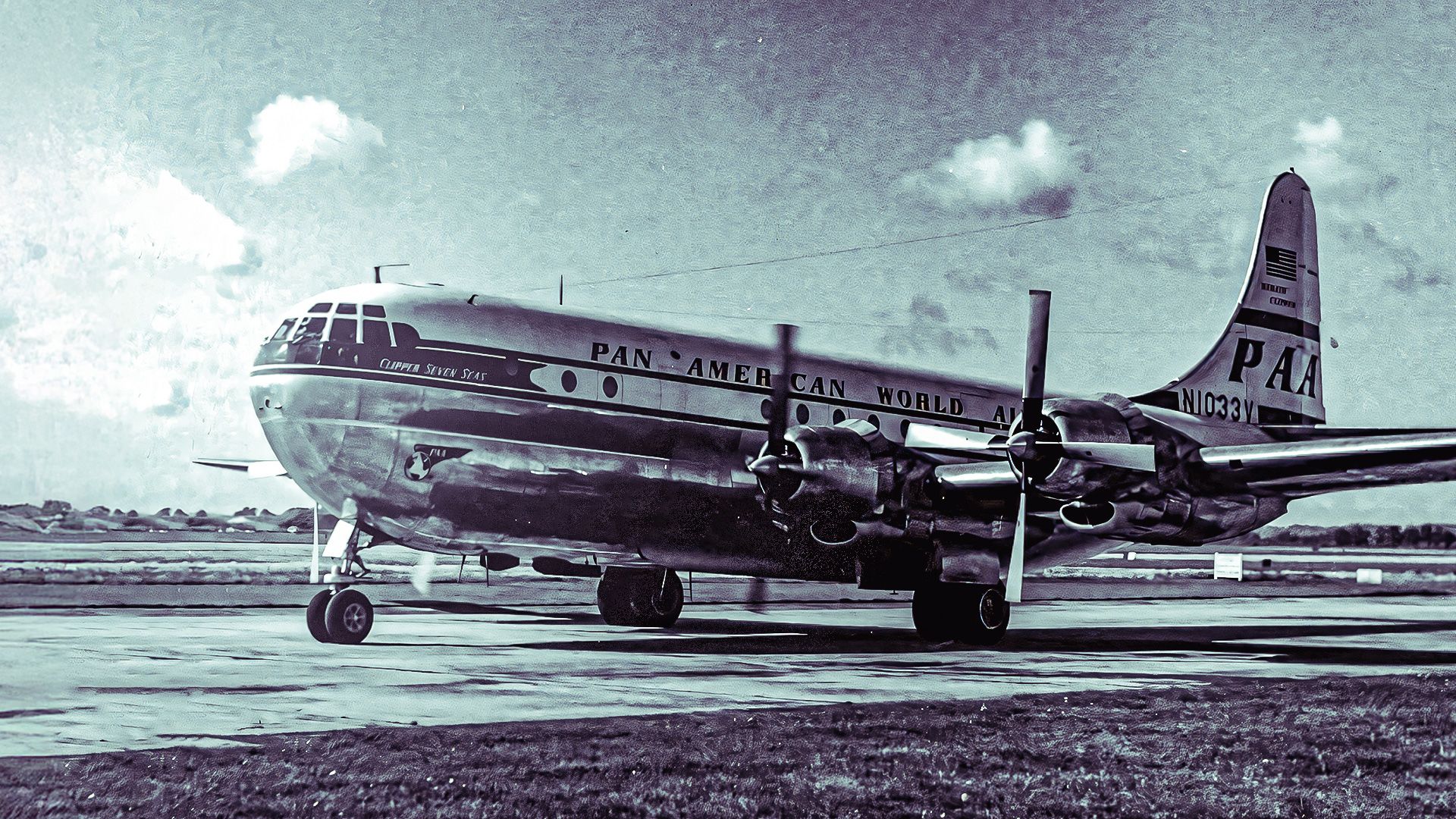
November 8, 2025, marked 68 years since the disappearance of Pan Am flight 7. The service, operated by a Boeing 377 Stratocruiser, was flying from San Francisco to Honolulu as part of a round-the-world flight from San Francisco to Philadelphia via 15 intermediate stops. On the morning of November 8, 1957, the aircraft departed San Francisco to embark on the first leg of PA7, from San Francisco to Honolulu. The flight was scheduled to land in Honolulu 10 hours and 15 minutes after departure, but the aircraft never made it to Hawaii.
The flight made a routine position report at 17:04 and was due to report again at 18:00, but failed to do so. After failing to hear back from the flight for over three hours, a search was launched to find the missing plane. The aircraft was found on November 14, and the Civil Aeronautics Board (CAB), precursor to the FAA and NTSB, immediately began investigating. However, after over 14 months, the CAB’s final report stated that investigators were unable to determine a probable cause for the crash, which remains a mystery.
The Flight From San Francisco To Honolulu

PA7 was a westbound round-the-world flight operated by Pan American World Airways. At the time, it operated from San Francisco International Airport to Philadelphia International Airport, with stopovers in Honolulu, Wake Island, Tokyo, Hong Kong, Bangkok, Rangoon, Karachi, Beirut, Istanbul, Frankfurt, Brussels, London, Glasgow, Boston, and New York. This itinerary made for a total of 15 stopovers and five days in the air.
On November 8, the segment from San Francisco International Airport to Honolulu International Airport was being operated by N90944, a Boeing 377 Stratocruiser 10-29 named ‘Clipper Romance Of The Skies.’ It was being piloted by 40-year-old Captain Gordon H Brown, 37-year-old First Officer William P Wygant, 35-year-old Second Officer William H Fortenberry (who was acting as the flight’s navigator), and 26-year-old Flight Engineer Albert F Pinataro.
|
Name |
Position |
|---|---|
|
Gordon H Brown |
Captain |
|
William P Wygant |
First Officer |
|
William H Fortenberry |
Navigator |
|
Albert F Pinataro |
Flight Engineer |
All in all, there were four members of cockpit crew, four flight attendants, and 36 passengers onboard, for a total of 44 occupants. The flight departed at 11:30 and climbed to a cruising altitude of 10,000 feet. The flight made a routine position report at 17:04 and was due to report again at 18:00, but failed to do so. Pan Am first notified the US Coast Guard that it had not heard back from the aircraft for over 90 minutes at 18:42, and after another 90 minutes had passed, the Coast Guard dispatched search aircraft to find the missing flight.
Searching For The Missing Flight

Four Coast Guard ships, two submarines, and several aircraft searched for the missing Boeing 377 on day one. By the next day, there were over 30 aircraft searching for the plane, along with 17 surface vessels from the Coast Guard and the United States Navy. Pan Am dispatched another Boeing 377 Stratocruiser to aid with the search, loaded with supplies that could be dropped to any survivors. Additionally, the carrier also dispatched a Douglas DC-7 with full fuel tanks to remain airborne for up to 16 hours.
The search became the largest in the Pacific Ocean at the time, and while Pan Am initially expressed confidence that the aircraft could have floated indefinitely if the plane’s airframe was not punctured, the prospect of finding survivors became more grim. Crews reported hearing radio broadcasts that were initially thought to be distress signals, but these proved to be false alarms. Finally, on November 14, a US Navy aircraft observed aircraft wreckage and bodies in the water. In total, 19 victims were found.
The wreckage was found 900 NM (1,700 km) northeast of Honolulu, and roughly 90 NM (170 km) north of the plane’s intended flight path. No major parts of the airframe were found, and the ocean’s depth of roughly 16,500 feet (5,000 meters) meant that crews could not search for the wreckage on the ocean floor, as it was too deep. 14 victims were wearing life jackets, and all 19 victims were not wearing shoes, while three of the victims were wearing watches that were stopped at 17:27, 23 minutes after the aircraft’s final position report.
The Subsequent Investigation By The CAB

All 44 occupants on board were killed, and most of the aircraft’s wreckage was never found. Additionally, the Boeing 377 did not include any flight recorders, meaning that CAB investigators had to rely primarily on analyzing the aircraft’s wreckage and its record logs to determine the cause of the crash. This was especially challenging as much of the aircraft’s structure was lost to the depths of the ocean, leaving investigators with limited information.
However, there were clues. The fact that the recovered victims were not wearing their shoes and that a majority of them were wearing life jackets indicated that passengers were aware that the aircraft was headed towards the ocean. The stopped times on the watches indicated the time of impact, and none of the victims showed evidence of burns, while burn marks were found on the top of recovered debris, which also showed a clear water line. This suggested that the debris caught fire after impact.
|
Timeline |
Event |
|---|---|
|
November 8 17:04 |
Last Position Report By PA7 |
|
November 8 18:42 |
Pan Am alerts the US Coast Guard |
|
November 8 20:12 |
Search begins |
|
November 14 |
Aircraft wreckage found |
Investigators ruled out the presence of any prohibited items onboard or a deliberate explosion. 14 of the 19 recovered bodies showed high levels of carbon monoxide, which remains unexplained. Based on the damage, investigators also concluded that a water landing was attempted and had nearly succeeded until the right wing dragged into the water, tearing the aircraft apart. What’s still unknown is why the aircraft was attempting a water landing, as well as why it had flown off course.
A Possible Mechanical Failure Onboard

Mechanical failures on aircraft were much more common 70 years ago than they are today, and the Boeing 377 Stratocruiser was one of the most troublesome airliners of its day. The primary issues that befell the double-decker often concerned the propellers. Several 377s experienced runaway propellers, in which a failure with the engine and propeller would leave the pilots unable to control the pitch of the propeller. This would cause an aerodynamic imbalance and could also lead to a structural failure of the propeller blades.
While the presence of carbon monoxide was ultimately unexplained, one possible explanation is that this could have originated from an engine failure. In addition, an analysis published by Smithsonian Magazine in 2017 examined radio recordings that could have been made by the pilots of PA7, and found that they may have broadcast a conversation on an open mic that appears to suggest a mechanical failure. However, it’s difficult to determine with certainty if these recordings originated from PA7.
|
Possible Transmissions From PA7 |
|---|
|
SO 292 Special Number and Flyer. [Also understood as “…number on fire.”] |
|
Attention All Stations Pan American Air. |
|
Verification Channel Bearing 11. |
|
Still have one tank full. Am ditching flight. |
|
CQ, CQ, Syracuse, New York. |
|
J arm is missing, tail. |
|
[Voice different from position report.] Did you chart me? [Inaudible]… Special position. |
|
[Same voice as position report.] Fuel control—3, 4, 5, 6, |
|
Zero 2 fuel flow! Zero 2 fuel flow! Coordinate. [Two voices speaking excitedly.]What about 3 engine? |
What could have happened then is that the aircraft experienced an engine failure. The pilots avoided dumping fuel due to the potential of a fire and aimed to ditch the jet in the ocean (which had been done more successfully the year prior by Pan Am flight 6, operated by another Boeing 377). However, when the aircraft landed on the water, the right wing was dragged into the ocean, and the aircraft tore itself apart.
Did Human Sabotage Doom PA7?

Aircraft bombings, sabotage, and hijackings were far more common in the 1950s than in modern times, and Pan Am pointed its finger at the flight’s purser, Eugene Crosthwaite, as he was disgruntled with the airline. Reportedly, Crosthwaite was a recent widower and had poor relations with his stepdaughter. Crosthwaite had made alterations to his will just days before the flight and kept a copy of his will in the glovebox of his car that he parked at the airport. However, the FBI declined to investigate him.
The individual who faced greater scrutiny was 41-year-old William Harrison Payne, a passenger on PA7. Payne was a former explosives expert for the US Navy and was in debt. He booked a one-way ticket from San Francisco to Honolulu and purchased three life insurance policies before the flight, one of which paid double in the event of an accidental death. While he told family members that he was traveling to Hawaii to settle his debts, his family members never knew the names of the alleged debtors.
|
Individual |
Possible Motivation |
|---|---|
|
Eugene Crosthwaite |
Dissatisfaction with the airline, poor familial relations |
|
William Harrison Payne |
Life insurance policy payout |
Whether the crash was an act of unleashed anger by a disgruntled flight attendant or if it was an attempt to collect life insurance money, the events would have largely played out the same. It’s theorized that an individual could have released carbon monoxide into the cabin, incapacitating most of the occupants. Ultimately, the CAB was unable to prove that a passenger or crew member intentionally caused the crash.
The Bottom Line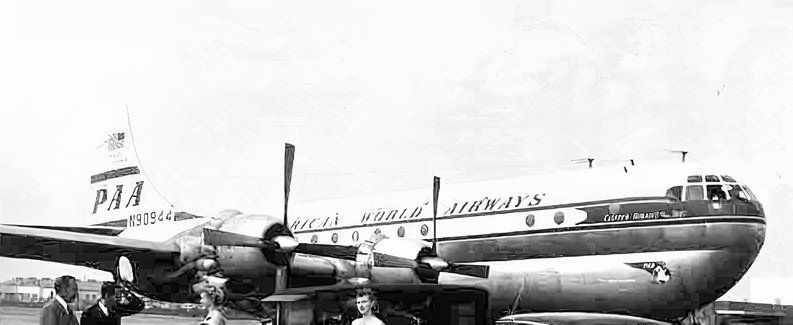
Pan Am flight 7 is one of the most mysterious aviation disappearances of all time. Like many other mysterious plane crashes, there are theories, as well as a most likely explanation. In the case of PA7, while there are suspicious circumstances surrounding the two aforementioned individuals, this does not prove that one of them intentionally caused the aircraft to crash.
In addition, the evidence from the wreckage suggested a nearly successful ditching attempt, which would mean that the pilots were flying the aircraft until the last minute. Given the 377’s history with propeller and engine problems, this likely caused the aircraft’s descent into the water. Additionally, the flight’s divergence from its course could be explained by a simple navigational error or by examining the condition of the water in preparation for a controlled ditching.
As it’s been nearly 70 years since the accident, and most of the wreckage was lost to the ocean, we’ll likely never know for certain what led to the crash of PA7. Investigators had access to far fewer resources than today, and the Smithsonian publication also alleges that the CAB overlooked potential issues with Pan Am’s maintenance procedures. As a whole, though, we’ll likely never know the real truth behind Pan Am PA7.
