


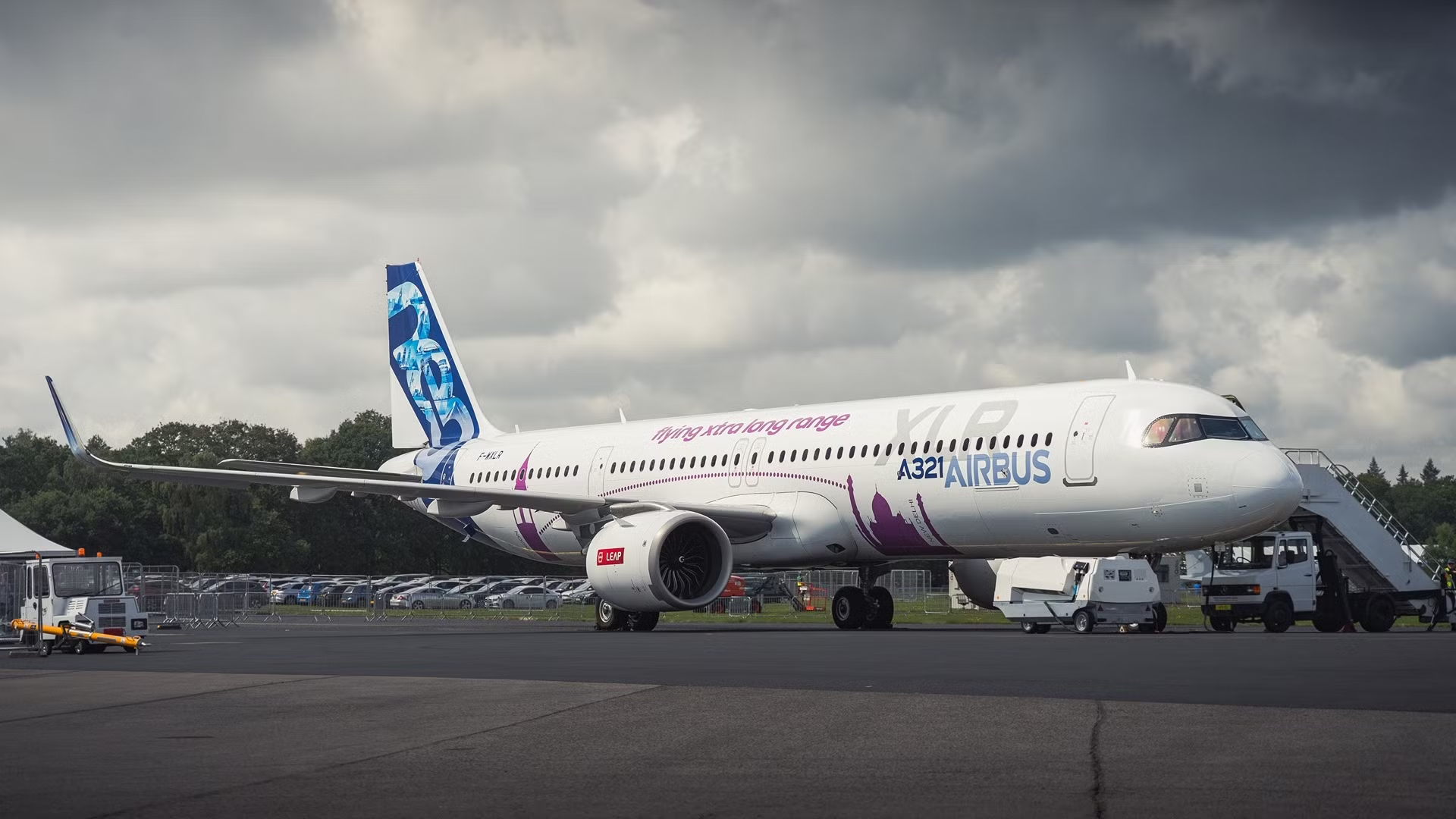
German airline  Lufthansa Group has made it clear it has no plans to acquire the Airbus A321XLR as part of its wider fleet strategy, as per an exclusive report by ch-aviation. Most airlines continuously re-evaluate aircraft types in the market to ensure they can meet market demand. Lufthansa Group is the parent company of carriers Lufthansa, Austrian Airlines, Swiss, Brussels Airlines, Discover, ITA Airways, among other subsidiaries.
The airline’s internal analysis was led by the airline’s board member Dieter Vranckx, and consideration was given to the A321XLR due to its range capabilities and economic advantages. Some other major European carriers, such as Iberia, Aer Lingus, and Wizz Air, operate the type, medium and long-haul operations from their respective hubs, while American Airlines and United Airlines look to introduce this aircraft from the other side of the pond.
Understanding The A321XLR

The A321XLR is set to become a game changer for modern aviation, as one of the first narrowbody aircraft with long-range capabilities. It is expected to become popular with airlines looking to move away from the hub and spoke model and focus on niche routes between new markets. The airline, which boasts a ‘superior passenger experience’, will be able to fly up to 4,700 nautical miles with a maximum seating capacity of up to 244 passengers.
These long-range capabilities make the aircraft a smart choice for those wanting to dip their toe in the long-haul game between niche and unique markets that cannot sustain full widebody long-haul operations. Such carriers that have found success with the airplane already such as  Aer Lingus, which deploys the aircraft on a number of Ireland – United States routes, including Nashville, Indianapolis, and Raleigh-Durham.
Should Lufthansa ever reconsider the A321XLR, this could see the airline reconsider US markets that it has withdrawn from or never served. Lufthansa operates a robust network of flights from its two main German hubs,  Munich Airport and
  Frankfurt Airport, while the wider LH Group operates from Rome, Brussels, Zurich, Geneva, and Vienna.
Soaring Into New Destinations With Less Risk

The ability for airlines to operate routes with lower risk than when compared to widebody flights, the A321LR can fly up to 30% farther than the A321neo (3,500 nautical miles vs 4,700 nautical miles). This aircraft can also support popular trunk-link routes, at off-peak times, allowing airlines to operate a broader schedule, without the risk of flying empty planes.
With the ability to serve routes up to 11 hours, this could include Paris to Calgary, Windhoek, Bangalore or Orlando, Kuala Lumpur to Sapporo, Kuwait, or Brisbane, and Dallas to Santiago, Oslo or Lisbon. Passengers onboard can enjoy the widest single aisle cabins in the air, with customizable lighting, the latest generation inflight entertainment, and slimmer sidewall panels. Specifications of the game-changing aircraft below, as per the manufacturer’s website:
|
Maximum Seat Capacity |
244 seats |
|---|---|
|
Maximum Seating Capacity With Typical Two-Class Configuration |
206-220 seats |
|
Overall Length |
146 ft (44.51 meters) |
|
Overall Wingspan |
117 ft 5 inches (35.80 meters) |
|
Overall Height |
38.7 ft (11.76 meters) |
|
Maximum Take-Off Weight |
222.667lb x 1000 (101 tonnes) |
While the likes of Aer Lingus, Iberia, and Wizz Air are already operating the aircraft type, some of the most substantial orders for the type include Indian carrier IndiGo (69), United Airlines (50), American Airlines (50), Air Canada (30), and Qantas (25).
The Lufthansa Fleet Today

Lufthansa operates a fleet of Airbus narrowbody aircraft, alongside Airbus and Boeing widebody aircraft. According to ch-avation, the airline has around 285 active aircraft. The A320 family dominates the narrowbody trans-European network, with a mix of A319-100, A320-200, A320neo, A3221-100, A321-200, and A321neo airplanes. LH was the launch customer for the A321-100, of which it has 17 in operation.
Looking at the airlines’ widebody operations, the A330-300, A340-300, A340-600, A350-900, and A380-800 take to the skies. The airline plans to retire the majority of its A330 and A340 by the end of the decade, with many of these planes destined to exit the Lufthansa fleet and be transferred over to its subsidiaries, such as Brussels and Discover Airlines. LH expects to welcome the A350-1000 from 2026.
Boeing also features heavily in the carrier’s wider long-haul reach, with the carrier being the largest operator of the Boeing 747-8I, including D-ABYP, which was the 1,500th 747 ever built. Other Boeing aircraft include the 747-400 and 787-9. 20 additional 777-9 are set to join the carrier’s fleet once deliveries commence, and will replace the airline’s aging 747-400s.
