



Multi-Static Active Coherent sonobuoys allow the MQ-9B to better detect submarines over large areas with fewer buoys than DIFAR and DICASS.
General Atomics Aeronautical Systems, Inc. (GA-ASI) announced on Jan. 13, 2026, a demonstration of the new expanded Anti-Submarine Warfare (ASW) capability of its MQ-9B SeaGuardian Unmanned Aerial System (UAS). The test was conducted on Dec. 17, 2025, but the company did not specify the location.
Sponsored by the U.S. Navy, the flight tests were supported by the Naval Air Warfare Center Aircraft Division’s (NAWCAD) AIRWorks department. Specifically, the tests were aimed at certifying the Sonobuoy Dispensing System (SDS).
GA-ASI further said the pods were “more than previously tested, doubling the number of sonobuoys available.” While the number of sonobuoys released was not disclosed, available photos show the MQ-9B equipped with two SDS pods, although it is unclear if the image included in the press release was captured on occasion of the Dec. 17 test.
Each pod is capable of safely carrying and deploying 10 U.S. Navy-compliant ‘A’ size or 20 ‘G’ size sonobuoys, with a maximum of four pods that can be carried by the UAS. The “more than previously tested” mention could thus refer to the test featuring four pods on the SeaGuardian, which would give it the capability to carry 40 ‘A’ size or 80 ‘G’ size sonobuoys.
The company mentioned the use of three types of air-launched sonobuoys in the latest test – the AN/SSQ-36 Bathythermal, the passive AN/SSQ-53G Directional Frequency Analysis and Recording (DIFAR) and the active AN/SSQ-62F Directional Command Activated Sonobuoy System (DICASS) buoys. Notably, the press release added that this trial also “was the first time Multi-static Active Coherent (MAC) buoys have been dispensed from an uncrewed aircraft.”
Multi-static active coherent buoys were dispensed from a #UAS for the first time during flight test to enhance the anti-submarine warfare capability of the MQ-9B SeaGuardian®.
Read the news: https://t.co/BLwTAkec21#MQ9B #RPAS pic.twitter.com/RGruMyNj1A
— General Atomics Aeronautical Systems, Inc (GA-ASI) (@GenAtomics_ASI) January 13, 2026
This could refer to the AN/SSQ-125 buoys, for which the Naval Air Systems Command (NAVAIR) placed an 20,000 units, $101.7 million order with Sparton, an Elbit Systems of America company, in December 2024, according to Military Aerospace Electronics. Beside the SSQ-36, SSQ-53 DIFAR and the SSQ-62 DICASS, the SSQ-125 buoys also work with the AN/SSQ-101 Air Deployed Active Receiver (ADAR), in a network operating on diverse underwater detection parameters.
Following the data review from the test, GA-ASI said it now expects a “deployment flight clearance for ASW operations” from the U.S. Navy this month. Notably, the company said that “flight testing supports the Commander, U.S. Pacific Fleet’s Operational Evaluation deployment to SEVENTH Fleet,” indicating where the MQ-9B might head next after the clearance.
Previous and current SDS tests
The company has already tested the SDS in the past, with the last time being a ten-day campaign in January 2025. On that occasion, an MQ-9B deployed multiple SSQ-36, SSQ-53 DIFAR and SSQ-62 DICASS buoys “to conduct onboard thermal-depth and acoustic data processing.”
The SeaGuardian “effectively detected, tracked, and analyzed underwater targets while collecting critical acoustic intelligence.” This trial also allowed to collect data of the interaction of the buoys with the SDS, as the company recorded “ejection speed with stress/strain data.”
In the latest trial, mentioning the first such use of MAC buoys from an unmanned aerial vehicle, GA-ASI said that the “MAC buoys are better at detecting submarines over large areas and require fewer buoys compared to using DIFAR and DICASS.”
“Expanding sonobuoy capacity, including Multi-static Active Coherent (MAC) technology for SeaGuardian, has been an integral part of our advanced ASW strategy to broaden and enhance search areas,” said GA-ASI President David R. Alexander. “The wider maritime coverage our MQ-9B’s ASW capability provides is extremely valuable to our customers.”
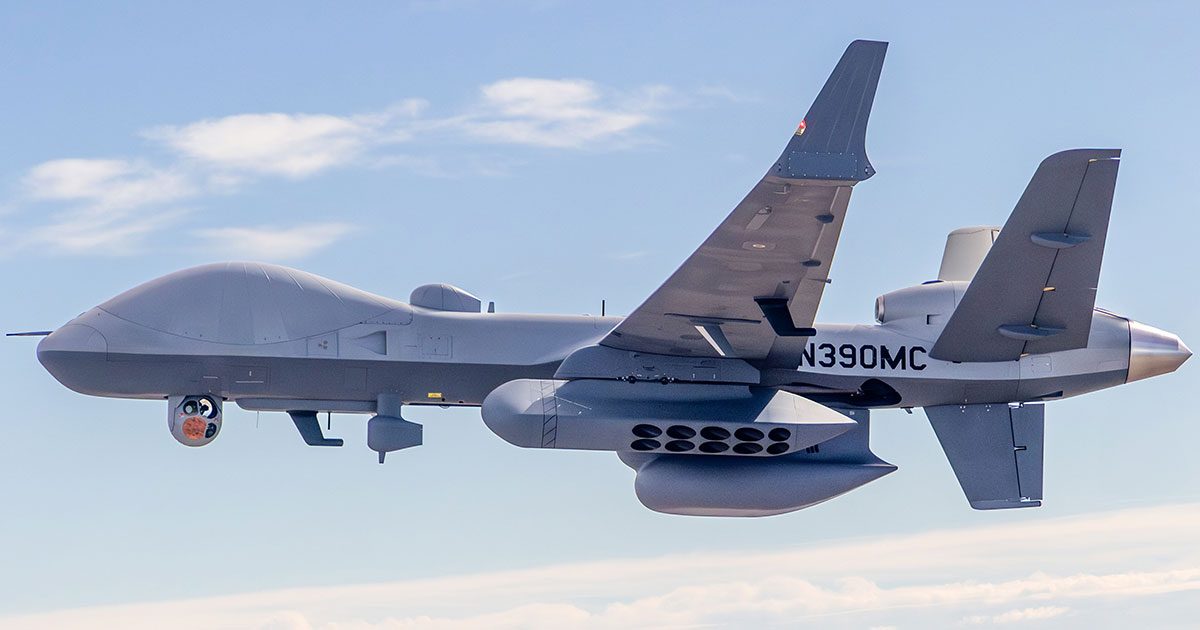
Sonobuoys Dispensing System
The Sonobuoy Dispensing System has been prominently shown in renditions and press releases. The system, a large hexagon-shaped pod with diagonally downward-facing ejection ports, was tested for the first time in November 2020 on an MQ-9A Block 5.
The SDS pod was mentioned again by GA-ASI in a release and a photograph of a February 2024 test at the Navy’s W-291 test range in southern California. On that occasion, a SeaGuardian released eight AN/SSQ-53 and two AN/SSQ-62 sonobuoys from the SDS’s pneumatic ejection system. The ejection system is developed by Italy’s AREA, which also supplies the internal structure assembly of the pod.
As mentioned earlier, the SeaGuardian can carry four pods, each one deploying ten A-size sonobuoys or 20 G-size sonobuoys, for a total potential capacity of 40 and 80 sonobuoys, respectively. The P-8A Poseidon and MH-60R Seahawk, the U.S. Navy’s main anti-submarine warfare (ASW) platforms, can deploy around 129 A-size sonobuoys or over 250 G-size sonobuoys and 25 A-size or 50 G-size sonobuoys, respectively.
#SeaGuardian‘s maritime capabilities don’t stop at the surface. It has demonstrated the ability to release sonobuoys and track submarines while integrated with naval units. #UAS #ASW
Find out more: https://t.co/ghb2ABJ6et pic.twitter.com/TAjZJM54tr
— General Atomics Aeronautical Systems, Inc (GA-ASI) (@GenAtomics_ASI) December 21, 2022
Sonobuoy capabilities
According to MAE, for underwater sensing through multi-static fields, the AN/SSQ-125 also works with the AN/SSQ-53F, AN/SSQ-77C and, as mentioned earlier, the AN/SSQ-101 ADAR sonobuoys. “The AN/SSQ-125 sonobuoy is a source in a multi-static field, and can generate a variety of waveforms,” MAE said.
Interestingly, the Naval Air Test and Evaluation Squadron (VX-1) tested in July 2025 the Multi-Static Active Coherent Enhancements (MAC-E) system on two P-8A Poseidon aircraft, as a part of its Increment 3 Block 2 (I3B2) upgrades. The MAC-E on the P-8A and the AN/SSQ-125 sonobuoys would thus be able to complement each other in the multi-static realm of underwater sensing for ASW.
Finishing checks. ✅
Naval aircrewmen assigned to Helicopter Maritime Strike Squadron (HSM) 79 inspect sonobuoys aboard #USSPaulIgnatius (DDG 117).
📸 Mass Communication Specialist 2nd Class Aaron Lau pic.twitter.com/ilmxJC8LP6
— U.S. Navy (@USNavy) August 28, 2022
The AN/SSQ-125’s RF channel can be programmed to any of the standard sonobuoy operating channels, and it can be also commanded to change its operating parameters or increase the depth, generate a ping, or scuttle. The AN/SSQ-36B maps the temperature of various ocean layers and detects submarines through localized effects on seawater temperature and sonar propagation. The AN/SSQ-53F uses four hydrophones that operate at depths of 90, 200, 400, and 1,000 feet to listen for potentially hostile submerged enemy submarines.
The AN/SSQ-62E DICASS sonobuoy provides range and bearing to the target submarine and uses four acoustic frequencies as selected via the Electronic Function Select. The AN/SSQ-101 ADAR sonobuoy conducts a commandable passive search, and functions as the receiver in a multi-static active receiver system, using pentagon-shaped hydrophones.
Maybe the craft we see aren’t traveling light years individually but are carried inside larger craft as disposable sensor systems. The US Navy drops thousands of disposable sonobuoys into the ocean every year, where they operate for some set amount of time and then “crash” to the… pic.twitter.com/7Ir6xUybJ7
— VoxDemosthenes (@VoxDemosthenes) November 26, 2025
Aircraft can drop a pattern of sonobuoys, which relay the information on the exact locations of enemy submarines by radio link. The buoy digitally conditions and amplifies the acoustics and provides directional data that helps establish azimuthal bearing to the submarines being tracked.
