


The loss of an F-15E Strike Eagle in Iran prompted specialized Combat Search and Rescue units to spring into action, with a multitude of assets working together to recover all missing aircrew. Here’s how.
On Apr. 3, 2026, multiple specialized units sprang into action for a complex mission they train extensively for but hope never to execute: Combat Search and Rescue (CSAR). As we reported, an F-15E Strike Eagle was lost over Iran and an A-10C Thunderbolt II crashed in Kuwait after being hit by enemy fire while supporting the CSAR operation.
The Ongoing Effort
Early in the morning, videos started emerging on social media, showing U.S. rescue assets in flight at low altitude over southern Iran. Among them, two were quickly recognizable: the HC-130J Combat King II aircraft and the HH-60W Jolly Green II helicopter.
U.S. Special Operations Command MC-130J Commando II aircraft, escorting two HH-60 helicopters, have been confirmed on video flying south of the city of Lali in Iran’s Khuzestan Province.
POV is likely at 32°15’48.92″N, 49°04’40.02″E. https://t.co/snO9HpiVEs pic.twitter.com/Gi3fNugufP
— Egypt’s Intel Observer (@EGYOSINT) April 3, 2026
These are both designed specifically to conduct personnel recovery operations, including CSAR. The first videos from Iran showed them flying both on their own and together, the latter during aerial refueling.
This is not without risks, as the aircraft have to fly over hostile territory in plain daylight, completely exposed. This is further demonstrated by the videos of Iranian police targeting the HH-60s with small arms fire as they fly over them.
Footage of Iranian police firing small arms at a pair of USAF HH-60Ws searching for the downed F-15E crew earlier today. pic.twitter.com/9SwhyhY1Aw
— OSINTtechnical (@Osinttechnical) April 3, 2026
According to U.S. media outlets, the HH-60s were damaged by small arms fire, wounding crew members, yet they were able to safely return to base. In one video, an HC-130J is also seen dispensing flares, although it is unclear if it was a precaution or a reaction to a threat.
The helicopter that rescued the downed USAF F-15E pilot was hit by Iranian small arms fire, wounding crew members on board -CBS pic.twitter.com/nUczvgiabG
— OSINTtechnical (@Osinttechnical) April 3, 2026
I’m working on the assumption that the image on the left is real, the right however is fake. pic.twitter.com/7Sc0IWH2Dp
— Aurora Intel (@AuroraIntel) April 3, 2026
Small arms fire is not the only threat, as Man-Portable Air Defense Systems (MANPADS) are also active in the area. One of these systems is believed to have struck the A-10C which later crashed in Kuwait while returning to base.
The A-10 that crashed in Kuwait was providing close air support for the search and rescue mission for the crew of the F-15 when it was hit by Iranian fire, a US official tells ABC.
The aircraft was able to make its way to Kuwait where it crashed after the pilot ejected— Selina Wang (@selinawangtv) April 3, 2026
In fact, the CSAR effort see more than just the HC-130s and HH-60s in action. Among the other assets involved, which were also seen in action in Iran, are the A-10s, F-35s and MQ-9 drones, as well as many more assets which are not immediately visible.
An A-10C attack aircraft has been spotted in the skies over Iran and is reportedly taking part in a SAR operation for the pilot of the downed F-15E. pic.twitter.com/u5NJ34sR3k
— 𝔗𝔥𝔢 𝕯𝔢𝔞𝔡 𝕯𝔦𝔰𝔱𝔯𝔦𝔠𝔱△ 🇬🇪🇺🇦🇺🇲🇬🇷 (@TheDeadDistrict) April 3, 2026
In the end, these efforts have already resulted in two pilots being successfully rescued, while the search continues for the F-15E’s Weapon Systems Officer (WSO). According to reports, the WSO made contact with U.S. forces using an encrypted radio, while continuing to evade the pursuing Iranian forces.
#BREAKING Two US officials have now confirmed to Newsmax that one of the pilots has been rescued and is undergoing medical treatment. The status of the second pilot is unknown.
Search and rescue ops continue. We’ve seen video of HC-130 aircraft and helos in the skies. One source… https://t.co/kdP3EVUqnO— Carla Babb (@CarlaBNewsmax) April 3, 2026
https://t.co/EZWpwQmmXk pic.twitter.com/LFpBCVqVLM
— OSINTtechnical (@Osinttechnical) April 3, 2026
Combat Search and Rescue
Combat Search and Rescue (CSAR) is one of the most complex and delicate mission sets in modern air operations. Complex because this involves multiple units with multiple type of assets working together with small notice, and delicate because it means sending more people in harm’s way in a high-threat scenario where to rescue any isolated personnel (ISOP).
It’s difficult to explain Combat Search And Rescue (CSAR), but I use my account to explain aviation & military in simple terms, so I’m going to try.
To begin, CSAR is not just one unit. There are multiple specialized units among the different branches as well as units that serve… https://t.co/JlM4mWKv7y
— KC-10 Driver ✈️ 👨✈️ B-737 Wrangler (@MCCCANM) April 3, 2026
Personnel on these missions work under high pressure, knowing that every additional minute they take to arrive on target means an additional minute for enemy forces capturing the ISOP, who is meanwhile relying on the Survival, Evasion, Resistance & Escape (SERE) training to survive. This work requires extreme coordination, with each asset having a specific role.
Usually survivor moves in accordance with an EPA (Evasion Plan of Action) and must be authenticated on the basis of the ISOPREP (Isolated Personnel Report). The pilot awaiting recovery must act in accordance with an evasion plan (EPA) which, depending on the expected time behind enemy lines, the personal equipment available, and the capabilities of the CSAR units operating in theater, must include a pre-planned escape route.
CSAR teams do not rely solely on visual search in the area of the last known coordinates: downed pilots carry survival radios and locator systems that can transmit emergency signals, GPS data and secure messages to rescuers, although location alone is never enough and must still be matched with proper authentication before vulnerable assets commit to the pickup. Moreover, transmissions can be detected by enemy forces, and using them can quickly drain batteries. For this reason, radios and locator devices, whose range is obviously limited, are employed with extreme care.
In CSAR, finding the downed pilots is only part of the problem. The other is making sure the person calling for help using a radio really is the survivor and not the bait for an ambush. That is why rescue forces rely on layered authentication, which uses codewords and pre-shared personal details filed before the mission, that need to be validated in a quick challenge-response communication before the helicopters descend into hostile territory.
For this purpose, the ISOPREP is used, a document normally held by the intelligence section of the unit to which the pilot belongs and provided to rescue authorities in the event of a shootdown. In addition to the pilot’s photographs and fingerprints, it contains certain personal details used by rescuers to identify the survivor beyond doubt before bringing him aboard the helicopter. In a very loose sense, the logic is the same of the Zero Trust paradigm: never assume identity based on a single claim or signal, but verify it through multiple elements before granting access or, in this case, committing highly vulnerable rescue assets.

Public USAF doctrine openly acknowledges how exposed rescue assets are at the moment of pickup. The famous recovery of “Basher 52”, Capt. Scott O’Grady (who was shot down over Bosnia in June 1995), offers a textbook example: even after contact was established, O’Grady was reportedly asked a personal question only he was able to answer, in order to confirm the rescue force was talking to him.
To that respect, the ability to recover personnel from behind enemy lines has long been regarded as an important factor in sustaining the morale of tactical aircrews. Knowing that dedicated CSAR teams stand ready to risk their lives to recover isolated personnel in hostile territory can significantly boost the confidence of fast-jet crews flying under combat pressure. Therefore, it should not be too surprising to see the images of the HC-130J and HH-60s flying low level, in broad daylight, in hostile airspace to rescue the two F-15E aircrew members who ejected in Iran.
The HH-60W Jolly Green II is the platform of choice for this mission. The helicopter is specifically equipped to rescue downed pilots and bring them back to base.

The helicopters are armed with GAU-21 .50 cal machine guns and GAU-2 7.62 mm miniguns, and equipped with armor and self-defense systems. Their role is to get the rescue forces to the required location quickly.
Pararescuemen, also known as PJs, are highly trained experts that fly in the back of the HH-60. Their role is to get boots on the ground, locate, identify and medically assist the downed pilot.

This is perhaps the most delicate part of the mission, as the PJs must work quickly to minimize the time on the ground and thus the danger both to themselves, the helicopters and the downed pilot. “That Others May Live” (often “These Things We Do, That Others May Live”) is the official motto of the United States Air Force PJs.
While the HH-60s and PJs form the core of the CSAR mission, there is a host of assets which makes their job possible.
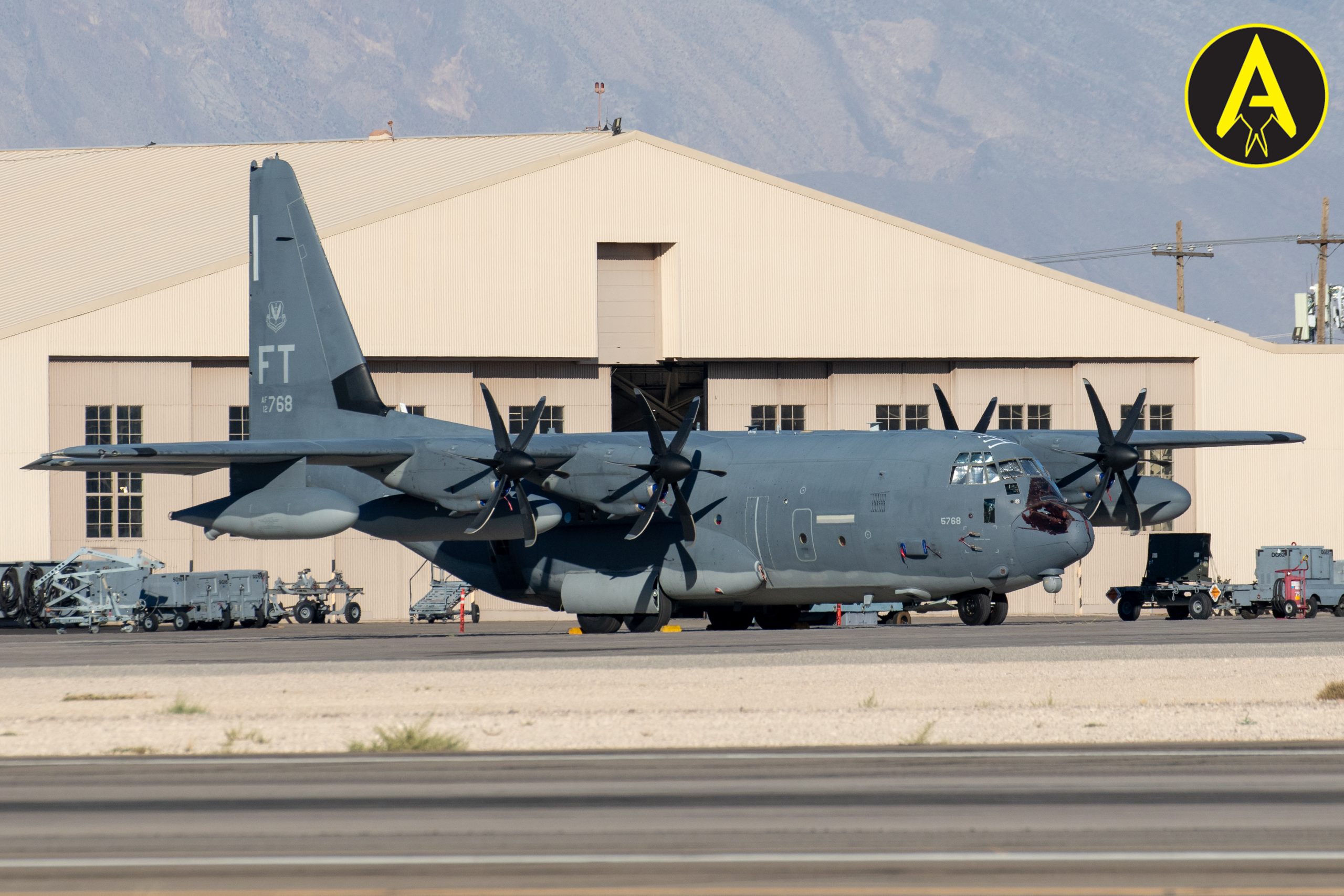
Here comes the HC-130J Combat King II, the Air Force’s only dedicated fixed-wing personnel recovery platform. Similarly to the HH-60s, they are specifically equipped to fly into contested environments to conduct a variety of missions.

One of their primary tasks is to provide the HH-60s with the range to reach their destination, thanks to the Helicopter Air-to-Air Refueling (HAAR) capability using two underwing pods, which allow the refueling of two helicopters at the same time. Additionally, the HC-130s coordinate the broader rescue effort.
Obviously, unarmed HC-130s and lightly armed HH-60s need protection. The A-10 Thunderbolt IIs are platform perfectly suited to fly the “Sandy” mission, as the CSAR support mission is commonly called: the platform is stable at slow speed and low altitude, it is armored, can take enemy hits and still get back to base, and it can engage ground targets and enemy soldiers.

Acting as the mission commander, the A-10s are tasked with the protection of the rescue assets, directing them to the target and suppressing any threat around it. Their role does not end here, as the Warthogs also escort the helicopter in and out of the target area.
Additionally, larger aircraft packages are involved to provide further assistance. An example could be F-16s and F-35s providing Suppression of Enemy Air Defenses (SEAD) support to pave the way for the rescue helicopters, as well as F-15s and F-22s to establish local air superiority so enemy air assets won’t be able to get close.
Obviously, a lot of support assets are also involved: tankers, airborne early warning, intelligence, surveillance and reconnaissance, electronic warfare and so on.
HH-60W Jolly Green II
The U.S. Air Force received the first two operational HH-60W Jolly Green II helicopters in 2020 at Moody Air Force Base, Georgia, beginning the transition from the HH-60G. The name Jolly Green II was chosen as a reference to the legendary tradition of the Vietnam-era HH-3E Jolly Green and HH-53 Super Jolly Green crews who pioneered the combat search and rescue mission.
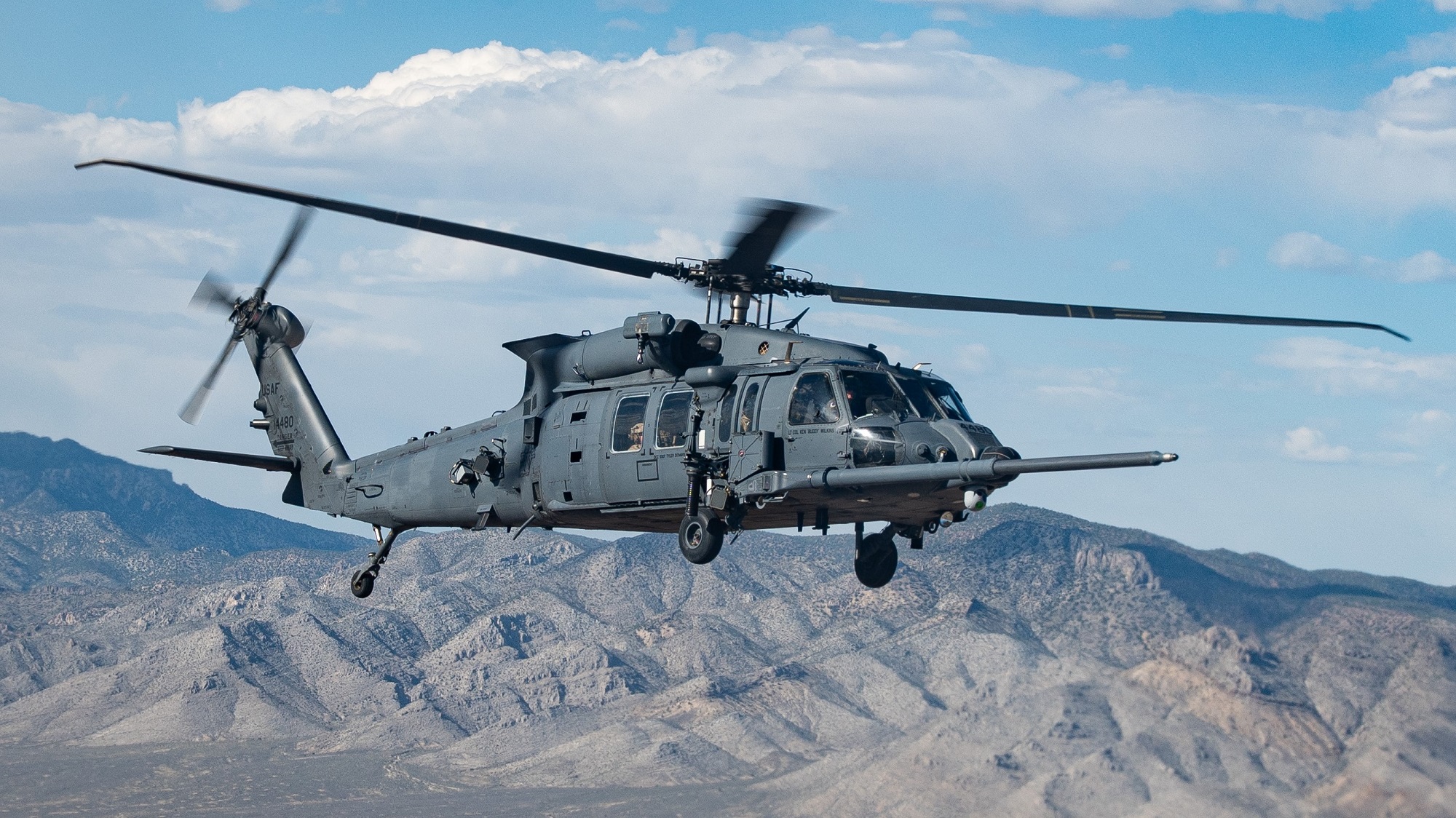
While the initial plan as part of the Combat Rescue Helicopter program was to acquire 113 “Whiskey” helicopters, the service later reduced the order to just 85. Based on the UH-60M, the HH-60W includes a number of improvements over the HH-60G, with a focus on range and survivability.
Modifications to the HH-60W include a digital radar warning receiver; laser, missile, hostile fire warning; integrated chaff and flares; cabin and cockpit armor; externally mounted 7.62 mm and .50 caliber weapons; LINK 16 military tactical data link network; Situational Awareness Data Link; integrated cockpit and cabin displays; advanced communications; Automatic Dependent Surveillance-Broadcast; tactical moving map displays; upturned IR-masking exhausts; and efficient wide-chord rotor blades.
Just two years after the first delivery and three after the first flight, the HH-60W reached the IOC (Initial Operational Capability) in 2022. A couple of days before the IOC declaration, Moody AFB already completed the first rescue mission in the Jolly Green II, and within a month launched the first-ever operational deployment of the HH-60W.
The HH-60W is now reaching all units across the Air Force. Aviano Air Base in Italy was the last active duty location to operate the older HH-60G Pave Hawk, and joined Moody AFB, Georgia, Davis Monthan AFB, Arizona, Nellis AFB, Kadena AB, Japan, Gabreski ANGB, New York, and Kirtlan AFB, New Mexico, which already operate the newer Jolly Green II.

HC-130J Combat King II
The HC-130J Combat King II is the only dedicated fixed-wing Personnel Recovery platform in the Air Force inventory, based off the KC-130J and modified with improved navigation, threat detection and countermeasures systems.
There are some of features that immediately differentiate the Combat King II from the regular KC-130J tanker. Among those features we can find defensive systems, like the Missile Warning Sensors (MWS), Radar Warning Receiver (RWR) and Large Aircraft InfraRed CounterMeasures (LAIRCM), which protect the aircraft during Combat Search And Rescue (CSAR) mission in hostile environments.
One of the main capabilities of the HC-130J, inherited from the KC-130J, is the Helicopter Air-to-Air Refueling (HAAR) thanks to the two pods under the wings that allow the refueling of two helicopters at the same time both during day and night. The pods, however, can also allow refueling on the ground through their Rapid Ground Refueling port, a capability especially useful when there is the need to set up a Forward Arming and Refueling Point (FARP) to support other aircraft during a long-range mission.
The Combat King II also has an array of different antennas for its radios which, during operational missions as part of a large package of aircraft such as CSAR, the Combat Systems Officer uses to receive a lot of info from different sources. The CSO acts as a filter for the overwhelming quantity of data and sends to every asset exactly what they need to build their Situational Awareness and complete the mission.
You can read more about the HC-130J Combat King II and the missions it can perform in this exclusive interview with a HC-130J instructor pilot of the 34th Weapons Squadron we published here at The Aviationist.