


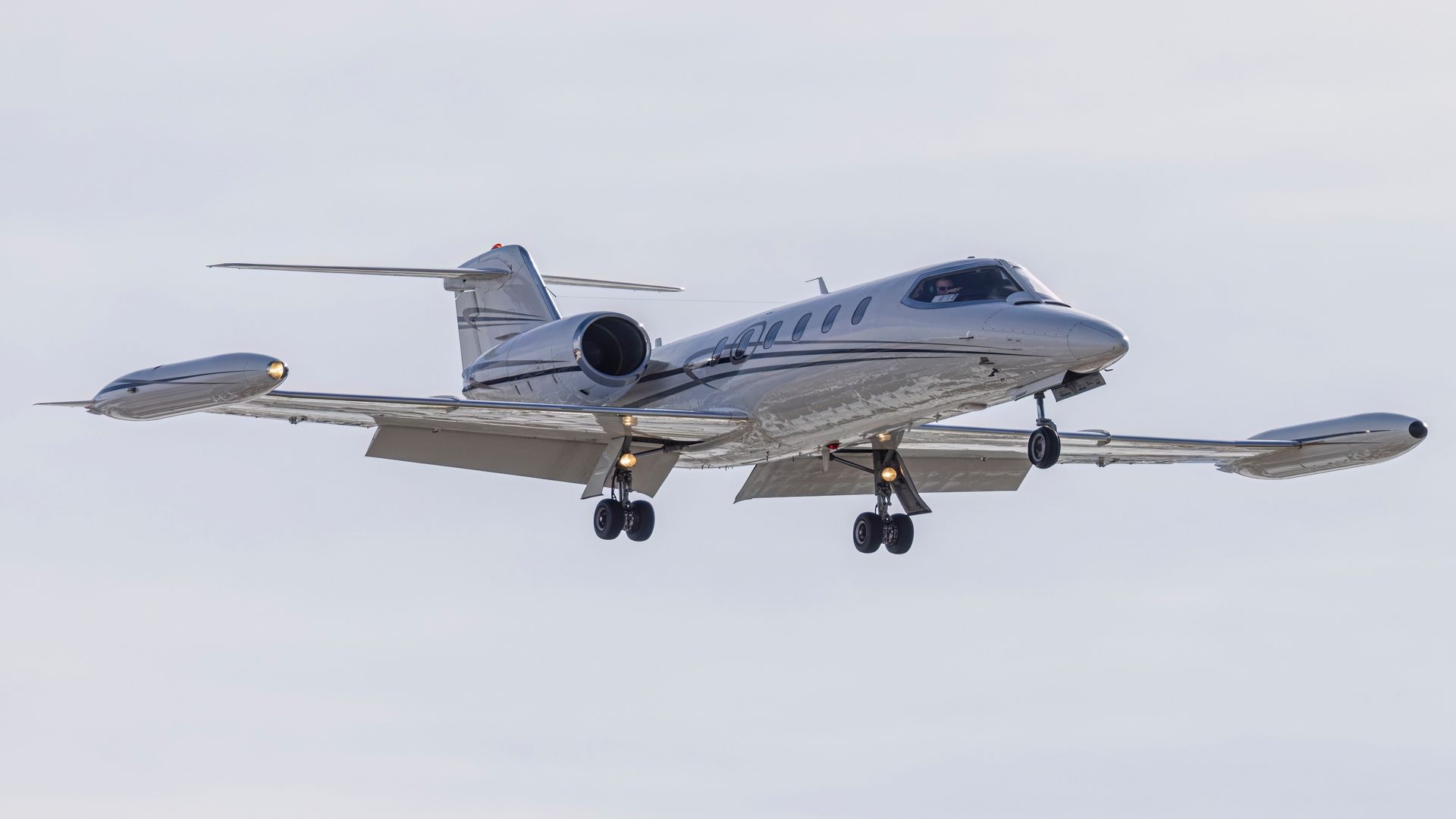
On October 29, 2025, the National Transportation Safety Board ( NTSB ) issued an urgent recommendation to the Federal Aviation Administration (FAA) to ensure the main landing gear is correctly installed on certain Bombardier Learjet aircraft. Recipients have 30 days to respond.
The recommendation follows an investigation into a fatal accident involving a Learjet 35A in Scottsdale, Arizona, on February 10. During the accident sequence, the left main landing gear separated from the aircraft. The NTSB discovered three previous incidents in which Learjet landing gear detached from the airframe.
Main Landing Gear Maintenance

The NTSB’s recommendation would require operators of 10 Learjet models to comply with manufacturer service bulletins on landing gear maintenance. This would affect 1,883 aircraft currently in service. The NTSB has also issued a second recommendation to the FAA, requiring Bombardier to revise its procedures to include a visual check of the aft landing gear trunnion pin position after maintenance.
The board warns that without a required verification step, a mechanic could inadvertently install the retaining bolt without it passing through the trunnion pin. The landing gear would be left insecurely attached to the aircraft. The misassembly cannot be easily detected during routine maintenance or pre-flight inspections.
The recommendations were prompted by the fatal runway excursion in Scottsdale in February. The Learjet 35A, registration N81VN, was operating a flight from Florida to Arizona, with a refueling stop in Austin, Texas. Upon touchdown, the jet entered a left-wing-low altitude and began veering left, exiting the runway and crashing into a parked Gulfstream G200. The left main landing gear came to rest on an adjacent taxiway.
Three Other Incidents Involving Learjets

The accident resulted in the death of the captain, while the first officer and one passenger were seriously injured. One passenger also sustained minor injuries, while an occupant of the Gulfstream was seriously injured. During the investigation, the NTSB discovered three prior events in which the landing gear on a Learjet disconnected from the airframe due to the retaining bolt not being engaged through the aft trunnion pin.
On October 4, 1995, the left main landing gear of a Learjet 25B collapsed while the aircraft was landing at Will Rogers World Airport in Oklahoma. Another incident occurred on February 4, 2001, when the left main landing gear of the same model aircraft disconnected from the airframe after touching down at Saint Lucie County International Airport in Florida. On March 28, 2008, a Learjet VU-35A suffered a runway excursion after the left main landing gear collapsed upon landing at Recife/Guararapes-Gilberto Freyre International Airport in Brazil.
After the Scottsdale incident in February 2025, Bombardier issued a service bulletin asking operators of the affected Learjets to carry out a one-time check to ensure landing gear were correctly installed. According to the manufacturer, only 12 percent of the subject aircraft have been inspected.
Main Landing Gear Issues

The NTSB issues urgent recommendations to address immediate, critical safety issues that threaten lives or property. The board does not have to wait until the end of an investigation to issue recommendations. During the investigation, the NTSB obtained video footage that captured the aircraft on final approach for 11 seconds.
The aircraft could be seen with the left landing gear trailing aft from its normal position. The video also shows a circular bright spot above the landing gear strut, consistent with the landing gear light illuminating the bottom of the wing flap and the landing gear strut positioned facing aft.
The Learjet 35A is equipped with a retractable, tricycle landing gear, electrically controlled and hydraulically actuated. The assembly is attached to the airframe with trunnion pins, with striker plates on the trunnions to actuate microswitches. The NTSB reports that the same flight crew for the accident aircraft had a landing mishap in June 2024 in McAlester, Oklahoma. The crew experienced a hard landing, causing both left main landing gear tires to burst. A mechanic worked on the landing gear following the maintenance manual for all of the work he performed.
