


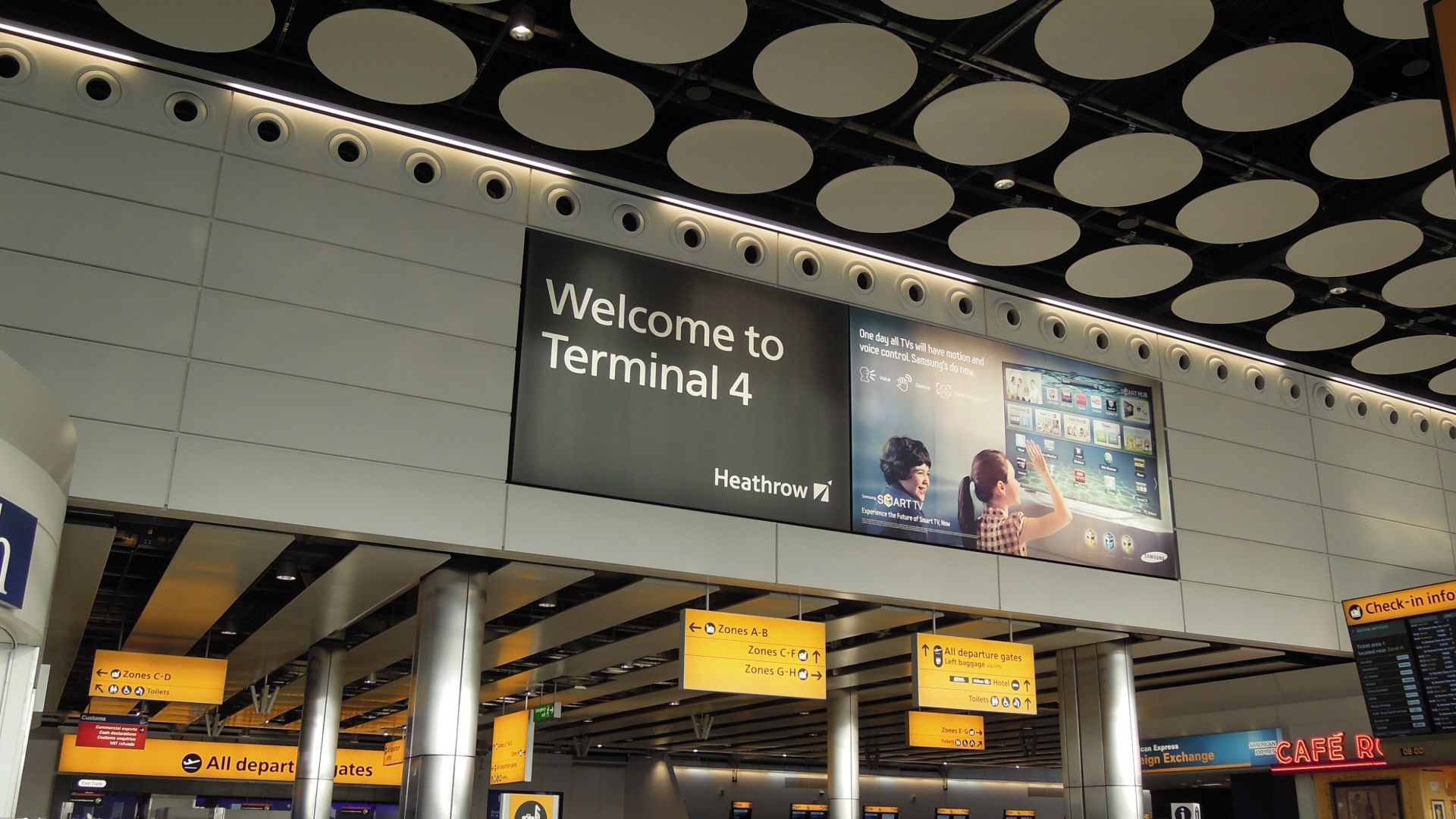
London Heathrow Airport’s Terminal 4 was evacuated on Monday evening, September 8, after emergency services responded to what officials described as a “possible hazardous materials incident.” Firefighters and paramedics were deployed to the site, and passengers were asked not to travel to the terminal.
The precautionary closure only applied to Terminal 4, while the rest of Heathrow continued operating normally. Flights were not affected, and the terminal has since reopened. The Metropolitan Police later confirmed that no hazardous substance was found.
London Heathrow Terminal 4 Reopened After Three-Hour Closure

The incident occurred around 17:00 local time, when the London Fire Brigade was called to Terminal 4, according to CNN. At the time, a brigade spokesperson said firefighters were responding to a “possible hazardous materials incident” at Heathrow. Crews from Feltham, Heathrow, Wembley, and other nearby stations were dispatched to the scene, with specialist teams carrying out assessments.
As a precaution, the entire check-in area was cleared while firefighters and paramedics investigated. The terminal reopened later in the evening; the entire event was resolved in roughly three and a half hours. In a statement to the BBC, the Metropolitan Police confirmed that “no trace of any adverse substance was found,” though around 20 people reported minor injuries.
None were considered life-threatening or life-changing, and authorities suggested the event may have been linked to a form of “mass hysteria.” Heathrow Airport later confirmed Terminal 4 was safe to operate. In a statement, it said:
“Emergency services have confirmed Terminal 4 is safe to reopen and we are doing everything we can to ensure all flights to depart as planned today. We are very sorry for the disruption caused, the safety and security of our passengers and colleagues is our number one priority. We encourage passengers to check with their airline for the latest information about their flight this evening and our colleagues will be on hand into the night to assist.”
Terminal 4 Evacuation Did Not Affect Flights

There was little sign of disruption to flights at Heathrow during the incident, and no delays or cancellations were reported at Terminal 4. The terminal is located south of the airport’s runways next to the cargo complex and serves a range of international carriers, including Aeromexico, Air France, Bulgaria Air, China Southern, Etihad Airways, Gulf Air, KLM, Korean Air, Qatar Airways, Saudia, Vueling, and WestJet.
|
Some of the airlines that operate from Terminal 4 |
|
|
Aeromexico |
Air Astana |
|
Air France |
Air Malta |
|
Air Mauritius |
Alitalia |
|
Azerbaijan Airlines |
Bulgaria Air |
|
China Eastern Airlines |
China Southern |
|
Etihad Airways |
Gulf Air |
|
KLM Royal Dutch Airlines |
Korean Air |
|
Kuwait Airways |
Malaysia Airlines |
|
Oman Air |
Qatar Airways |
|
Royal Air Maroc |
Royal Brunei Airlines |
|
Saudia |
Tarom |
|
Uzbekistan Airways |
Vietnam Airlines |
It is also home to several premium lounges, including facilities operated by Gulf Air, Malaysia Airlines, and Qatar Airways, alongside the  SkyTeam lounge. The latter is available to eligible passengers traveling with Aeroflot, Aeromexico, Air France, Alitalia, China Eastern, China Southern, Kenya Airways, KLM, Korean Air, Saudia, Tarom, and Vietnam Airlines.
Indeed, the terminal plays an important role in handling long-haul and transfer traffic, complementing Heathrow’s other terminals. It was closed for two years during the COVID-19 pandemic and reopened on June 14, 2022. During the closure, Heathrow carried out refurbishments to several facilities, including the air-conditioning system, bathrooms, and baggage screening machines.
Earlier This Year A Power Outage Shut Heathrow Down

Earlier this year, Heathrow experienced one of its most serious disruptions in recent history. On March 21, the airport shut down entirely after a fire at an electrical substation in Hayes, just a few miles away, cut power to the site. The outage forced the cancellation of more than 1,000 flights, disrupted around 270,000 passenger journeys, and left pilots diverting aircraft midair as the situation unfolded.
London Gatwick, Amsterdam Schiphol, and Paris Charles de Gaulle absorbed much of the immediate traffic within Europe, while Washington Dulles, New York JFK, and Chicago O’Hare all handled transatlantic flights that could not reach Heathrow. Even smaller airports, including Shannon, Bangor, Helsinki, and Birmingham, also accommodated some diversions.


The airport remained closed for a full day, which caused global travel disruption. British Airways, which is Heathrow’s largest operator, was hit hardest. The airline canceled its entire Heathrow schedule for the day and absorbed over $50 million in costs in the first quarter of 2025 as a direct result of the shutdown.
