


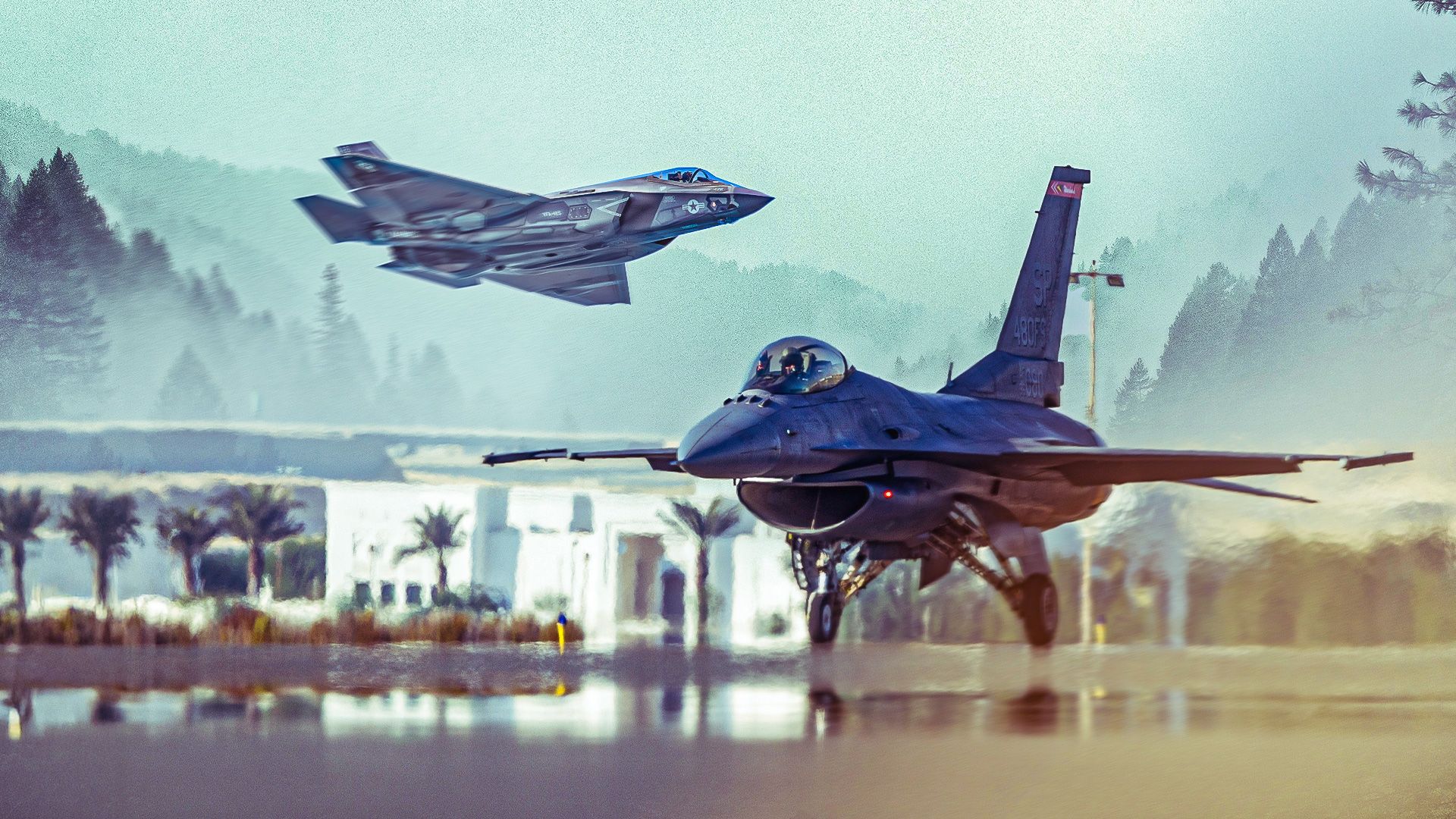
Across the US Air Force, (USAF) squadrons are steadily transitioning to the F-35 Lightning II as F-16 Fighting Falcons are retired. Meanwhile, the other variants of the F-35 have also replaced fighters in the Navy and Marines. The same pattern is unfolding in Europe, the Pacific, and the Middle East, where allies like the United Kingdom, Italy, Norway, Australia, Japan, and Israel are already flying the Joint Strike Fighter (F-35). Still others, like Poland, Switzerland, and Greece, have more orders pending.
A direct, head-to-head comparison of the F-35, aka “Fat Amy” as it is nicknamed, and the F-16 “Viper” highlights the generational difference in design and strategy. While the F-35 is supersonic, its top speed is lower than the F-16’s because its design prioritizes stealth above all else. Its shape, radar-absorbent materials, and internal weapons bays minimize its radar cross-section, allowing it to operate in heavily contested airspace where an F-16 could not.
F-35 Versus F-16: Bringing A Lightsaber To A Knife Fight

The F-35’s key superiority to the F-16 is in terms of stealth and beyond visual range (BVR) capabilities. The F-35’s design philosophy assumes that air-to-air combat will be decided at long ranges, where its advanced technology allows it to detect, track, and destroy enemy aircraft long before it is ever seen or engaged.
The F-35’s superior sensors and weapons give it an edge in dogfighting, but it has a slower top speed and reduced maneuverability. Yet, the F-16’s dogfighting advantage has been made obsolete in a contested environment where fifth-generation platforms exist. In modern warfare, a close-range fight is seen as a failure of tactics rather than a primary performance benchmark.

|
Specification |
|
|---|---|
|
Primary function |
Multirole fighter |
|
Thrust |
F-16C/D, 27,000 pounds |
|
Wingspan |
32 feet, 8 inches (9.8 meters) |
|
Length |
49 feet, 5 inches (14.8 meters) |
|
Height |
16 feet (4.8 meters) |
|
Weight |
19,700 pounds without fuel (8,936 kilograms) |
|
Maximum takeoff weight |
37,500 pounds (16,875 kilograms) |
|
Fuel capacity |
7,000 pounds internal (3,175 kilograms); typical capacity, 12,000 pounds with two external tanks (5443 kilograms) |
|
Payload |
Two 2,000-pound bombs, two AIM-9, two AIM-120 and two 2400-pound external fuel tanks |
|
Speed |
1,500 mph (Mach 2 at altitude) |
|
Range |
More than 2,002 miles ferry range (1,740 nautical miles) |
|
Ceiling |
Above 50,000 feet (15 kilometers) |
|
Armament |
One M-61A1 20mm multibarrel cannon with 500 rounds; external stations can carry up to six air-to-air missiles, conventional air-to-air and air-to-surface munitions, and electronic countermeasure pods |
The F-35 is less of a single-mission fighter and more of a networked multirole sensor platform. As a networked asset, the F-35 can act as a central hub, using its advanced sensors to provide target information to other less advanced aircraft, increasing the lethality and survivability of the entire force. The same technology and advanced tactical features that make up for the F-35’s performance disadvantage in a dogfight are what make it so strategically valuable.
F-35: Half Fighter, Half Intel Node

The F-35 is designed to be the “first-in” aircraft, entering hostile airspace to gather intelligence, disable air defenses with electronic warfare, and establish air dominance for other aircraft. For stealthy optimization, the F-35 can choose to carry a reduced internal weapons load. When stealth is not critical, it can carry additional munitions on external pylons, like the F-16.

The aircraft automatically aggregates data from all of its Electro-Optical Targeting System (EOTS), the Distributed Aperture System (DAS) with 360-degree infrared coverage, and the Active Electronically Scanned Array (AESA) radar, into a single, user-friendly display.
|
Specification |
F-35A |
|---|---|
|
Prime Contractor |
|
|
Power Plant |
One Pratt & Whitney F135-PW-100 turbofan engine |
|
Thrust |
43,000 pounds |
|
Wingspan |
35 feet (10.7 meters) |
|
Length |
51.5 feet (15.7 meters) |
|
Height |
14 feet (4.38 meters) |
|
Payload |
18,000 pounds (8,160 kilograms) |
|
Maximum Takeoff Weight |
70,000 pound class |
|
Speed |
Mach 1.6 (~1,200 miles per hour) |
|
Range |
More than 1,350 miles with internal fuel (1,200+ nautical miles), unlimited with aerial refueling |
|
Ceiling |
Above 50,000 feet (15 kilometers) |
|
Armament |
Internal and external capability. Munitions carried vary based on mission requirements. |
The F-35’s tactical advantage is that it can “see” and “think” faster than its adversaries, and often engage targets before an F-16 would even detect them. The F-16, even with modern upgrades like AESA radar, remains a more visible platform that relies on its speed and agility to survive. This renders the F-16’s dogfighting strengths less relevant in a modern, information-driven battlespace.
New High-Low Mix And Multi-Role Versatility

The introduction of the F-35 also alters the USAF’s long-standing “high-low” fighter mix and redefines mission capabilities. The F-16 served as the “low” end of the mix, a cheaper, high-volume aircraft for less-demanding missions. The F-35, while costly, is designed to take on the “high” end, entering and controlling heavily defended airspace.

The F-35 is a purpose-built multirole fighter capable of strategic attack, air defense suppression, anti-surface warfare, and close air support, consolidating the mission sets of many fourth-gen aircraft into a stealth package. The F-16 is also multirole, but its mission versatility is limited by the lack of stealth as well as the trade-off between performance and the amount of external ordnance.

The F-35’s design makes it far more survivable in a modern threat environment with advanced surface-to-air missiles and adversary fighters. On the battlefield of tomorrow, the F-35 is the tip of the spear while legacy jets like the Viper, or F-15 Eagle, ride in to deliver sweeping blows after the JSF surgically removes the highest threats. This allows the USAF and other air forces to recapitalize fourth-gen fighters and demands less investment in new fifth-gen, “exquisite” systems like the F-35.
One Airframe To Rule Them All

The F-35 program, conceived under the Joint Strike Fighter (JSF) initiative, offers significant logistical, interoperability, and cost benefits for the branches of the US military that fly the F-35. The commonality of the F-35 airframe simplifies logistics and maintenance efforts across the services, allowing for a shared supply chain, easier procurement, as well as standardized maintenance training and support even with international allies.

At a ceremony in Sardinia on July 2, 2025, Defense Minister Guido Crosetto declared that Italy is prepared to create the first F-35 fighter pilot training school outside of the United States, according to Second Line of Defense. Sicily will host the ground-breaking facility, solidifying Italy’s standing as a major collaborator in the global F-35 program. Crosetto gave the following statement:
“The future is built not by limiting ourselves to defence, but by making defence a social, economic, and technological innovation engine.”
Research and development (R&D) savings are also lower thanks to pooling resources into one airframe. That theoretically lowers overall development costs for the Department of Defense. However, the drive for a single airframe created a highly complex development program that faced significant cost overruns and delays.
Mission-specific changes introduced complexity and higher costs, which have caused controversy and public debate over the F-35’s affordability. The total cost of the F-35 program is the highest in history. It has exceeded the historic Manhattan Project that developed the atomic bomb in World War II, as well as the Boeing B-29 Superfortress, which was tailor-made to drop it, and cost twice as much to create.
A New Global Fleet

The United States, Japan, the United Kingdom, Australia, and Italy make up the heart of the program, while 20 other nations now fly or have ordered the fifth-generation fighter. In total, they will deploy about 3,000 airframes in three different versions. Although the United States controls almost two-thirds of the global fleet, partners are gradually growing their stealth fighter fleet in order to strengthen the common defense system.
More than 4,600 F-16s have rolled off the line, and roughly twenty-five countries still operate them. Today, around 1,300 JSF’s have been built, following in the footsteps of the Viper. The F-16 took off on a fast start, with four NATO countries agreeing to a consortium with the United States to construct the F-16, a template for the multinational program that jump-started the F-35.

The aircraft was produced by the European Participation Air Forces (EPAF) and made around 350 jets in total before the program ended. The last assembly NATO lines to shutter were in the Netherlands and Belgium, but US production continues to this day. Until the recent introduction of the Lockheed Martin F-35 Lighting II, it has been retained for decades by almost every operator that initially procured it.

To achieve cost efficiency, the F-35 program benefits from economies of scale, combining production for multiple services and nations, reducing the cost per jet over time. The primary factory is at the USAF “Bomber Plant” of WWII vintage in Texas, but another final assembly line was made at Cameri, Italy, and Nagoya, Japan. International partners share in the massive costs of the F-35’s ongoing development, modernization, and upgrades, such as funding the Block 4 modernization program.
The F-35’s technological superiority presents a formidable technological advantage against near-peer adversaries like China and Russia. The F-35’s presence in allied air forces around the world enhances extended deterrence by projecting a united front, sending a clear signal of collective resolve against potential Russian or Chinese aggression.
