


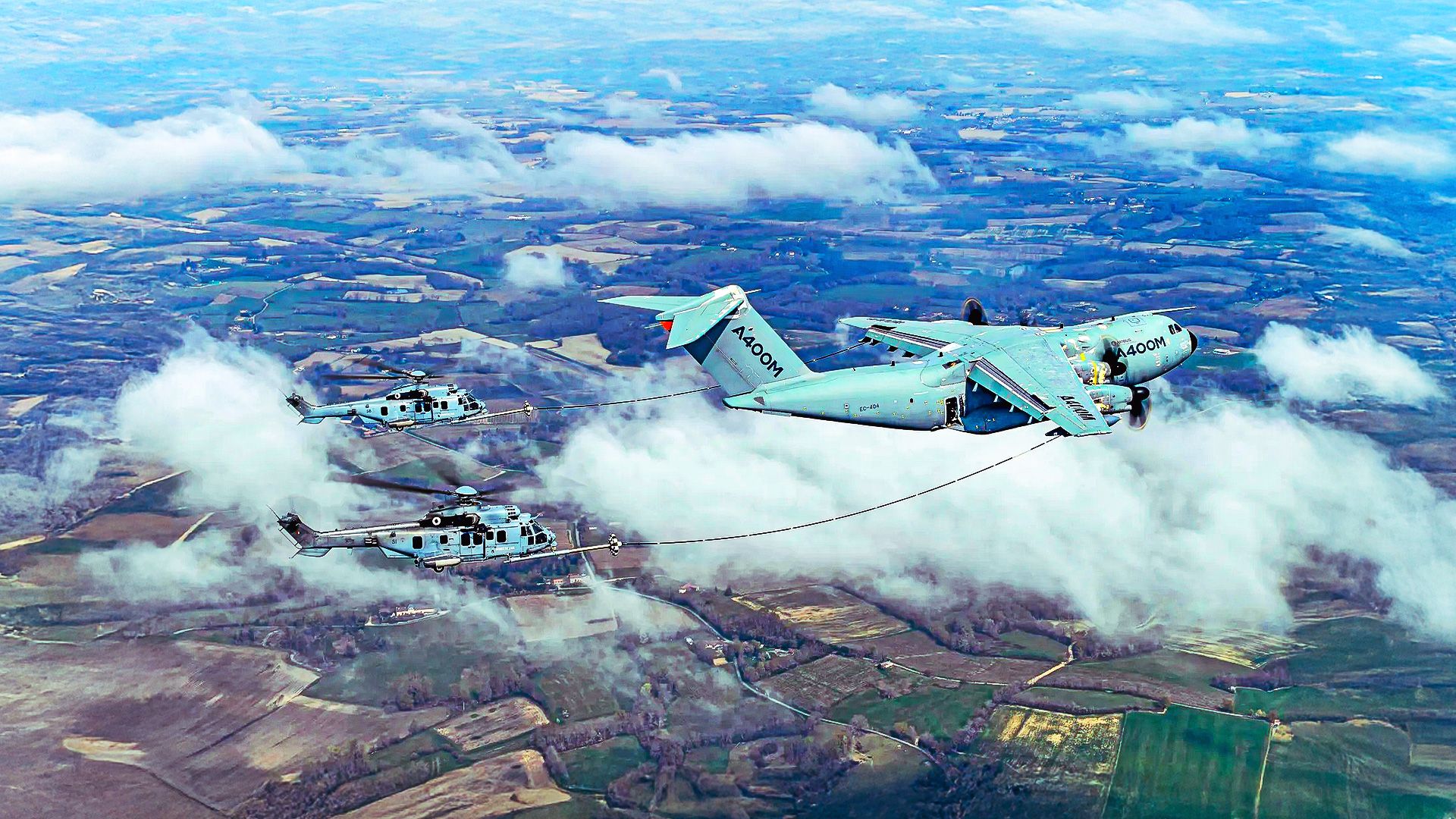
While best known for its commercial products, Airbus is also one of the world’s leading military aircraft manufacturers, which includes combat aircraft, transports, refuelers and helicopters. While its defense portfolio is narrower and more focused compared to other global defense companies, Airbus Defense and Space is the largest military aircraft producer in Europe and sees strong export demand for its products.
The defense division has undergone significant restructuring in recent months to adapt to changing market conditions, cutting thousands of jobs amid a wider reorganization. Despite the company being dwarfed in size by rivals such as Boeing, Lockheed Martin and Northrop Grumman, it continues to play a key role in the production of military platforms and the innovation of new technology.
Airbus Defense And Space

According to Defense News’ Top 100 for 2025, Airbus ranks as the 14th-largest defense company in the world today, as measured by revenue. This puts it behind industry juggernauts like Lockheed Martin, RTX and General Dynamics, and in third place for European defense firms, behind France’s Thales and the UK’s BAE Systems. While Airbus as a whole is Europe’s largest aerospace business due to its huge commercial aircraft revenues, its defense division still trails BAE and Thales in terms of revenue.
Posting full-year revenues of €12.1 billion ($14.2 billion) for FY2024, Airbus Defense and Space oversaw a 5% year-on-year increase in revenue. Additionally, its half-year 2025 results were impressive with a 17% year-on-year revenue increase, largely led by growth in its Air Power division. Its Air Power business comprises tactical and strategic airlifters, aerial tankers, and combat aircraft, including the Eurofighter Typhoon, A400M, C295, CN235 and A330 MRTT.
Although there are many reasons for Airbus Defense and Space to be optimistic, it has taken a major hit in the satellite business, primarily due to ongoing problems with its OneSat program. The company revealed €1.3 billion ($1.5 billion) in charges in 2024 and €600 million ($704 million) in 2023 due to significant delays, ultimately forcing Airbus to restructure its space division this year.
Inside The Airbus Military Aircraft Portfolio

Unlike most of its major rivals, Airbus does not manufacture a wide range of military aircraft, but it has managed to do well in certain niches by putting out top-quality machines. It has mainly focused on transports and tankers, two aircraft types that will always be in demand, and is also a key partner in the Eurofighter Typhoon program.
The company’s best-selling transport and lifter has been the C295 with over 230 deliveries, followed by the Airbus A400M Atlas, a turboprop developed to rival the Lockheed C-130 Hercules and Boeing C-17 Globemaster. The A400M hasn’t achieved the sales of those two aircraft given its development problems and cost overruns, eventually entering service a decade late with costs exceeding $30 billion.
|
Aircraft |
Type |
Status |
|---|---|---|
|
A400M Atlas |
Strategic/Tactical Airlifter |
In production |
|
A330 MRTT |
Multi-Role Tanker Transport |
In production |
|
C295 |
Medium Transport |
In production |
|
CN235 |
Light Transport |
In production |
|
Eurofighter Typhoon |
Multi-Role Fighter |
In production |
|
A320/A330 Special Mission Conversions |
Various |
Offered on demand |
Arguably, its most acclaimed aircraft has been the A330 MRTT, which was developed from the A330-200 airframe. This multi-role tanker and transport has attracted high export interest from customers across the globe, entering service with the likes of Australia, Saudi Arabia and Singapore over the years. With over 60 deliveries and sales topping 80 aircraft since its entry into service in 2011, the aircraft has logged more than 300,000 flight hours and commands over a 90% share of the non-US market.
Comprehensive Support Services

The acquisition costs of military aircraft are only part of the overall commitment to maintaining an airworthy fleet. Operators have sizable annual upkeep costs and also need to ensure their aircraft remain in optimal condition, as well as keep their pilots, maintenance teams and other support roles sharp. In fact, a significant portion of military contracts involves payment for ongoing support services and parts, with agreements typically lasting decades.
Airbus has developed one of the most forward-thinking lifecycle support philosophies for both its commercial and defense products, delivering training, spares and maintenance support throughout the aircraft’s lifecycle. Among the company’s support services are maintenance, repair and overhaul (MRO), spare parts management, pilot and support crew training, technical support and software upgrades.
With a presence on five continents, Airbus has ten global training centers that take crew and engineers from basic to advanced training. According to Airbus,
“Airbus offers an extended portfolio of services to ensure that customers can fulfil their missions under the most demanding conditions. The portfolio includes flight and ground crew training, maintenance, repair and overhaul (MRO) solutions, aircraft and systems upgrades, material services and support engineering.”
What Makes Airbus Military Aircraft Great?

Airbus has established a strong reputation for reliability and quality in the lifter and tanker market, building on its achievements in the commercial aircraft market. One of the standout qualities of its military aircraft portfolio is versatility, with Airbus understanding the varying challenges that operators face. This is why it builds most of its aircraft to tackle multiple roles, enabling its customers to obtain maximum value from their investment.
Take the A330 MRTT for example – the platform is capable of refueling and aerial refueling duties, but can also take on significant cargo or troop transport missions, or be fitted out for other roles, like medevac. The A400M was built with the same versatility principle, while the C295 is capable of diverse missions like maritime patrol, ISR, firefighting and AEW.
|
Specification |
A330 MRTT |
A400M |
C295 |
|---|---|---|---|
|
Length |
58.8 meters |
45.1 meters |
24.5 meters |
|
Height |
17.7 meters |
14.7 meters |
8.66 meters |
|
Wingspan |
60.3 meters |
42.4 meters |
27.59 meters |
|
Engines |
2 × Rolls-Royce Trent 700 |
4 × Europrop TP400-D6 turboprop |
2 × Pratt & Whitney PW127XT |
|
MTOW |
233,000 kg |
141,000 kg |
23,200 kg |
|
Range |
8,000 NM (14,800 km) |
2,450 NM (4,500 km) |
2,000 NM (3,700 km) |
Airbus has also incorporated multiple technological innovations in its aircraft, much like it did with its fly-by-wire system on the Airbus A320. The A400M was the first large military aircraft to feature fly-by-wire technology, while the A330 MRTT pioneered the use of automatic air-to-air refueling boom systems. In all, the combination of versatility, state-of-the-art technology and world-class support services make Airbus Defence and Space’s military aircraft portfolio highly sought after.
Significant Restructuring This Year

As Airbus announced in late 2024, its defense division would be cutting thousands of jobs “in light of a continued complex business environment,” with over half of the 2,043 total job reductions hitting its Space Systems business. While this was a reduction of its planned 2,500 job cuts announced earlier in 2024, it still impacted around 5% of jobs at the company.
Airbus said it hopes to avoid compulsory redundancies and will instead seek to achieve these job cuts through early retirements and voluntary departures. Much of this restructuring was forced upon the company by significant financial losses incurred in 2023 and 2024, including over $1 billion in charges in the first half of 2024 alone related to OneSat program setbacks.
Effective from July 1, 2025, Airbus Defense and Space streamlined its three main businesses – Air Power, Connected Intelligence and Space Systems – to “provide stronger end-to-end accountability.” With job reductions and other operational restructuring, the company is hoping to lower its overheads amid rising cost pressures and supply chain disruptions.
What’s Next For Airbus Defense And Space?

One of the most anticipated developments coming to the Airbus portfolio is its A330 MRTT+ program, which will upgrade to the A330neo (A330-800) as the base airframe, alongside other changes to the wings, engines and cabin. This will lead to an 8% reduction in fuel burn and also serve to enhance the tanker’s range. The aircraft will be equipped with the latest Rolls-Royce Trent 7000 engines and feature a new-generation wing fitted with sharklets for enhanced aerodynamic efficiency.
Airbus is also co-leading Europe’s 6th-generation fighter program, dubbed the Future Combat Air System (FCAS). Much like the US NGAD program, FCAS will feature a manned aircraft accompanied by “loyal wingmen” unmanned drones, and is currently in the demonstrator phase ahead of its entry to service in the mid-2030s. Another key component in this program is the Combat Cloud, a sophisticated network to coordinate data and integrate different systems for greater mission cohesion.
Closer to realization is the Eurodrone program, which Airbus is leading in partnership with Dassault and Leonardo. The Eurodrone, which is essentially Europe’s answer to the MQ-9 Reaper drone used by the US military, is a medium altitude, long endurance platform that will be the first remotely piloted aircraft system (RPAS). While primarily designed for ISR missions, the Eurodrone was built with versatility in mind, but it will be capable of carrying munitions in the future.
