


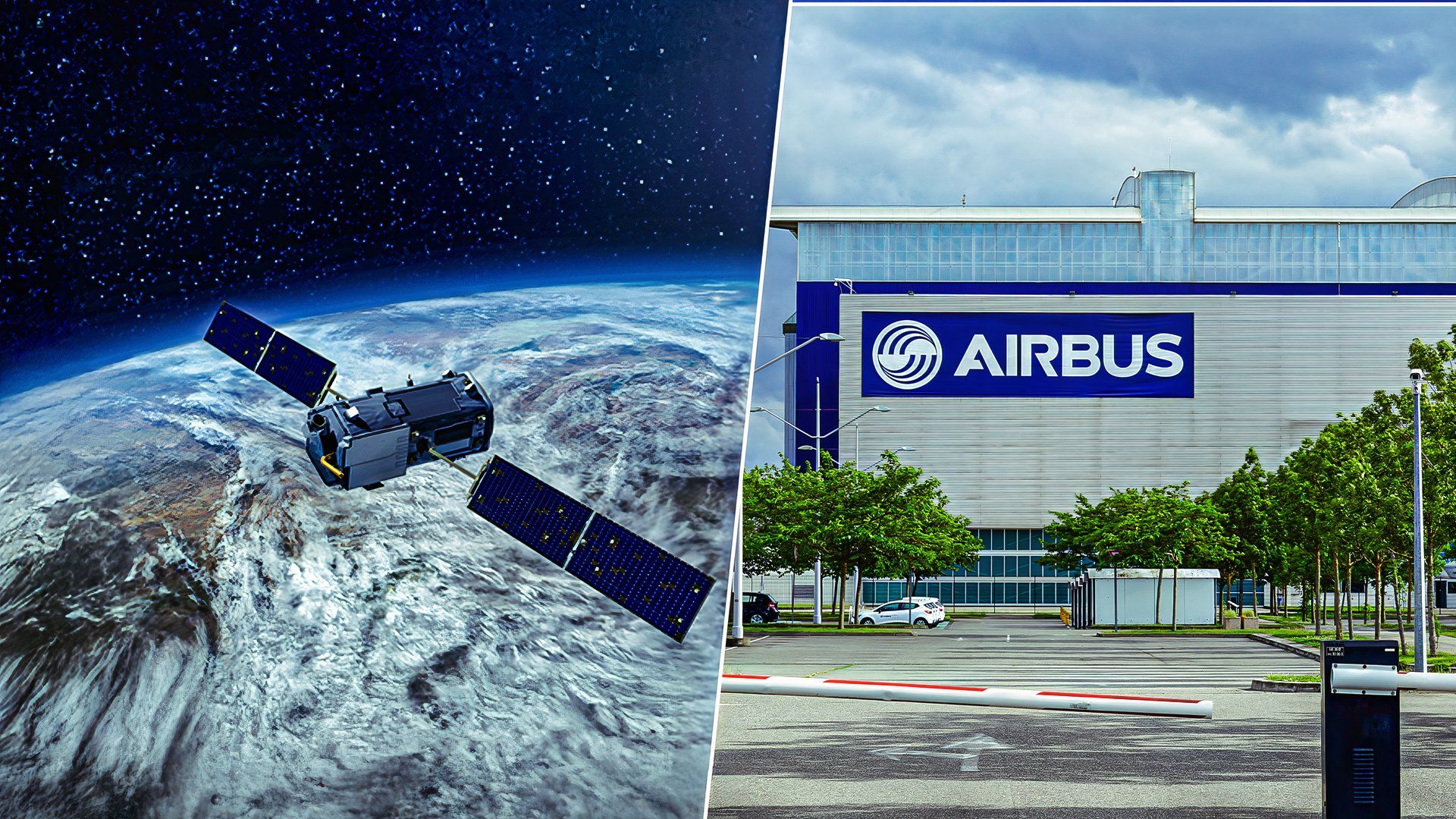
When we think of Airbus, most of us picture sleek airliners crossing the globe, from the popular Airbus A320 series, which you can spot literally at every airport in the world, to the majestic superjumbo, the iconic Airbus A380. However, while the company’s aircraft dominate the skies, few people are aware that Airbus collaborates with the ESA (European Space Agency) in outer space, which could prove even more groundbreaking. The European aeronautical giant is at the forefront of a revolution in weather forecasting, building satellites and systems that promise to make predictions sharper, faster, and more relevant to our daily lives. In this guide, we’ll explore how the aerospace giant is shaping the future of meteorology and why that matters for aviation, climate science, and even your smartphone weather app.
Forecasting the weather is a much more complex activity than just deciding whether to bring an umbrella or not. From aviation safety to disaster preparedness, accurate predictions are critical. The challenge? Earth’s atmosphere is vast, complex, and ever-changing. Airbus is entering this area with next-generation satellites poised to transform how we track weather systems, solar storms, and even the subtle climate patterns that drive global change. It is crucial for the European continent because over one-third of Europe’s economy is weather-sensitive. This is particularly true for agriculture, energy, and transportation, as described on the Airbus website.
From Balloons To Satellites – The Evolution Of Weather Forecasting

Weather forecasting has come a long way from barometers, weather vanes, and atmospheric balloons. In the 19th century, predictions relied on painstaking observations, with accuracy often limited to local conditions. Telegraph systems enabled the transmission of weather data across regions, but forecasts were still marred by uncertainty and inaccuracies. Fast-forward to today, and we have satellites offering a bird’s-eye view of the entire planet, with Airbus playing a leading role in providing Europe’s eyes in the sky.
One of Airbus’ most recent achievements is the successful launch of the Meteosat Third Generation (MTG) Imager satellite, which began operations in 2025, according to the Airbus Press Release. This satellite builds on decades of progress, dating back to the launch of the first Meteosat satellite by ESA in 1977. Designed to provide sharper images and near-real-time updates, MTG is expected to enhance the temporal accuracy of severe weather alerts, enabling countries to better prepare for floods, heatwaves, and hurricanes.
To appreciate the scale of this leap, consider that previous satellite generations provided refresh cycles of 15 minutes. MTG can deliver updates in just 2.5 minutes, significantly enhancing meteorologists’ ability to track rapidly changing events, such as thunderstorms. That’s a life-saving difference in aviation, where every minute counts when rerouting flights. In practice, this means airlines will have the ability to respond to changing conditions mid-flight, saving fuel and improving safety.
The difference is as striking as comparing an old black-and-white weather broadcast to a high-definition, color-coded live stream. Where once meteorologists had to rely on grainy snapshots, now they have a fluid, almost cinematic view of Earth’s atmosphere in motion.
Airbus’s Expanding Role In Space-Based Weather Technology

Airbus has a long history of research in Earth observation. It includes building key weather satellites for Europe and beyond, but the MTG series marks a milestone in ambition. By combining state-of-the-art imaging with lightning detection instruments, MTG promises an unprecedented level of data detail.
The lightning imager, for instance, allows scientists to track electrical discharges across the entire European and African continents. This helps meteorologists identify the formation of storm systems hours before they become visible on traditional radar. For pilots, this means receiving earlier warnings about potential turbulence hotspots, which improves decision-making for long-haul flights.
|
Satellite Generation |
Operational Period |
Refresh Rate |
Orbit |
Key Instruments |
Key Features / Improvements |
|---|---|---|---|---|---|
|
Meteosat Second Generation (MSG) |
2002–present (gradual replacement by MTG) |
15 minutes |
Geostationary (0° longitude) |
Spinning Enhanced Visible and InfraRed Imager (SEVIRI) |
Provides 12 spectral channels for cloud, temperature, and moisture monitoring; supports nowcasting and short-term forecasting; primary focus on visible and infrared cloud imagery. |
|
Meteosat Third Generation (MTG) |
2022–present (full operational capability expected by late 2025) |
2.5 minutes (Europe and Africa) |
Geostationary |
Flexible Combined Imager (FCI), Lightning Imager (LI), Infrared Sounder (IRS) |
Offers 16 spectral channels with higher spatial and temporal resolution; first European satellite with continuous lightning detection; improved storm tracking and early warning; supports air traffic safety and severe weather forecasting. |
But Airbus’ role doesn’t stop at building satellites. The company also manages operations that integrate these systems into Europe’s broader weather infrastructure. This includes partnerships with EUMETSAT (the European Organisation for the Exploitation of Meteorological Satellites) and national weather agencies, ensuring the data is processed, distributed, and applied in real-world scenarios.
For aviation, the impact is, of course, profound. Better lightning detection and near-real-time cloud monitoring mean fewer surprises mid-flight. Airlines can adjust routes proactively, avoiding diversions that waste thousands of gallons of fuel and disrupt schedules for thousands of passengers.
The Smartphone Connection – Accurate Weather Forecast At Your Fingertips

It’s easy to take the daily forecast on our phones for granted. But behind that familiar weather app lies an intricate network of satellites, ground stations, and supercomputers. Airbus’s satellites directly feed into this ecosystem, transforming data collected from orbit into forecasts that anyone can access.
According to Airbus, the company’s role is not limited just to building and sending satellites into orbit. It’s about ensuring that this information reaches the hands of people who need it most, from a farmer deciding when to harvest to an airline dispatch team plotting transatlantic routes, or a commuter figuring out whether to cycle to work.
The dissemination of space-based data represents one of the most significant shifts in modern meteorology. Instead of forecasts being the domain of specialists, Airbus’s technology ensures that accurate, high-resolution predictions are available to millions, often updated in near real-time.
Consider the ripple effects: more accurate forecasts help airlines reduce delays, farmers minimize crop losses, energy providers anticipate demand spikes, and even outdoor event planners avoid costly disruptions. Every layer of society benefits from forecasts that are a little more accurate, and Airbus is one of the companies ensuring that this accuracy continues to improve.
Weather Beyond Earth – The Rise Of Space Weather Forecasting

Weather doesn’t happen only on Earth. Solar storms, cosmic radiation, and other phenomena, known as “space weather”, can disrupt everything from GPS signals to airline communications. Airbus is also working to improve forecasting in this overlooked but critical domain.
In May 2025, Airbus highlighted the importance of space weather. A single solar storm has the potential to knock out satellites, disrupt power grids, and ground aircraft on polar routes, as illustrated in this Airbus Story. By developing monitoring tools for solar activity, Airbus is helping to ensure that aviation remains resilient, even when the Sun is at its most unpredictable.
|
Space Weather Hazard |
Potential Aviation Impact |
|
Solar Storms |
GPS disruptions, radio blackouts |
|
Cosmic Radiation |
Crew/passenger exposure at high altitudes |
|
Magnetic Disturbances |
Navigation inaccuracies |
The challenge here is not only detecting these events but also predicting them early enough to allow airlines and governments to respond effectively. For example, airlines operating polar routes between North America and Asia might lose communications during a solar storm. With early warning, flights can reroute, avoiding potentially dangerous situations. Airbus’s work positions Europe as a leader in safeguarding against the celestial wildcards that could impact aviation and beyond.
Why Airbus’s Forecasting Leap Matters For Aviation

Airlines have long relied on meteorologists, but the stakes are rising. Climate change is increasing the frequency of severe weather events even in areas that were once considered calm, while air traffic continues to grow. Airbus’s contribution means better foresight, which translates directly into fewer delays, reduced fuel burn, and enhanced passenger safety.
Take turbulence as an example. Although most incidents are minor, severe turbulence can cause injuries to passengers and damage to the aircraft. With MTG satellites providing rapid updates to flight planning systems, pilots can reroute before encountering rough patches, saving fuel and avoiding unnecessary risks and potential damage. This is especially important on ultra-long-haul routes, where mid-flight adjustments can mean the difference between arriving on time and diverting to an alternate airport.
As BBC News reported in August 2025, Airbus’s work is not limited to Europe only. These satellites have global implications, as their data is shared across international meteorological organizations. That means improved forecasts worldwide. The aviation industry thrives on predictability, and Airbus is helping to provide exactly that. From reducing delays caused by storms at hub airports to optimizing transoceanic routes, the company’s satellites are quietly shaping the passenger experience in ways most travelers will never realize, but will always benefit from.
The Bigger Picture – From Climate To Everyday Life

Weather satellites are not just tools for pilots or scientists; they are instruments that shape humanity’s response to a changing planet. The same data that reroutes flights also supports climate modeling, disaster response, and agricultural planning. For example, Airbus’s systems can detect subtle shifts in cloud patterns and solar radiation that help climatologists refine long-term models. Farmers can receive hyper-local forecasts, reducing crop losses during droughts or floods.
Meanwhile, governments can issue faster disaster warnings, potentially saving thousands of lives. However, beyond the immediate benefits, a larger story is unfolding. The ability to forecast weather more precisely is part of a broader “weather economy,” where accurate predictions shape financial decisions, insurance policies, and infrastructure planning.
Airbus’s satellites can influence stock markets, construction projects, and even military operations that depend on accurate forecasts, and not only feed some weather apps. And in the background, climate change looms. As extreme weather events become more common, Airbus’s contributions will only grow more vital. The MTG satellites and their successors could become the world’s most essential tools in managing the risks of an unpredictable world.
