


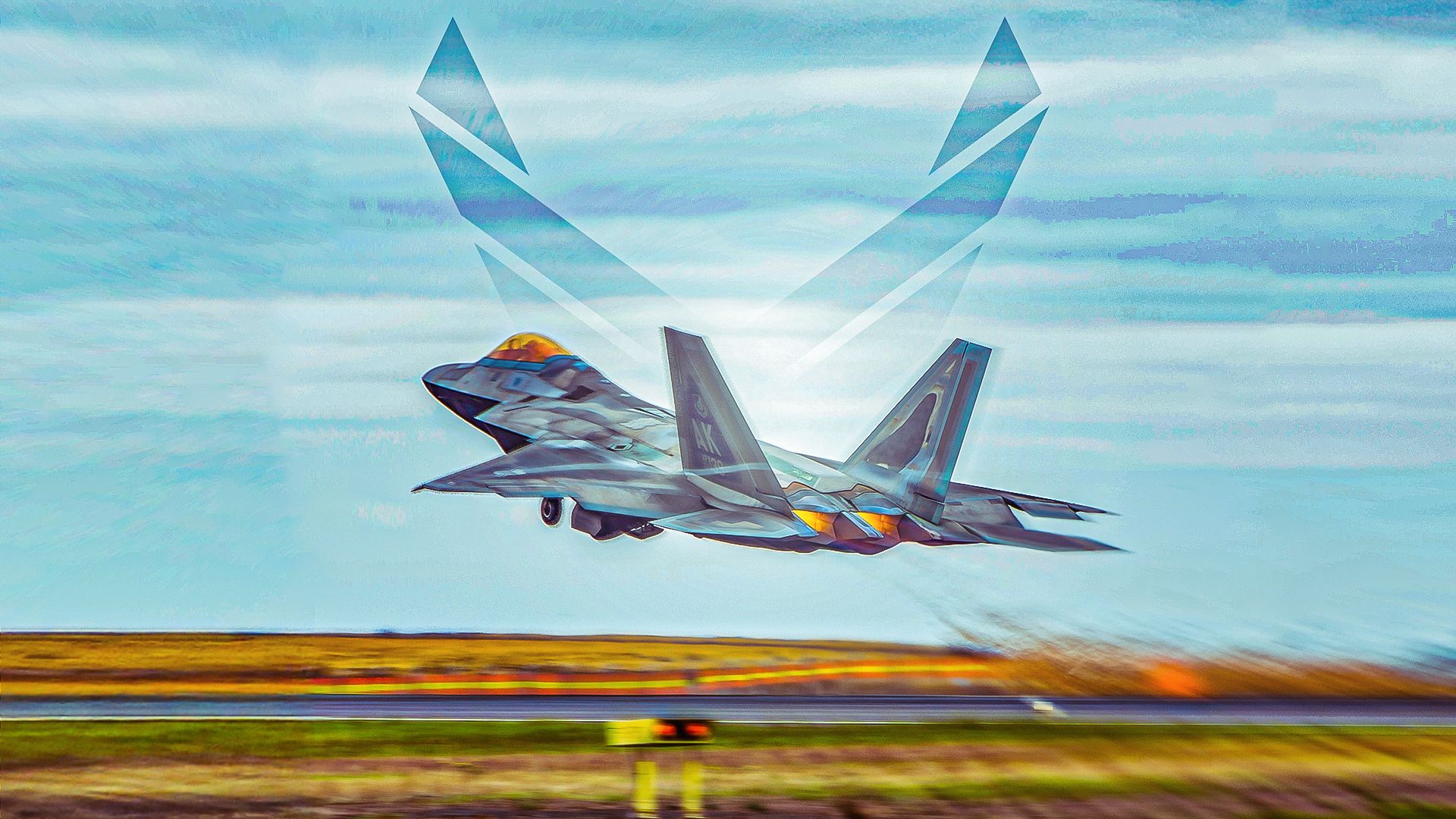
The US Air Force is moving to keep its F-22 Raptor stealth fighters competitive for another decade. In its latest Fiscal Year 2026 budget, the service requested $90.34 million for a new “Viability” upgrade package, an effort designed to protect the jet’s edge against evolving Chinese and Russian threats. Since the Boeing F-47, the centerpiece of the Next Generation Air Dominance (NGAD) family, is still years away from hitting operational readiness, the USAF is working on a smart, layered strategy for its stealth fighter.
That’s not limited to a fresh coat of paint, of course, but involves hardware, smart fleet management, pilot retraining, and tough calls on where to spend the budget. The payoff? A Raptor force that stays one step ahead of adversaries such as China’s J-20 or Russia’s Su-57 Felon, buying time for the sixth-gen revolution without leaving gaps that could invite trouble. With adversaries fielding improved passive sensors, integrated air defenses, and advanced electronic warfare tools, the Raptor’s old-school edge, such as its low radar observability and Mach 2+ speed, won’t cut it solo anymore. It needs continuous, targeted modernization, especially with emerging threats like China’s new quantum radars.
Why The F-22 Still Matters

The F-22’s combination of stealth, speed, maneuverability, and sensor fusion remains uniquely suited to penetrating contested airspace and generating decision-quality targeting data; those combined attributes make it the logical platform to hold air superiority while NGAD matures.
Back in 2006, training and reports from the Northern Edge exercise and subsequent public accounts emphasized the Raptor’s force-multiplying role in advanced air-combat training: in particular, Air Force reports from that exercise highlighted the F-22’s strong training performance against simulated opposing aircraft and underscored the type’s value in joint-force interoperability and tactics development.
In 2014, the Department of Defense confirmed that US aircraft, including F-22s, conducted strikes in Syria as part of the initial operations against ISIS and related targets, carrying out precision strikes against identified militant nodes as US Central Command described in its public briefing on those operations.
During later rotational deployments, the Air Force reported sustained F-22 presence and high sortie generation in support of Operation Inherent Resolve, with unit press accounts and Air Combat Command summaries describing lengthy deployments in 2018 that involved hundreds of sorties and thousands of flight hours while performing air superiority and strike support missions for coalition operations.
In February 2023, F-22 Raptors were employed to detect, track, and ultimately engage a high-altitude surveillance balloon that transited the US airspace; the aircraft’s speed, altitude performance, and integrated sensors allowed commanders to monitor the object and execute a controlled intercept in coordination with NORAD and other authorities. Raptors have also been used to investigate other anomalous high altitude objects and to support identification and escort missions, illustrating how air dominance platforms can be repurposed for sovereign airspace protection and rapid-response tasks.
Today, the Air Force operates around 185 F-22s, but only about 143 are combat-coded, with the rest used for training or test work. The Viability project aims to sustain that small but vital fleet through incremental, software-driven updates rather than a costly redesign.
For the USAF, viability is a working strategy that leverages the excellent capabilities of the F-22 Raptor against smarter sensors and denser air defense networks, prioritizing targeted redesigns and limited investments. In practice, the work focuses on preventing the aircraft from losing capability due to operational wear and on adding tools the jet didn’t originally carry or had only in limited form. We will examine the pillars of viability in more detail in the next paragraph.
Maintaining a credible Raptor fleet during the NGAD transition is both tactical and strategic: asAir Combat Command’s Gen. Kenneth Wilsbach put it in July 2024:
“The F-22 is a fantastic aircraft. We’re actually planning several upgrades to the jet as we speak, and there is no official replacement to the F-22 right now.”
The Upgrade Architecture

The Air Force is not rebuilding the F-22; it will rebuild the stealth fighter fleet, adapting it to the 2030 context. The viability upgrade is a single, integrated effort built on four reinforcing pillars: stealth, sensing, electronic warfare, and sustainment, designed to keep the Raptor lethal and available until NGAD arrives in force.
-
Stealth and signature management: Stealth sustainment consists of a continuous investment in low-observable materials, repair techniques, and inspection practices to ensure optimal
radar
cross-section (RCS) performance throughout the aircraft’s operational life. - Sensors and situational awareness: Sensor and avionics upgrades are focused on passive detection. We will discover them in detail in the next paragraph. Additionally, processors and fusion algorithms will be updated to enable the pilots to get a clearer, faster picture without needing to emit radar energy. Recent reporting on Chinese research into ultra‑sensitive single‑photon and “quantum” sensing techniques suggests a potential future threat to low‑observable designs. However, these technologies remain at an experimental stage and lack publicly verified demonstrations against operational stealth aircraft, so they should be treated as a conditional driver for accelerated passive sensing and EW investments rather than a current capability.
- Electronic warfare and countermeasures modernization: The modernization aims to detect emergent threat waveforms and automate countermeasure responses, so Raptors can survive against increasingly sophisticated integrated air defenses.
- Logistics upgrades to keep airframes mission-ready longer: Depot and sustainment investments increase depot throughput, spare parts availability, and service-life extension work, so a larger number of airframes can carry the new kits at any given time.
These updates, together, will make the F-22 more resilient and more relevant, enabling a gradual handoff to the F-47 when numbers and capability mixes allow.
The Hardware Changes

Recent Air Force budget justification books outline a specific set of funded insertions. Chief among them are the Infrared Defensive System (IRDS) and the Infrared Search and Track (IRST) hosted in a low-visibility, sub-wing pod, both derived from Lockheed’s TacIRST family. These provide passive detection of airborne threats without emitting radar energy, a key survival advantage in high-EW environments.
Avionics and sensor fusion upgrades aim to reduce pilot workload while sharpening target discrimination in dense, contested electromagnetic environments. The Low-Drag Tanks and Pylons (LDTP) package, tested on the F-22 since 2023, allows extended missions while maintaining supercruise capability and minimizing radar signature.
A new Helmet-Mounted Display (HMD), long missing from the type, is also part of the plan, giving pilots true off-boresight engagement and improved situational awareness. Add in processor and software block upgrades, and the F-22 becomes a more efficient sensor-shooter node within the future NGAD kill chain.
|
Upgrade |
Primary Effect |
Operational Benefit |
|---|---|---|
|
IRDS / IRST |
Passive long-range threat tracking |
Earlier engagements, reduced emissions |
|
LDTP |
Increased endurance with reduced radar signature |
Longer missions, Pacific reach |
|
EW Suite |
Modern countermeasures, automated threat handling |
Higher survivability in contested airspace |
|
Avionics Refresh |
Faster data fusion, AI-assisted display |
Shorter kill chain; lower pilot workload |
|
HMD |
Off-boresight cueing |
Enhanced visual acquisition & missile employment |
These upgrades are deliberately modular to allow phased insertion across the fleet and to ensure maintainers can retrofit airframes with limited downtime, keeping sortie rates high as upgrades roll through units.
Fleet Management And Industrial Partners

Upgrades are most effective when more airframes can carry them, so the Air Force combines capability insertion with fleet-management actions: depot refurbishments, selective service-life extension programs, and conversion of some training or non-combat-configured airframes into upgraded, mission-ready jets.
Recent moves being reported include plans to bring back or convert some Block 20 training airframes and other Raptors through refurbishment efforts, which could yield several dozen additional combat-capable jets and improve fleet depth while new platforms enter service.
For industry, the Viability program provides steady workstreams across Lockheed Martin, BAE Systems for the AN/ALR-94 advanced digital electronic warfare system , Collins Aerospace for the avionics, and depot partners at Hill AFB and Tyndall Air Force Base, supporting research into next-generation RAM coatings and infrared sensors that will ultimately benefit NGAD.
The cumulative effect is a larger, more robust pool of combat-capable Raptors able to surge, rotate, and sustain operations without exhausting depot buffers, thereby reducing operational risk during the NGAD transition and allowing planners to maintain credible deterrence while prototype and production timelines for the F-47 proceed.
Risks, Trade-offs Of The F-22 Raptor

The Raptor still matters, but it isn’t perfect. Years in service have shown all the qualities, but also some practical limits that matter in a fight:
- Low‑observable coatings and repairs wear down in the real world;
- Passive, long‑range detection is weaker than some of the new sensor concepts coming online
- The F-22’s Common Integrated Processor (CIP) and Intra-Flight Data Link (IFDL) exhibit performance degradation in high-intensity electromagnetic interference and electronic attack (EA).
There are also some key risks to monitor, such as advances in adversary passive sensing and counter‑stealth techniques and vulnerabilities in supply chains for low‑observable materials. Operationally, the Air Force must guard against overuse of upgraded Raptors in high‑tempo contingencies, which could deplete depot buffers and shorten the fleet’s effective service life.
Sustaining and modernizing the F-22 is a conscious trade-off, and funds and industrial capacity devoted to widening the platform’s viability are not immediately available to accelerate NGAD production, so policymakers must balance short‑term deterrence and operational readiness against long‑term modernization goals to avoid strategic risks.
Operationally meaningful signs include how Raptors are employed in coalition exercises, whether they appear as data-providing nodes or primary shooters, sortie-generation rates during surges, and public statements from commanders and program offices about upgraded pacing and depot capacity.
What The F-22 Viability Plan Means

For allies, the US decision to sustain and modernize the F-22 signals continued investment in fifth-generation combat power that can operate in coalition contexts and provide reassurance where partner air forces do not yet field similar capabilities.
For industry, the viability program creates multi-year workstreams for Lockheed Martin, EW and sensor suppliers, depot operators, and materials researchers, stimulating R&D in low-observable coatings, infrared sensors, advanced processors, and modular integration techniques.
The phased approach to upgrades and depot refurbishment also smooths the transition to F-47-centric force structures: by keeping a credible, modern Raptor fleet operational, the Air Force reduces the pressure to procure large numbers of an unproven NGAD variant quickly, enabling a more measured rollout of sixth-generation capabilities.
The upgrades will not turn the F-22 Raptor into a sixth‑gen jet, but they will be instrumental in raising the baseline, counteracting the fighter jet’s aging, and stretching its operational relevance during the whole maturation period of the NGAD. If the NGAD hits its milestones, Raptors will hand off lessons, some software patterns and selected sensor packages. If NGAD slips, the viability work will buy time, not by pretending the Raptor is the long‑term answer, but by turning each sortie into a higher‑value piece of a distributed force.
