



The YFQ-44A has carried out its first captive carry evaluations with an inert AIM-120 AMRAAM missile as the U.S. Air Force entered the weapons integration testing phase of the Collaborative Combat Aircraft program.
On Feb. 23, 2026, the U.S. Air Force released the first photo of an Anduril’s YFQ-44A Fury “fighter drone” carrying an AIM-120 AMRAAM (Advanced Medium Range Air-to-Air Missile) during an undated captive carry test.
The test was conducted as part of the weapons integration phase of the Air Force’s Collaborative Combat Aircraft program, which employs inert munitions to methodically validate integration, structural performance, and safety, ensuring the platform can safely carry external stores: aerodynamic performance and structural integrity are extensively evaluated under different conditions to confirm the compatibility between the external stores and the aircraft ahead of live employments.
The use of inert test weapons allows engineers and test pilots to evaluate performance characteristics and separation safety in a controlled environment without live ordnance.
Although the accompanying caption does not specify where the photo was taken, mentioning only a “California test location,” the image was almost certainly taken at Southern California Logistics Airport in Victorville, California, where the type also conducted its first flight on Oct. 31, 2025.
We are moving with urgency & purpose to deliver game-changing capabilities to our warfighters. CCA inert captive carry testing is a deliberate step in our plan to build a more lethal & integrated @usairforce.https://t.co/S1zR1jMO1f pic.twitter.com/2OQDKd9A2n
— General Ken Wilsbach (@OfficialCSAF) February 24, 2026
“We are following the same detailed approach used in every other aircraft developmental test program to validate structural performance, flight characteristics and safe separation,” said Air Force Chief of Staff Gen. Ken Wilsbach in a public release. “This ensures the CCA can safely integrate inert weapons before future employment.”
The CCA program aims to deliver affordable, risk-tolerant unmanned systems designed to operate alongside piloted fighters as force multipliers in what, in the past, has often been called a “loyal wingman” scenario: in this role, autonomous aircraft can operate as part of a human-machine team, extending the reach, survivability and effectiveness of crewed platforms in missions conducted in contested that would otherwise place the life of human pilots at risk.
“CCA is a critical part of a larger, integrated system-of-systems that will give our warfighters the overwhelming advantage,” Wilsbach said. “This program is about delivering a network of effects that will sense, strike and shield our forces in contested environments. We are empowering our teams to take smart risks and deliver this capability faster, ensuring we can deter, and if necessary, defeat any adversary.”
Throughout development and testing, a human retains authority over weapons release decisions. CCA is designed to operate within established command structures and legal frameworks that govern all Air Force weapons systems.
To date, no images have been released of the other design under development as part of the first phase, or Increment 1, of the CCA program, General Atomics’ YFQ-42A Dark Merlin prototype carrying any munition.
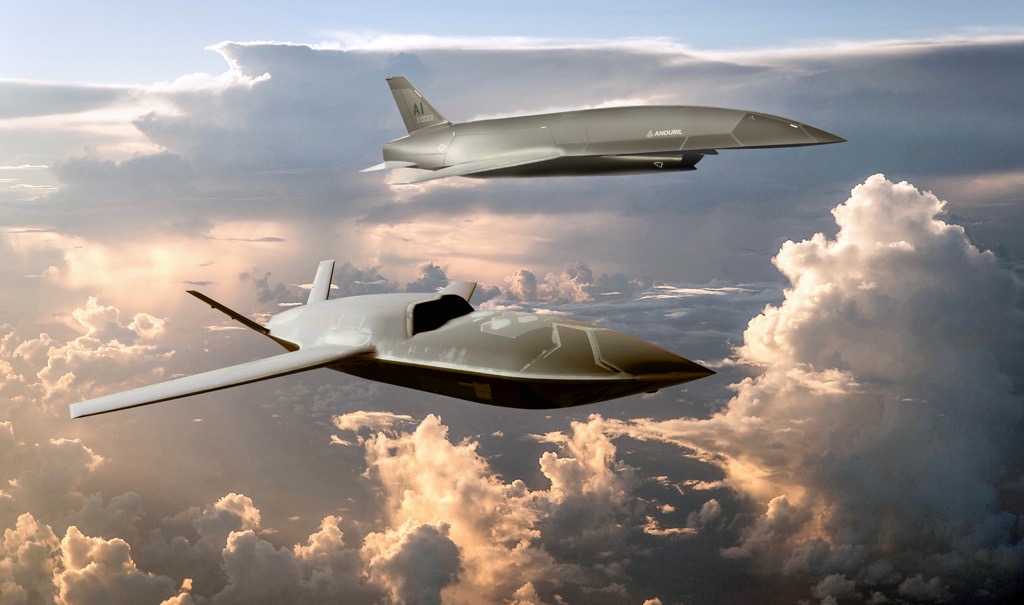
Here’s what we wrote about CCA in a previous story we published at The Aviationist after the YFQ-44A successfully conducted its first flight:
The development of the autonomous systems has advanced more rapidly than expected, leading some to suggest that NGAD’s crewed fighter might not be as essential as initially planned. The combination of CCAs with manned platforms like the F-35 and F-15EX could provide a more affordable and flexible solution to achieving air superiority.
The rise of CCAs reflects the Air Force’s shifting priorities, where a system-of-systems approach may take precedence over a singular focus on a high-cost manned fighter. The combination of manned and unmanned systems also allows for greater flexibility and the potential to deploy assets in more distributed and resilient ways.
The Air Force is rapidly advancing the development of CCAs, with plans to begin deploying over 150 units in the next five years. These autonomous systems could take on a range of missions, from surveillance to direct combat, working as force multipliers in collaboration with manned platforms and taking on high-risk missions traditionally performed by manned fighters.
Unlike legacy fighters, CCAs feature modular designs, enabling rapid upgrades and streamlined maintenance. The modular design and open architecture, the latter becoming a staple in the design of modern military aircraft, allows to introduce new capabilities as they become available, allowing in turn to always field the latest technologies to keep an edge over rapidly evolving battlefields.
In early 2024, Anduril Industries and General Atomics were awarded contracts to design and test production-ready CCAs, marking a pivotal step in the program. Both companies are developing these unmanned aircraft to support both the upcoming NGAD fighters, as well as current F-35s and other manned aircraft, by sharing sensor data, executing coordinated maneuvers, and potentially carrying out combat roles.
In early 2025, U.S. Air Force’s Chief of Staff, General David Allvin, announced the official designation of the first two CCAs. The two aircraft by General Atomics and Anduril have been named YFQ-42A and YFQ-44A, respectively, marking the first use of the ‘Unmanned Fighter’ designation by the USAF.
“We have two prototypes of Collaborative Combat Aircraft that were on paper less than a couple of years ago,” Allvin said. “For the first time in our history, we have a fighter designation in the YFQ-42 Alpha and the YFQ-44 Alpha – maybe just symbolic, but it’s telling the world that we are leaning into a new chapter of aerial warfare.”
The Air Force is planning to field a diverse fleet of over 1,000 CCAs, designed with modular configurations for weaponry, sensor capabilities, and rapid adaptability to mission needs. One notable advancement in 2024 was the first flight of the XQ-67A, a low-cost drone designed by General Atomics under the Off-Board Sensing Station (OBSS) program, which occurred in February 2024.
This platform, along with the earlier XQ-58A Valkyrie, demonstrates a “common chassis” concept—using shared components for various drone models to streamline production and reduce costs. This approach aims to provide a scalable, cost-effective solution for enhancing combat capacity without relying on high-cost crewed jets, which is essential given the Air Force’s budget constraints and strategic emphasis on distributed, resilient forces.
“A competitive Increment 1 production decision is expected in fiscal year 2026,” says the Air Force, “with development for Increment 2 beginning that same year to expand mission applications and integrate emerging technologies.”
