


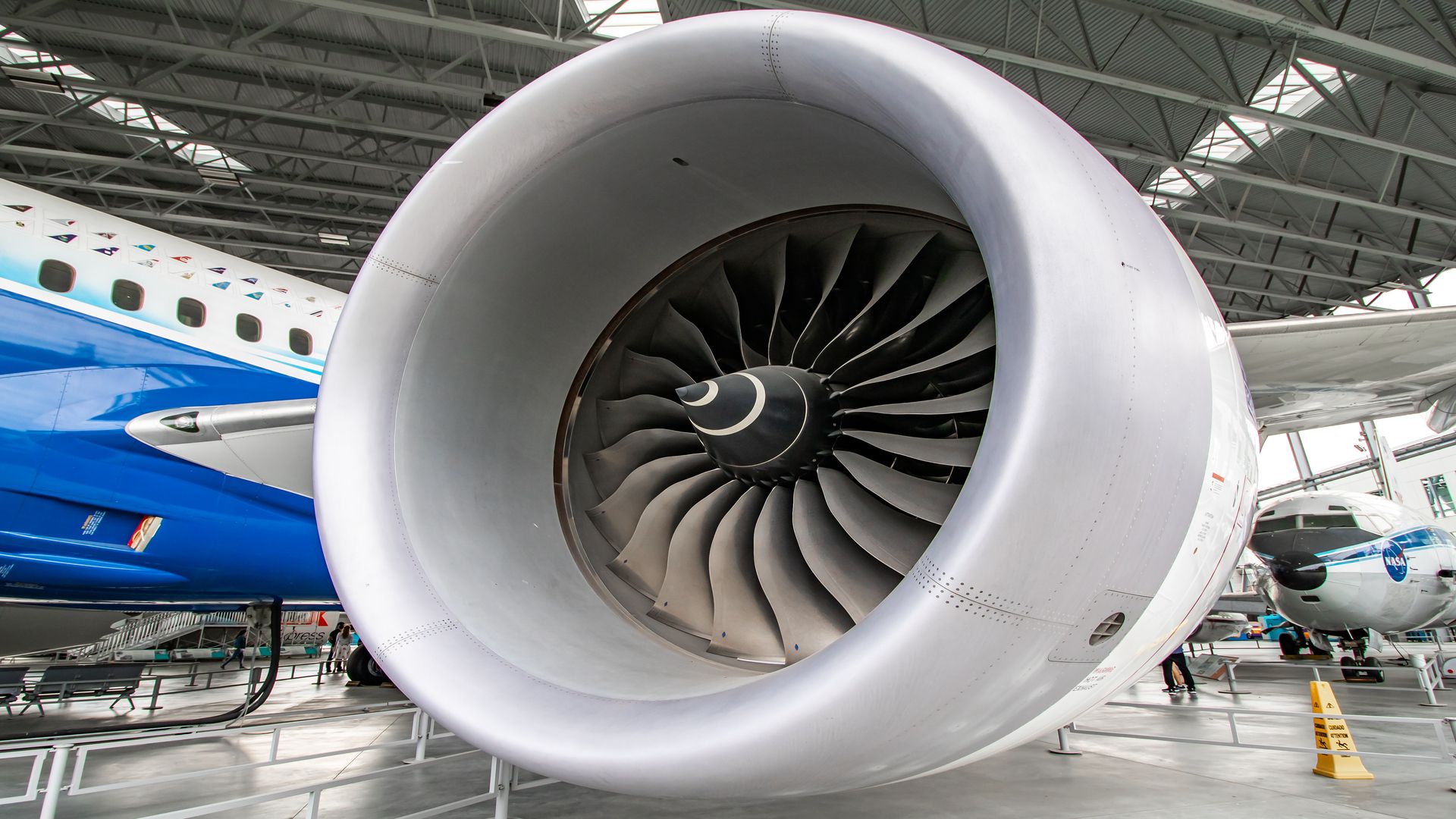
Jet engine manufacturer GE Aerospace continues to record higher profits amid increased demand for its commercial jet engines and services. The company saw increased revenue and orders during the third quarter and has raised its full-year guidance across several metrics.
With the industry facing aircraft delivery delays and supply chain constraints, GE Aerospace is seeing increased demand for maintenance services. Q3 also saw the manufacturer pick up several new orders, following significant orders for  Boeing aircraft, many of which are powered by GE engines.
Raising Forecasts For The Year

In the three months ending September 30, 2025, GE Aerospace’s adjusted revenue (non-GAAP) stood at $11.3 billion, a 26% increase from last year’s $8.9 billion. During the same period, it recorded an operating profit of $2.3 billion, up 26% from $1.8 billion in Q3 2024. Over the last nine months, the company has recorded revenue of $30.5 billion and an operating profit of $6.8 billion.
Given its strong year-to-date performance and trajectory entering Q4, the company has updated its full-year 2025 guidance yet again. Last quarter, GE advised that it expected operating profit to reach $8.2 – $8.5 billion, up from $7.8 – $8.2 billion. This has now been increased to $8.65 – $8.85 billion for the full year. At the end of Q2, revenue growth was expected to be in the +mid-teens, but this has been increased to +high teens. GE Aerospace Chairman and CEO H. Lawrence Culp, Jr. said,
“GE Aerospace delivered an exceptional quarter with revenue up 26%, EPS up 44%, and more than 130% free cash flow conversion. Given the strength of our year-to-date results and our expectations for the fourth quarter, we’re raising our full-year guidance across the board.”
More Demand For Engines And Services

GE Aerospace’s commercial products include the GEnX, which powers the Boeing 787 Dreamliner, GE9X (Boeing 777X), and CFM LEAP ( Airbus A320neo and Boeing 737 MAX). CFM is a joint venture between GE Aerospace and France’s Safran. While the company has a significant market share in commercial aviation, over 70% of its commercial engine revenue comes from parts and services.
With OEMs facing massive aircraft backlogs, partly due to engine delivery delays, many operators have been forced to delay the retirement of older aircraft to maintain capacity. The situation has benefited GE Aerospace, which makes a large share of its profits from high-margin, long-term contracts for parts and maintenance. During the quarter, services increased by 32%, partially offset by the timing of equipment orders. Meanwhile, internal shop visit revenue grew by 33% and spare parts revenue grew by over 25%.
GE’s Commercial Engines & Services (CES) wing saw revenue of $8.9 billion, up 27% year-on-year. Equipment revenue grew by 22%, with unit volume increasing by 33%. The revenue growth was influenced by a 35% increase in material input from priority suppliers and high-single-digits sequentially. In 2025, CES now expects revenue growth in the low twenties, growing from the prior guide of high-teens.
Increased Engine Deliveries And New Orders

In order to address supply chain bottlenecks, the manufacturer sent its engineers to work directly with its most critical suppliers. This has helped increase jet engine output. Deliveries were up 33% year-on-year, including record LEAP deliveries, which increased by 40%.
GE also secured new engine orders, as Korean Air selected GEnX, GE9X, and CFM LEAP-1B engines. In August, the carrier committed to a record purchase of 103 Boeing jets, including 25 787-10s, 20 777-9s, 50 737-10s, and eight 777-8 Freighters. Additionally, GE secured an order for 28 more GE9X from Cathay Pacific, taking the airline’s total commitment to 70.
Orders for the quarter totaled $10.3 billion, representing a 5% year-on-year increase. However, the value of orders decreased from $11.69 billion in the second quarter. Q2 saw massive orders from Qatar Airways after it placed a record order for Boeing jets, as well as a commitment from IAG Group after it ordered 71 aircraft in May.
