


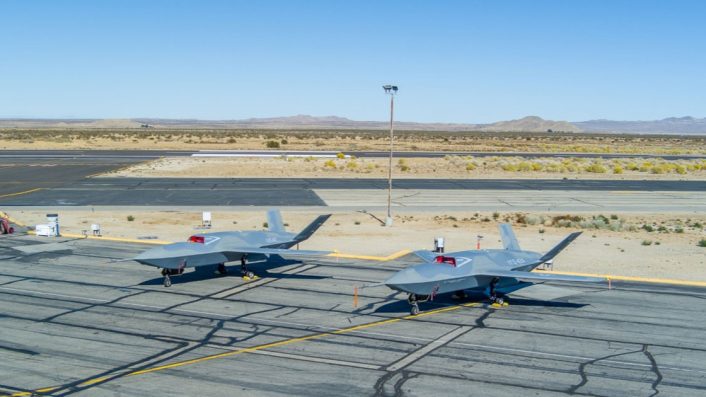
GA-ASI has flown a second YFQ-42A Collaborative Combat Aircraft, following the type’s first flight in August.
Two months after the type’s first flight on Aug. 27, 2025, General Atomics Aeronautical Systems revealed on Nov. 3 that it has flown a second YFQ-42A Collaborative Combat Aircraft (CCA). The company released photos of the second aircraft together with the announcement of the participation to the International Fighter Conference 2025.
The unveiling of the second YFQ-42 also comes few days after Anduril flown for the first time the YFQ-44A on Oct. 31, 2025. Following this milestone, both the U.S. Air Force’s new uncrewed fighters are now in flight testing as part of the Increment 1 of the CCA program.
“The YFQ-42A is a revolutionary aircraft, and the fleet is in production and in the air today,” said David R. Alexander, president of GA-ASI. “This isn’t a ‘wait and see’ moment. We’re flying. We’re delivering. And we’re advancing this future of combat aviation, the same way we have for more than three decades.”
The YFQ-42
The YFQ-42A is designed for semi-autonomous air-to-air operations and draws on the “genus-species” approach pioneered with the XQ-67A Off-Board Sensing Station (OBSS). GA-ASI says it leveraged advanced model-based digital engineering to accelerate the aircraft’s development while optimizing capabilities for future air dominance.
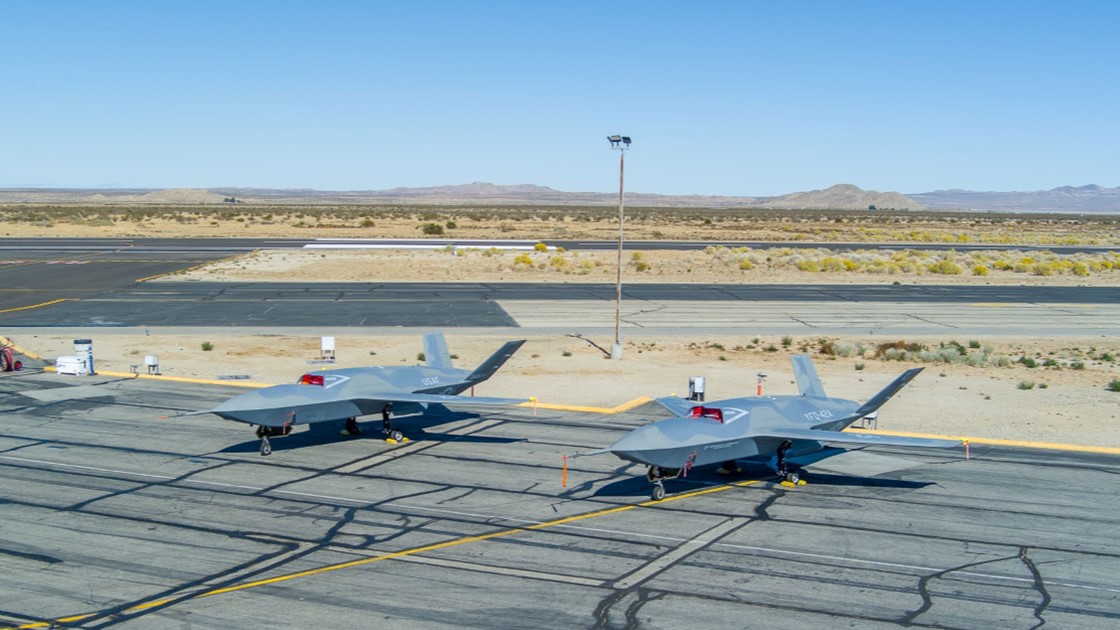
Compared to the XQ-67, the YFQ-42A features an engine air inlet with serrated edges, similar to the B-2 Spirit stealth bomber, as well as apparently slightly modified fuselage mold lines. The nose is also different, changing from the XQ-67’s ‘shovel’-like design to a more conventional one.
Differences can be seen in the wings’ design, with the YFQ-42 showing a higher sweep angle and a higher taper ratio, as well as a larger surface. The V-tails, although they have an angle similar to the XQ-67’s, appear to be shorter, with higher taper ratio and no clipped tips.
These design changes might be the result of attempts to reduce the airframe’s radar cross-section to match stealth requirements of the CCA program. Also, the modifications reflect the CCA’s requirements for speed and maneuverability.
Central to the program is the autonomy core that will make the YFQ-42 able to operate together with manned aircraft. The company says this core has been refined through more than five years of testing on the MQ-20 Avenger, which is also being used to test multiple autonomy agents for the Air Force.
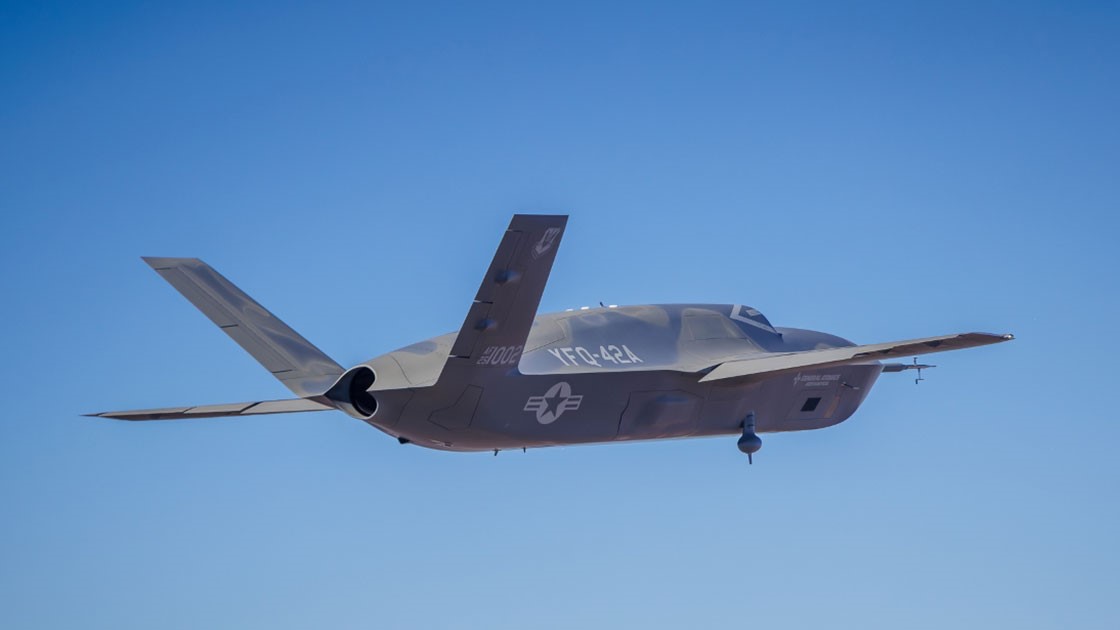
By combining a stealthy, air-to-air-focused design with this AI-driven autonomy, the YFQ-42A is intended to provide warfighters with an advantage in future combat scenarios. Originally intended to complement the Next Generation Air Dominance manned fighter, the Boeing F-47, the CCAs will also fly with the current 5th gen platforms, the F-22 Raptor and the F-35 Lightning II.
GA-ASI emphasized that the program is designed around scalability and affordability. The company is preparing for high-rate production that would support the Air Force’s stated goal of fielding more than 1,000 CCAs on an accelerated timeline.
The F-22 as “Threshold Platform” for CCA
According to a recent report by Aviation Week, the U.S. Air Force will initially pair CCAs only with the F-22 Raptor. In fact, the service mentioned in a report to Congress that the Raptor is the “threshold platform” for CCA, while integration with F-16s, F-35As, F-15Es and F-15EXs is being considered.
“America’s adversaries are countering U.S. air power with greater mass and a challenging air defense laydown that limits the United States’ ability to project combat power in traditional ways,” the report says. “CCAs allow for risk-tolerant aircraft at a lower price point and serve as a force multiplier.”
Aviation Week further mentioned that the report says CCAs “are expected to increase survivability of crewed aircraft, while expanding sensor coverage, carrying additional weapons, increasing capacity of combat aircraft, providing flexibility for different missions and providing a less costly option compared to crewed fighters.”
The Air Force is also continuing parallel testing with the XQ-58A Valkyrie unmanned aircraft to prepare for the introduction of CCAs. In fact, the service has recently demonstrated the ability to have multiple autonomous collaborative platforms (ACPs) flying alongside crewed fighter aircraft.
During an air combat training scenario at Eglin Air Force Base, Florida, the pilots of an F-16C Fighting Falcon and an F-15E Strike Eagle each controlled two XQ-58As. The test has been defined as “a major leap in human-machine teaming.”
The Air Force Research Laboratory (AFRL) also said the goal of the XQ-58’s integration into air combat scenarios is to reduce pilot workload while enhancing situational awareness and mission effectiveness. Moreover, “data from the recent flight demonstration will inform future development and deployment of semi-autonomous capabilities across the Department of Defense,” seemingly referring to the CCAs.
