


The demo will be conducted at GA-ASI’s Desert Horizon facility in California using a company-owned MQ-9B equipped with AEW&C systems supplied by Saab.
General Atomics Aeronautical Systems (GA-ASI) has announced that it will test the new podded Airborne Early Warning and Control (AEW&C) capability for the MQ-9B Remotely Piloted Aircraft (RPA) in collaboration with Saab in the summer of 2026. The announcement comes five months after the two companies first announced the work on the new system.
The GA-ASI MQ-9B equipped with a Saab-developed AEW&C pod will be tested at the former’s Desert Horizon flight operations facility in Southern California. The two companies also previously mentioned 2026 as the year the system would be operational.
GA-ASI’s MQ-9B #RPAS will demonstrate airborne early warning & control capability in summer 2026.
Read the news: https://t.co/jWVJ4WsTbB#AEWC #DubaiAirshow #DAS25 pic.twitter.com/7szKqjfZrZ
— General Atomics Aeronautical Systems, Inc (GA-ASI) (@GenAtomics_ASI) November 17, 2025
The introduction of an unmanned airborne radar surveillance comes amid a diminishing Western and NATO capability in that area. In fact, the increasing age of the E-3 AWACS, the cancellation of the E-7A Wedgetail for NATO and the slow development of its U.S. Air Force variant are prompting consideration of other alternatives, like space-based tracking and the E-2D Advanced Hawkeye, to bridge the gap.
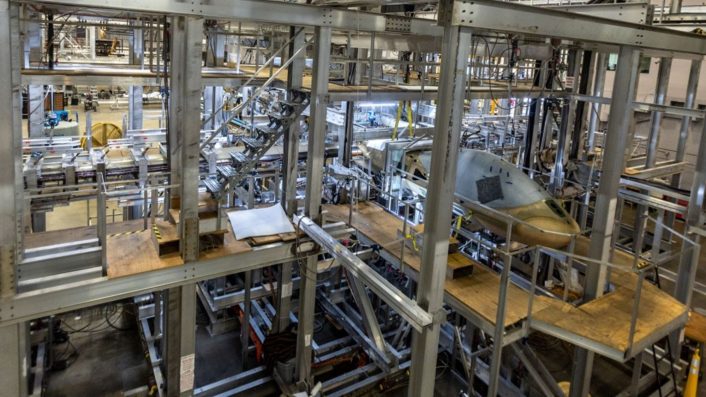
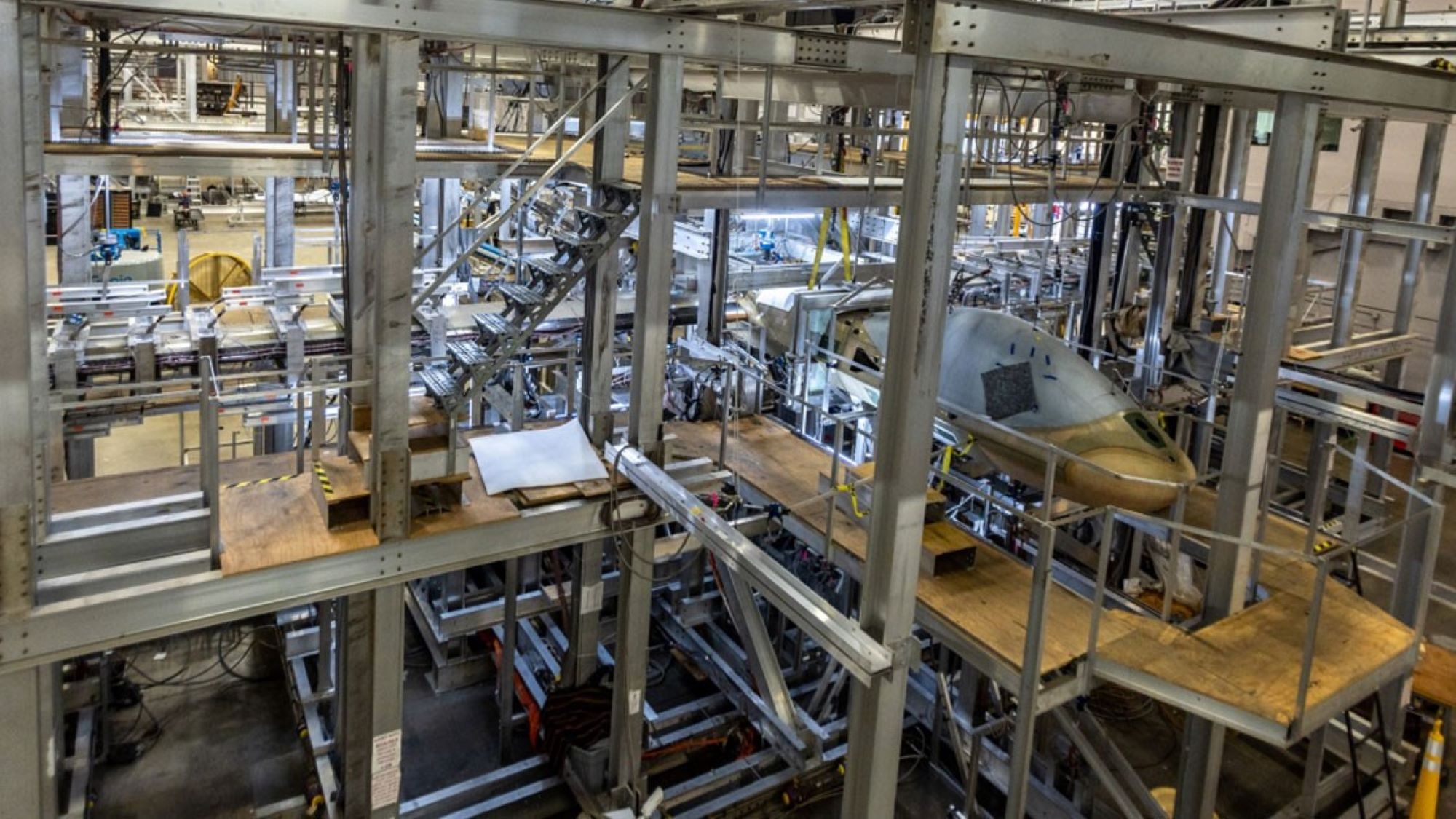
GA-ASI has also reiterated the reliability of the MQ-9B RPA platform ahead of the Dubai Air Show, announcing that on Oct. 31, 2025, it completed its “third lifetime” of full-scale fatigue (FSF) testing. The company says the “third and final lifetime” FSF testing included “120,000 operating hours (40,000+ flight hours per aircraft life)” and was a “key milestone in validating the design of the airframe.” The testing verifies the airframe structural integrity in support of certification to the NATO STANAG 4671 standard.
Interestingly, the announced future test of the MQ-9B podded AEW also comes on the day the Dubai Air Show opens, suggesting the capability is already being marketed internationally. More details might emerge on the interested customers, and what industrial partnerships GA-ASI and Saab offer to sweeten the deal for potential customers.
Affordable, persistent and effective surveillance
In the press release, GA-ASI said that pairing Saab’s AEW sensors with the MQ-9B, the “world’s longest-range, highest-endurance RPA,” would offer “persistent air surveillance […] at sea or over land.” This, in turn, would make AEW possible “in areas of the world where it doesn’t currently exist or is unaffordable, such as for navy aircraft carriers at sea.”
RELEASE: Saab and @GeneralAtomics develop unmanned airborne early warning solution. @GenAtomics_ASI will integrate Saab’s AEW sensors with their unmanned MQ-9B-platform. #defence #UAEW https://t.co/PryWrX0eQP
— Saab (@Saab) June 16, 2025
Notably, Saab is also the developer of the Erieye aerial AESA radar system, the main component of the GlobalEye AEW&C aircraft, and is also developing the Artificial Intelligence-based Arexis electronic warfare system that equips the Gripen E and, in future, the Eurofighter EK.
“The AEW solution for MQ-9B will offer critical aloft sensing to defend against tactical air munitions, guided missiles, drones, fighter and bomber aircraft, and other threats. Operational availability for a medium-altitude, long-endurance UAS is the highest of any military aircraft, and as an unmanned platform, its aircrews are not put into harm’s way,” explained GA-ASI in the press release. This highlights the specific use cases, tactical scenarios and theoretical concept behind the using unmanned AEW capability.
Integrating the system with fifth-generation fighters like the F-35 Lightning II used by U.S. and NATO air forces, Dassault Rafales, Eurofighter Typhoons and the future E-7A Wedgetail can make up a reliable airborne radar surveillance capability against modern threats.
MQ-9のAEWの成否はこのポッド無くしては…という感じだけど見込み立ってるのか https://t.co/x9b1GGPWTi pic.twitter.com/dPzd4byGlh
— ふるーす (@kleinenf) September 22, 2024
Capabilities
GA-ASI and Saab’s AEW will be enabled by a line-of-sight and SATCOM (Satellite Communications) control systems, offering “early detection and warning; long-range detection and tracking; and simultaneous target tracking and flexible combat system integration,” the release said.
“Adding AEW&C to the MQ-9B brings a critical new capability to our platform,” said GA-ASI President David R. Alexander. “We want to deliver a persistent AEW&C solution to our global operators that will protect them against sophisticated cruise missiles as well as simple but dangerous drone swarms.”
China has reportedly already introduced a similar capability with the AESA radar-equipped WZ-9 Divine Eagle drone, with Turkey aiming to have a similar capability with the Kizilelma and Akinci UCAVs. The cost-effective uncrewed AEW assets can unburden manned platforms, constrained by limitations of human endurance, airframe fatigue and maintenance.
Air Forces can enforce a significant air denial over certain sectors, or at least complicate adversary plans, both in defensive and offensive operations.
I don’t want to comment too much on range, but there’s one thing Aselsan and Baykar want to emphasize through the official video: Kızılelma locked onto a target well over 200km away with its Murad-100A AESA radar. Disregarding the target’s RCS, I can say that the Murad AESA and… https://t.co/RV3ayQP5TP pic.twitter.com/9NQUu7QfHA
— TR_tech (@T_Nblty) October 21, 2025
MQ-9 evolution
Systems-wise, the MQ-9 is experiencing a renewed evolution, with the UAS also being rapidly repurposed with podded equipment for other low-risk yet critical roles, such as ASW (Anti-Submarine Warfare), counter-drone missions, electromagnetic sensing and data/communications relay.
The podded AEW capability is also likely to head to the U.K. as its MoD was considering the MQ-9 for the Royal Navy’s Carrier Strike Airborne Early Warning requirement, replacing the Merlin HM2 Airborne Surveillance and Control aircraft. As we had reported previously, and GA-ASI mentioned explicitly in its latest press release, the new capability will also encompass RPAs across the MQ-9 series – the SkyGuardian, SeaGuardian, the United Kingdom’s Protector RG1, and the new MQ-9B STOL (Short Take-Off Landing).
The “STOL mission kit” GA-ASI was testing in a wind tunnel for the MQ-9B SeaGuardian and SkyGuardian RPAs would support the carrier-borne and general unmanned AEW, C-UAS and possibly communications, data-relay and ISR/targeting roles from short-runways and naval assets. We analyzed that the STOL kit could be a rapidly strappable system for the existing MQ-9Bs, while the Gray Eagle’s C-UAS test might have served to quickly prove its STOL wing before its kitted form is tested on the MQ-9B for carrier operations.
