


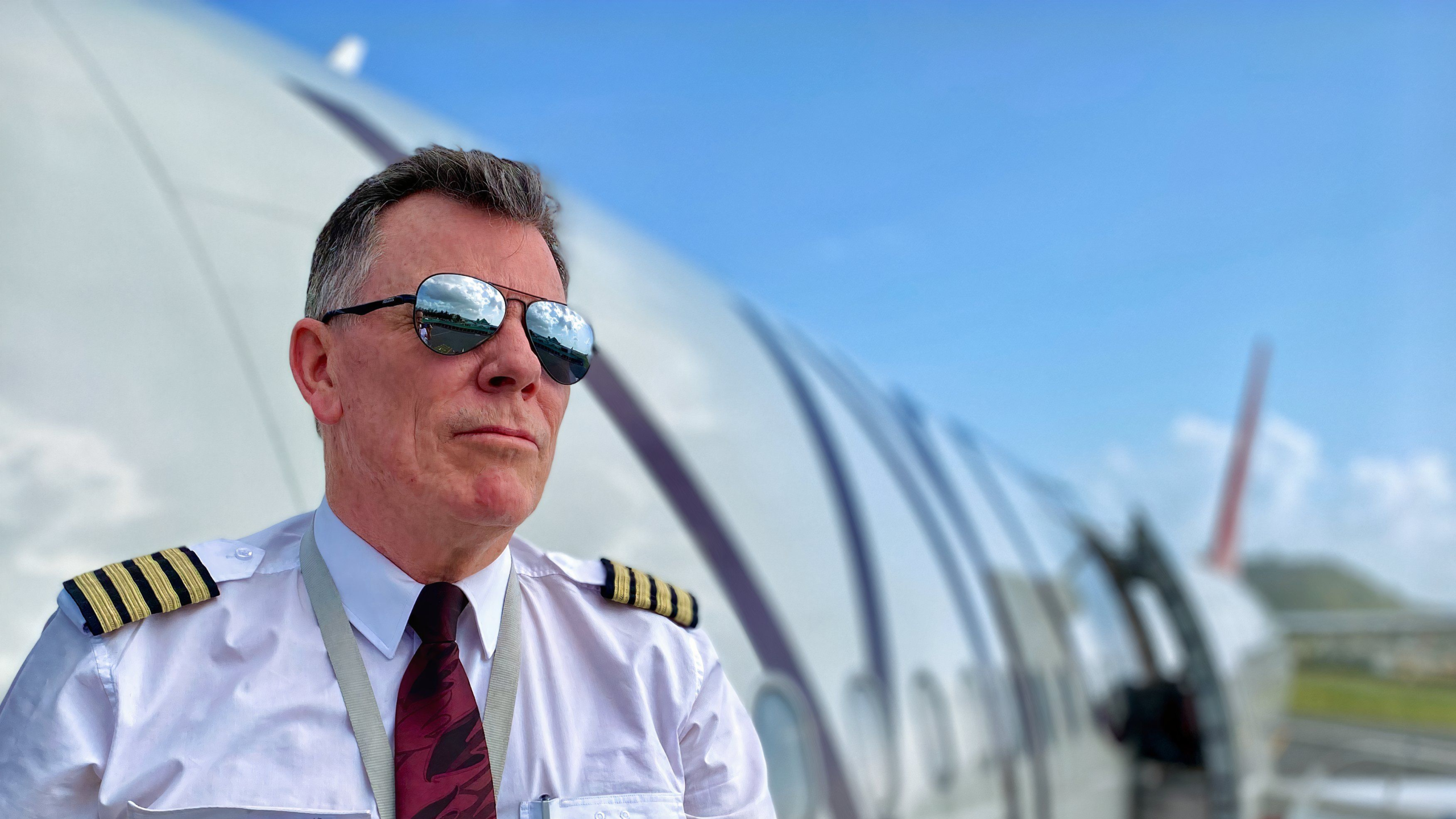
I’ve been a fan of Simple Flying since the pandemic, relying on their website and app to keep me up to date with aviation news. I’ve also had the pleasure of meeting some of the team at airshows around the world and joining a couple of their podcasts. So, when they asked me to write a regular column, I was delighted. We agreed the best place to start was for me to introduce myself and then share stories from my career as an international airline captain. Like many pilots, my journey began with one life-changing moment.
A Childhood Dream

I was born and raised in Melbourne, Australia, the eldest of four children. My dad worked as a builder, and although money was tight, when I was 12, my parents planned a family trip to Queensland to visit relatives. It was my very first flight, on a Trans-Australian Airways (TAA) Boeing 727.
Before boarding, my father asked the hostess (as they were known in the 70s) if I could see the cockpit. She said, “Yes, come this way.” Two uniformed pilots sat with their backs to us, hands darting across switches and knobs, while a third pilot at a side panel turned, smiled, and welcomed us. He paused the captain and first officer to say hello, as my dad proudly explained that this was my very first flight.
Then came the question that would change everything: would I like to stay in the cockpit for takeoff? I didn’t fully grasp what that meant, but my dad’s beaming face told me it was something special. I was strapped into a seat behind the captain, and suddenly I was about to witness the magic of lifting a giant metal machine into the sky.
Sitting In The Cockpit

Once the cabin and cockpit doors closed, the atmosphere changed. The outside noise dimmed, and through the headset the engineer handed me, I could hear the calm voices of the pilots and the control tower. He patiently explained the engine start sequence, pointing out gauges as lights flickered and needles came alive. He mentioned how quiet it seemed, since the three engines sat far behind us, muffled by layers of insulation.
Then the beast awoke. Fuel and oil smells mingled with the thrum of hydraulics and the rising whine of the engines as we taxied to the runway. “Clear for takeoff!” crackled in my headset. The engineer advanced the tall thrust levers, the captain resting his hand on top. The whine rose to a thunderous scream, and the 727 surged forward, slowly at first, then with unstoppable force. The runway stretched endlessly ahead until, at breathtaking speed, I heard the command: “Rotate.” The Captain eased back on the control column and, in an instant, we were flying. Houses and fields fell away beneath us as the roar softened into the distance.
When the checks were complete and the autopilot engaged, the three men finally turned to me. “So, how did you like that?” they asked. I sat stunned, mouth open, until I managed an excited “Wow.” Then, almost without thinking, I blurted, “Can I be a pilot?” The captain looked me in the eye and said the words that would shape my entire life: “Yes, of course you can.”
That single sentence set my course.
The Long Road to the Cockpit

Back home, I set about earning money for flying lessons; delivering newspapers, stacking supermarket shelves, pushing trolleys, and even working on building sites. By the time I finished school at 18, I had saved half the cost of an integrated flight training program in Cessnock, New South Wales. With help from my parents and uncle to secure a loan, I became a commercial pilot in 1982.
Australia’s airlines, Qantas, TAA, and Ansett, required 3,000 hours before considering new pilots, so I spent four years flying anything I could: instructing at Moorabbin, towing targets for the Navy, running charters for news crews, even repatriating the deceased for a funeral company. I flew nearly every GA aircraft made by Cessna, Piper, Beechcraft, and many more, including the notoriously tricky Mitsubishi MU-2 on night freight runs.
Eventually, both Qantas and Ansett interviewed me. Qantas offered a second officer role on the Boeing 747, but upgrades to first officer took more than a decade. Ansett, by contrast, offered me the right-hand seat of the Fokker F-27 straight away. I chose Ansett and, in 1989, also became one of their first Airbus A320 pilots, an assignment that began my long association with Airbus aircraft. Unfortunately, that same year, a national industrial dispute grounded Ansett and TAA. More than 1,600 pilots, including me, resigned. Many of us left Australia, never to return.
Building a Career Abroad

After converting my license in the UK (while working as an aircraft cleaner at Gatwick to pay the bills), I began flying the Fokker 100 with Air Europe. When the airline collapsed six months later, I took short contracts with KLM and Swissair, then flew the A320 for Eurocypria in Cyprus and Air Lanka in Colombo. In 1994, while still with Air Lanka, I heard Virgin Atlantic was acquiring new Airbus A340s. I called the chief pilot from Colombo, interviewed the same week, and soon found myself at Airbus’s training facility in Miami. That was the start of a career with Virgin Atlantic that continues to this day.
Life as a Long-Haul Captain

I gained my first command in 1994 at the age of 30, flying the Airbus A340-300. That put me in the left seat of a long-haul jet years before I would have touched the controls with Qantas. Since then, I’ve flown the A330, A340, and now the A350-1000. For more than 25 years, I’ve also been a training captain and examiner, helping shape new generations of pilots.
Over 44 years, I’ve logged more than 27,000 flight hours and thousands of hours in full-flight simulators. The job has taken me around the world many times, but the thrill of flying never fades.
Sharing the Journey
During the pandemic, with much of aviation grounded, my daughter helped me set up my Instagram account, @captainchris. My goal was to promote positivity, encourage the public to support airlines, and inspire both colleagues and future aviators. To my surprise, it grew to more than half a million followers. I continue to post daily to educate, inform, and entertain fellow Avgeeks.
What’s Next?

That brings me here, writing for Simple Flying. My question to you, the readers, is this: What would you like me to write about?
• How to become a pilot?
• The lifestyle of long-haul flying?
• Technical explanations of the aircraft I fly?
• What causes turbulence, and how do we deal with it?
I’ll draw on four decades in the cockpit to share insights, stories, and hopefully some inspiration. After all, one sentence from a Captain on a 727 changed my life —maybe something I write here can spark someone else’s journey too.
