


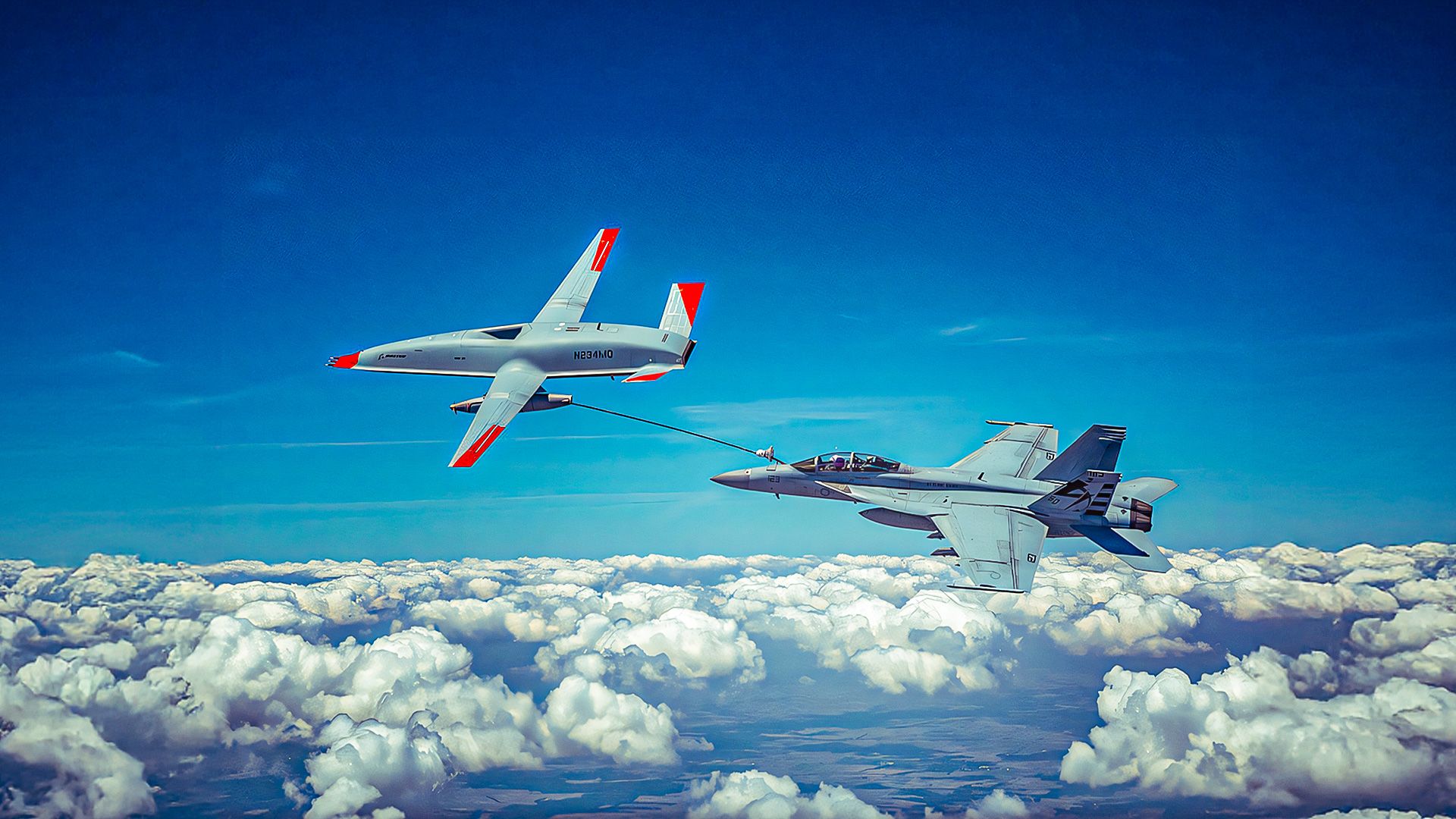
The US Navy is rushing the development and integration of the new Boeing MQ-25A Stingray tanker drone. As with Air Force counterparts, this humble tanker could take its place as one of the most important aircraft onboard the service’s aircraft carriers. Without fuel, even the most advanced fighter jet is little more than debris crashing into the sea.
As the US Navy is now focused on countering China in the Asia-Pacific, its requirements have also shifted. The US Navy lacks a modern, manned deep-strike option, and this is proving to be a problem that will not be fixed for a long time. The F/A-18 Super Hornet is a great aircraft, but it is limited in range. The F-35C is the world’s most advanced fighter jet, but it can’t operate from many carriers, its engines can overheat the flight deck, and its range is still limited, even though it has a longer range than the Super Hornet.
Getting Back To Basics

It is often said, “amateurs study tactics, experts study logistics.” In fighter jets, one key logistics challenge is ensuring fuel is reliably supplied. This is often more impactful than studying a fighter jet’s maximum Mach number or its supermaneuverability. While almost every military in the world is designed for defense, the United States’ military is designed for power projection. This is represented in the fact that the United States possesses around 75% of the world’s aerial tanker fleet.
During Operation Midnight Hammer against Iran, the United States used more tanker aircraft than any other country in the world is believed to possess. The operation once again underscored the Air Force’s ability to project power in many far-flung corners of the globe, something no other air force is capable of. By contrast, other nations, like Russia, have almost no ability to project power beyond a couple of hundred miles from their borders.
When it comes to the US Navy, the Navy can reduce range by sailing its ships right off the coast. But this soon runs into limitations. One limitation is if the target is deep inside the mainland, while another is if a hostile nation can contest the littoral waters, forcing the Navy to pull farther from the coast. This opens up more ranges that unrefueled fighter jets soon struggle with. Fighter jets have very limited combat ranges once they carry heavy payloads and are forced to fly in combat conditions, avoiding radar and the like.
The Navy’s Post-F-14 Tomcat Range Gap

The retirement of the venerable F-14 Tomcat in 2006 left a gaping hole in the Navy’s capabilities. Since then, the Navy’s carriers have lacked a true manned deep strike capability. The Super Hornet is the backbone of the Navy’s tactical fleet, but its range is limited. With a full load and without tanker support, it struggles to hit targets past 250 miles. Meanwhile, China’s land-based A2/AD missiles could threaten carriers from around 1,500 miles.
The F-35C has a somewhat longer range, but the problem remains. The F-35C is also limited by numbers, and which aircraft carriers are certified to operate it. To help address this, the Navy is prioritizing the development of the sixth-generation F/A-XX, which will increase range by about 25%. The Navy is also exploring other ways to extend the range of existing jets.
|
Select US Navy aircraft current/planned numbers |
|
|---|---|
|
MQ-25 Stingray |
76 (67 operational) |
|
F-35C Lighting II |
273 (program of record) |
|
F/A-18 Super Hornet |
Approx. 670 (in service + on order) |
|
EA-18G Growler |
153 |
|
F/A-XX |
Not publicly disclosed |
Making matters worse, the Navy had a carrier-based tanker, namely the KA-6D variant of the Grumman A-6 Intruder. But this, too, has been retired without a direct replacement. Today, the Super Hornet’s carrier-based refueling options are limited, although they can refuel from other Super Hornets. Modified CV-22 Ospreys are another refueling option. But the Navy needs a dedicated new tanker, and for that, it is pinning hopes on the upcoming MQ-25 Stingray.
Navy Aiming For 2026 Entry Date For MQ-25A Stingray
According to Boeing, the MQ-25 Stingray will be able to perform intelligence, surveillance, and reconnaissance (ISR) missions in addition to its core aerial refueling mission. Currently, the Navy is planning for the aircraft to first enter service in FY 2026 with initial operating capability in 2027. It will be the Navy’s first unmanned tanker and the Navy’s first carrier-based drone. It is planning to purchase three Stingrays in FY 2026.
Not only will the Stingray increase the range of tactical fighter jets, but it will also relieve strain on Super Hornets’ buddy refueling. This will free more Super Hornets up for other roles and reduce wear and tear on their airframes. The Navy has a program of record to purchase 76 Stingrays, including 67 operational examples and nine test and development aircraft.
|
Key Boeing MQ-25 Stingray dates |
|
|---|---|
|
2018 |
Contract awarded to Boeing |
|
2019 |
First flight |
|
2021 |
First refueling & flight from carrier |
|
2024 |
First representative example delivered |
|
2026 |
Planned service |
|
2027 |
Planned initial optional capability |
The Navy requested $1.04 billion in discretionary procurement and research, development, test, and evaluation funding for the program in 2026. For reference, a billion dollars is enough to purchase around ten new F-35s at flyaway cost. Development of the MQ-25 has taken time. It first flew in 2019, successfully refueled a Navy E-2D Hawkeye in September 2021, and completed its first carrier tests in December 2021.
Helping Navy’s Fighter Jets Go The Distance

With a per-unit cost of $161.51 million each, the first three MQ-25s cost more than F-35s. Boeing announced its delivery of the first of the nine pre-production Stingrays to the Navy in 2024. Of these nine aircraft, five will be used for fatigue and other static testing, and the other four will be System Demonstration Test Articles.
When Boeing first won the contract in 2018, the tanker was planned to enter service in 2024, but this has been delayed multiple times. Once they enter service, the Stingrays will extend the range of the deployed F/A-18 Super Hornets, EA-18G Growlers, F-35C Lightning IIs, and, eventually, F/A-XX fighter jets.
Rolls-Royce’s AE 3007 engine has been selected for the Stingray. This is the same engine that powers the Air Force’s RQ-4 Global Hawk and the Navy’s MQ-4C Triton. It also powers commercial aircraft like the Embraer ERJ family and the Cessna Citation X. The engine was first run in 1991, with over 3,400 being produced.
One Of The Navy’s Key Priorities

In January 2025, The War Zone reported on the key priorities that the US Navy laid out at the WEST 2025 conference. These priorities centered on ensuring the Navy could emerge victorious in a high-end fight in the Pacific. The centerpiece of those efforts was the MQ-25 Stingray, which would help the service achieve critical range extension and persistence in its other aircraft.
The War Zone reported the head of the Strike Aircraft and Weapons Branch as saying, “I want to pivot to the MQ-25 because it’s the nearest, most important capability that we’re going to field to extend the range and the persistence of the carrier air wing.” Another priority was new long-range weapons and advanced platforms capable of penetrating deeply into heavily defended enemy air defenses. The Navy also wants robust networks to support the kill chains that underpin these things happening.
For the F-35 (or any jet) to be effective, it must have fuel. Already, the Navy is considering expanding strike ranges, which will decrease sortie rates, but keeping the aircraft refueled is the most pressing concern. At WEST 2025, the Navy did not explicitly mention rumors that the MQ-25 or future variants could also be used as a carrier-based standoff strike aircraft.
The Evolving Game Of Great Power Competition

With 67 operational MQ-25s in its eventual fleet, the advanced tanker drone may emerge as one of the Navy’s most critical enablers. Fighter jets are only one piece of a much larger jigsaw puzzle, alongside a wide range of assets working in tandem. To be effective, fighter jets need electronic warfare (such as the EA-18G Growler), radar aircraft (such as the E-2D Hawkeye), space-based assets (such as satellites), tankers (such as the Stingray), and more.
As previously mentioned, fighter jets with longer ranges also help keep the Navy’s aircraft carriers safer, enabling them to operate further out to sea away from threats. In the era of Great Power Competition, China is also adapting to exploit weaknesses in the Navy and Air Force. It has focused on developing missiles to destroy aircraft on the ground, “carrier killer” missiles to force aircraft carriers further out, and its new 5th- and 6th-generation fighter jets are designed with the range to threaten tankers.
With this in mind, it is not so crucial if the J-20 is inferior to the F-35 in an air superiority role. The same result of defeating the F-35 can be achieved by targeting airfields, pushing carriers away, and threatening tankers. Separately, the Air Force is seeking to address this tanker vulnerability by developing a stealthy (possibly autonomous) tanker called the NGAS.
