



The Navy has launched a Programmed Structural Sustainment Repair program for the dozens of F-16s acquired from the Air Force, which will allow them to fly through 2035.
The U.S. Naval Air Systems Command (NAVAIR) announced last week two major milestones with its ex-U.S. Air Force F-16 jets used in the Adversary role. The Adversary and Specialized Aircraft Program Office (PMA-226) and Fleet Readiness Center Southwest (FRCSW) said they completed the “first-ever Programmed Structural Sustainment Repair (PSSR)” on a U.S. Navy F-16C Viper this month, delivering the aircraft “eight months early.”
This milestone followed FRCSW and PMA-226 setting up a new maintenance program for the Navy’s F-16 Vipers. The vital depot-level facility, providing PSSR capabilities to the aircraft, was launched in “an unprecedented 18-month timeline,” instead of the average five years usually necessary for this activity.
U.S. Navy F-16s
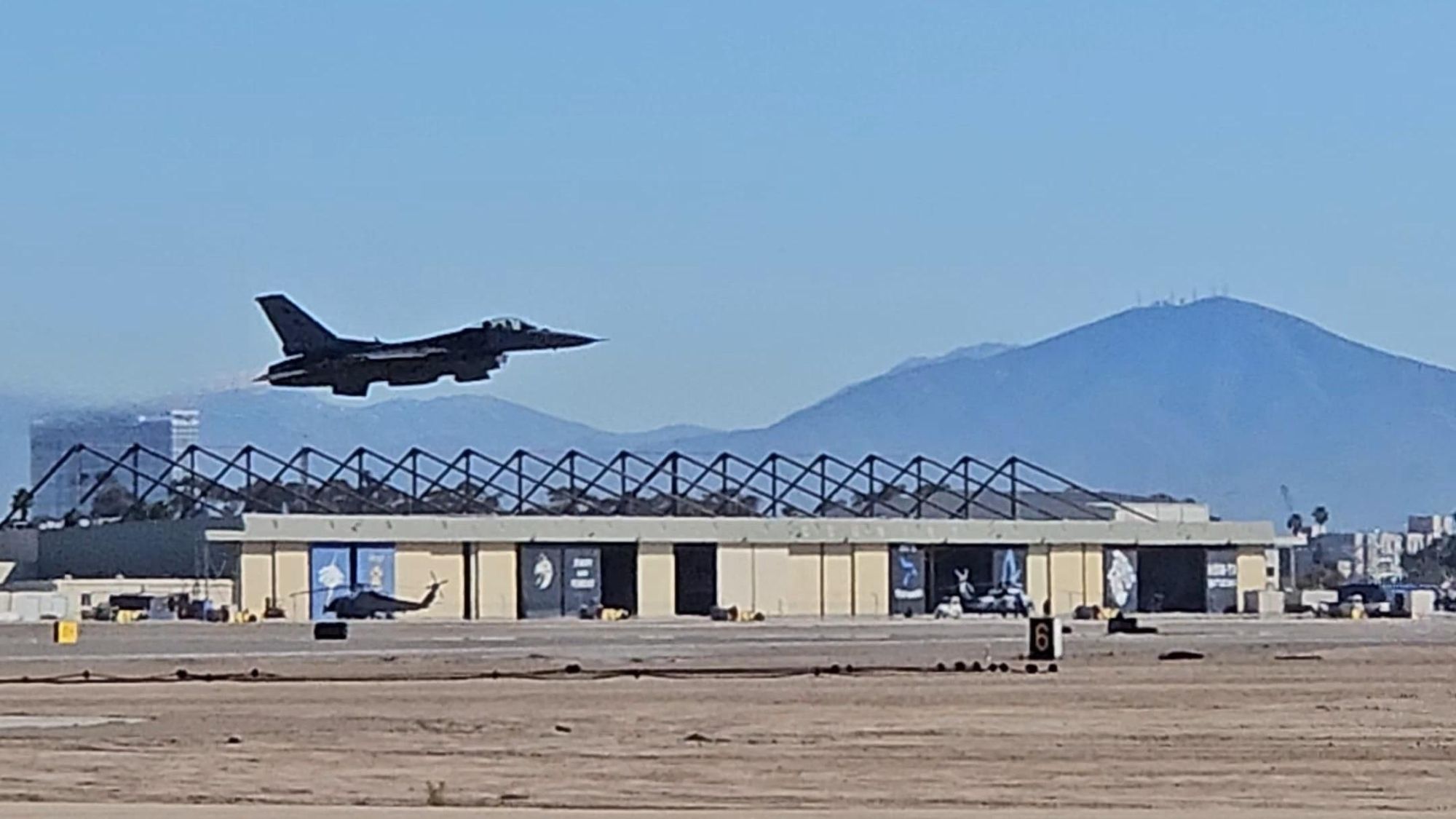
The Navy operates retired U.S. Air Force F-16A/B fighters since the 2000s, and later received its first F-16C/D fighters in 2022. They replaced F-5N Tiger IIs of the Fleet Composite Squadron (VFC) 13 “Fighting Saints” at Naval Air Station (NAS) Fallon, Nevada, that received 20 single-seat Block 32 F-16Cs and six two-seat Block 25 F-16Ds from the USAF. The USAF was retiring them in line with a divestment scheme to phase out 124 F-16s by 2026.
The Navy describes adversary aircraft in its budget documents saying they provide “essential sorties” in support of the U.S. Navy Strike Fighter Tactics Instructor (SFTI) course (TOPGUN) – previously known as Fighter Weapons School and the Naval Strike and Air Warfare Center (TOPGUN) at NAS Fallon, as well as Fleet Replacement Squadrons and Carrier Strike Groups.
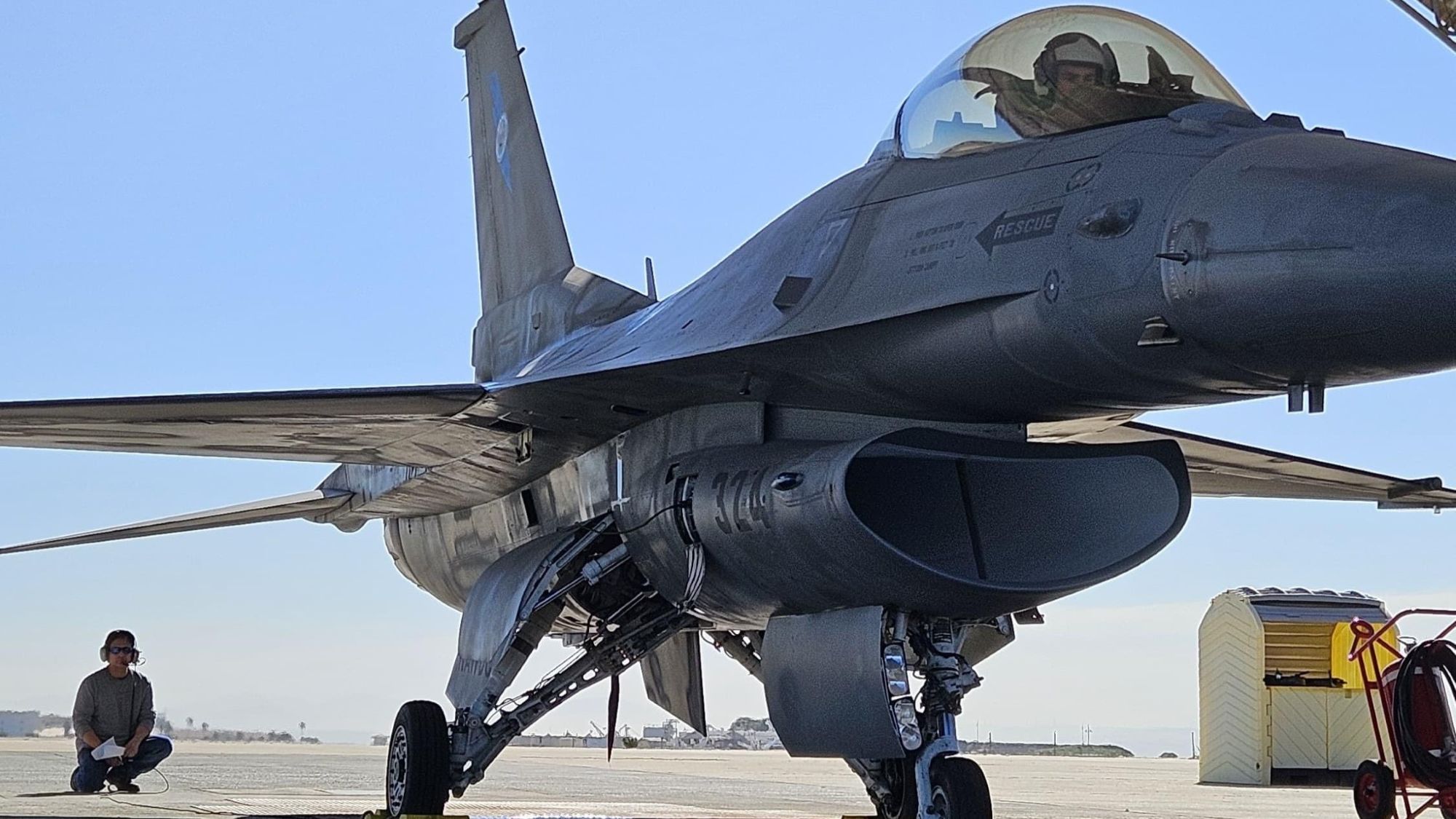
“The F-16 plays a vital role in the Navy’s inventory, serving as a cost-effective, 4+ generation adversary aircraft for training operational pilots,” says NAVAIR. “The jets are flown by the Naval Aviation Warfighting Development Center (NAWDC) and Air Force Reserve components to simulate modern threats during deployment training and TOPGUN activities for naval aviators.”
The service plans to use both the F-5s and the F-16s in their Adversary mission through 2035.
PSSR on U.S. Navy F-16C Viper
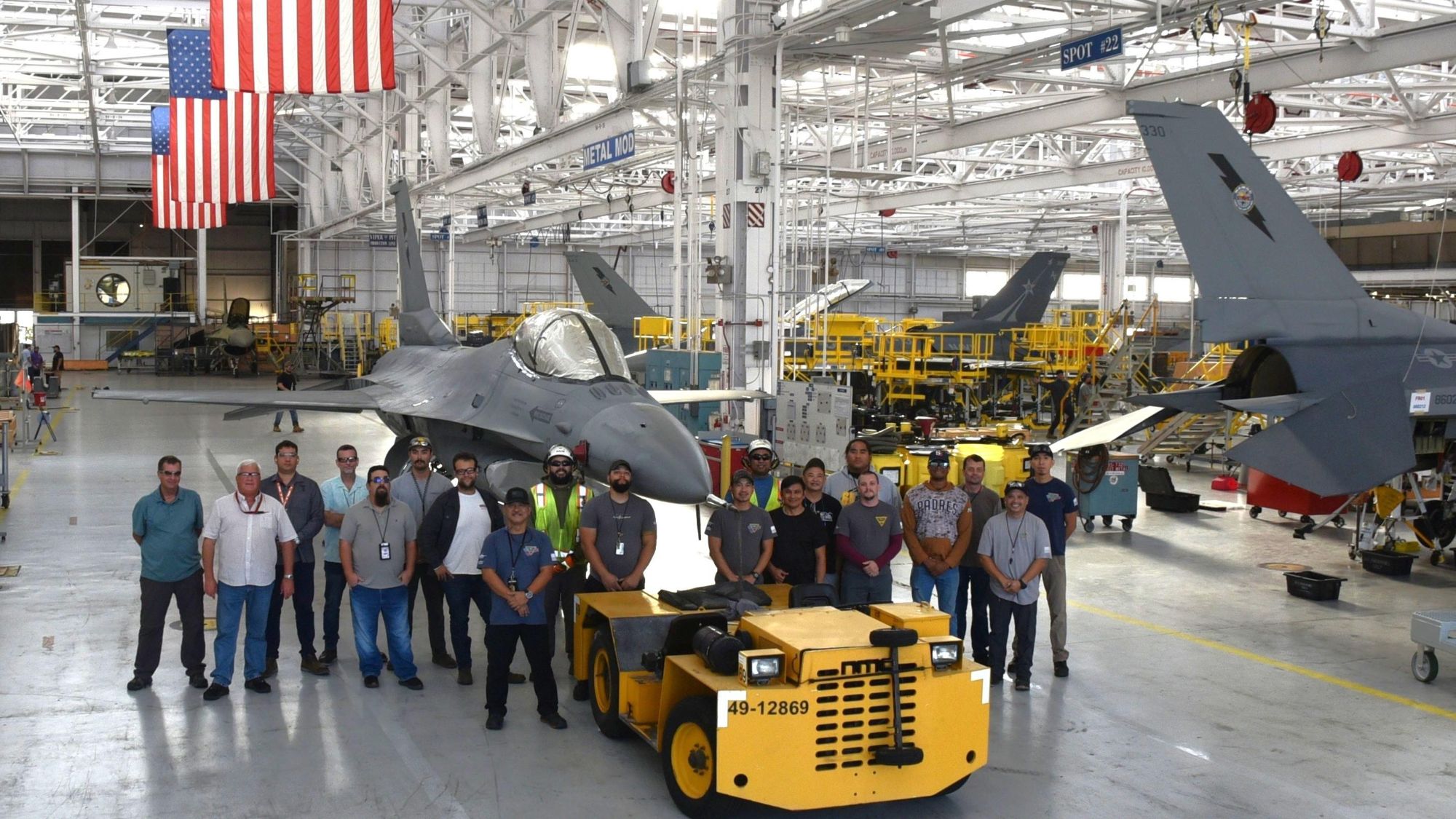
According to PMA-226 and FRCSW, the first PSSR on the F-16 was completed eight months ahead of schedule, demonstrating the “ability to deliver critical capabilities to the fleet with unprecedented speed and precision.” Program manager for PMA-226, Capt. Jason Pettitt, said the strategic collaboration between FRCSW and PMA-226 saw both teams working tirelessly to “procure, train and install the necessary equipment to stand up the F-16 PSSR capability in just 18 months – an unprecedented pace for depot line activation.”
The need for this kind of work sparked from the fact that “F-16s acquired from the Air Force were life-limited between one to five years,” says NAVAIR. The Navy thus needs to ensure that these aircraft “continue to safely operate for decades as an adversary training aircraft.”
The collaborative effort between PMA-226 and FRCSW “focused on performing essential structures inspections and repairs,” explained the service. Mark Greenamyer, the F-16 Depot Integration lead with PMA-226, said: “Bringing a new aircraft into a military depot in 18 months is an amazing achievement. Most depot standup activities can take five years or more.”
Challenges included adapting to Air Force technical data in the Navy, “manually adding thousands of parts to the Navy supply system, and training personnel on a new platform,” while setting up a new depot for the new platform. Greenamyer said the first aircraft induction was used as a learning opportunity for “processes, calculating timelines and training artisans,” adding that cross-service collaboration with the Air Force’s PSSR process helped “avoid potential pitfalls and streamline their own planning efforts.”
The NAVAIR release further said that the FRCSW is now expanding its capacity to support the entire fleet of aircraft with additional docks. It is also “working on its first Canopy Sil Longeron (CSL) repair and is scheduled to apply the first Uniform Have Glass (UHG) paint application.”
New depot program for Navy F-16 maintenance
FRCSW and PMA-226 also talked about the overall maintenance program for the U.S. Navy’s F-16 Viper aircraft, the PSSR, which is similar to the Navy’s F/A-18 High Flight Hour Inspection. The effort required the procurement of new equipment, the design and installation of specialized tools, and devising training programs.
The service says a standout achievement was the “rapid adaptation of legacy F/A-18 equipment for F-16 use, notably the wing removal and installation stands.”
“Using legacy F/A-18 inner wing stands, the team was able to adapt these tools to the F-16, working with engineers to ensure safety and structural integrity,” explained NAVAIR. “The result was a new process that allowed for a more efficient, cost-effective means of servicing the aircraft.”
For instance, the service mentioned that, when unable to source critical bolts through the Navy’s supply system, the team refurbished old bolts and got engineers to approve them for “continued usage in the maintenance process.” Jake Weintraub, FRCSW’s lead engineer for the F-16 program, certified the changes and engineering modifications, including the introduction of the first Local Engineering Specification (LES) from the U.S. Navy on the F-16.
A LES provides detailed, specific technical requirements for maintenance, repair, and engineering support at the local levels of Naval Air Stations or the Fleet Readiness Centers. The Depot also partnered with personnel from Hill Air Force Base (AFB), Utah, who provided valuable training on F-16 systems. This training began when PMA-226 was able to procure a trainer aircraft and sent it to FRCSW for a familiarization effort.
Personnel from Hill AFB then provided hands-on training sessions on wing removal and installation, tire and wheel servicing, and other basic maintenance tasks. Lockheed Martin meanwhile provided guidance on “radar-absorbent coatings and other structural repairs.”
U.S. Navy Adversary F-16 procurement and modernization
The service aims to have more F-16s, including Block 40 and above, for its own aggressor (AGR) squadrons. The U.S. Navy’s Fiscal Year 2022 budget document said 20 single-seat Block 32 F-16Cs and six two-seat Block 25 F-16Ds were being transferred to the Navy at the time.
Dark Falcon! One of the 20 F-16C Block 32s transferred from the USAF to the US Navy’s VFC-13, “Fighting Saints,” composite squadron based at NAS Fallon. TopGun’s red star aggressors. pic.twitter.com/1vbsIMTtHI
— Air Power (@RealAirPower1) October 21, 2024
The U.S. Navy’s FY 2026 budget document has calculated $21.53 million to support Adversary aircraft. These include 42 F-5 Tiger IIs (39 F-5Ns and three F-5Fs) with maintenance for its J-85 engines, as well as 14 F-16 Block 15s (10 F-16As and four F-16Bs) and the maintenance support for its F-100 engine.
The document added that an additional 22 F-5s (16 F-5Es and 6 F-5Fs) were procured in 2020 from the Swiss government and were slated to be upgraded to the USN/USMC NATOPS configuration. It then referred to the 26 F-16s (20 F-16Cs Block 32 and six F-16Ds Block 25) that were transferred since April 2022 from the United States Air Force/Air National Guard.
“These aircraft will be upgraded to maintain common configuration with the USAF program,” said the document. “Adversary Missions Systems will provide peer threat replication and support future integration of Live, Virtual, and Constructive (LVC) capabilities.”
A #USNavy TopGun F-16B at NAS Fallon (Circa 2007). Did you know that this particular F-16 was actually meant for Pakistan? Back in the 80s, Pakistan placed an order for 111 F-16A/Bs. However, 71 of these jets were embargoed by the US due to Pakistan’s nuclear program. pic.twitter.com/Zj3BhqNM6f
— Air Power (@RealAirPower1) October 15, 2024
The document also lists a total request of $13.5 million for the Service Life Extension Program (SLEP) and mission systems upgrades for the Adversary F-16A/B fleet. This includes the legacy Falcon Structural Augmentation Roadmap (STAR) and additional structural modifications “to extend the service life of the current Adversary F-16 fleet from 4,250 flight hours to 8,000 equivalent flight hours.”
The systems work meanwhile comprises depot and field team-level work of “avionics and radar upgrades to maintain a common configuration with the USAF F-16 program.”
