


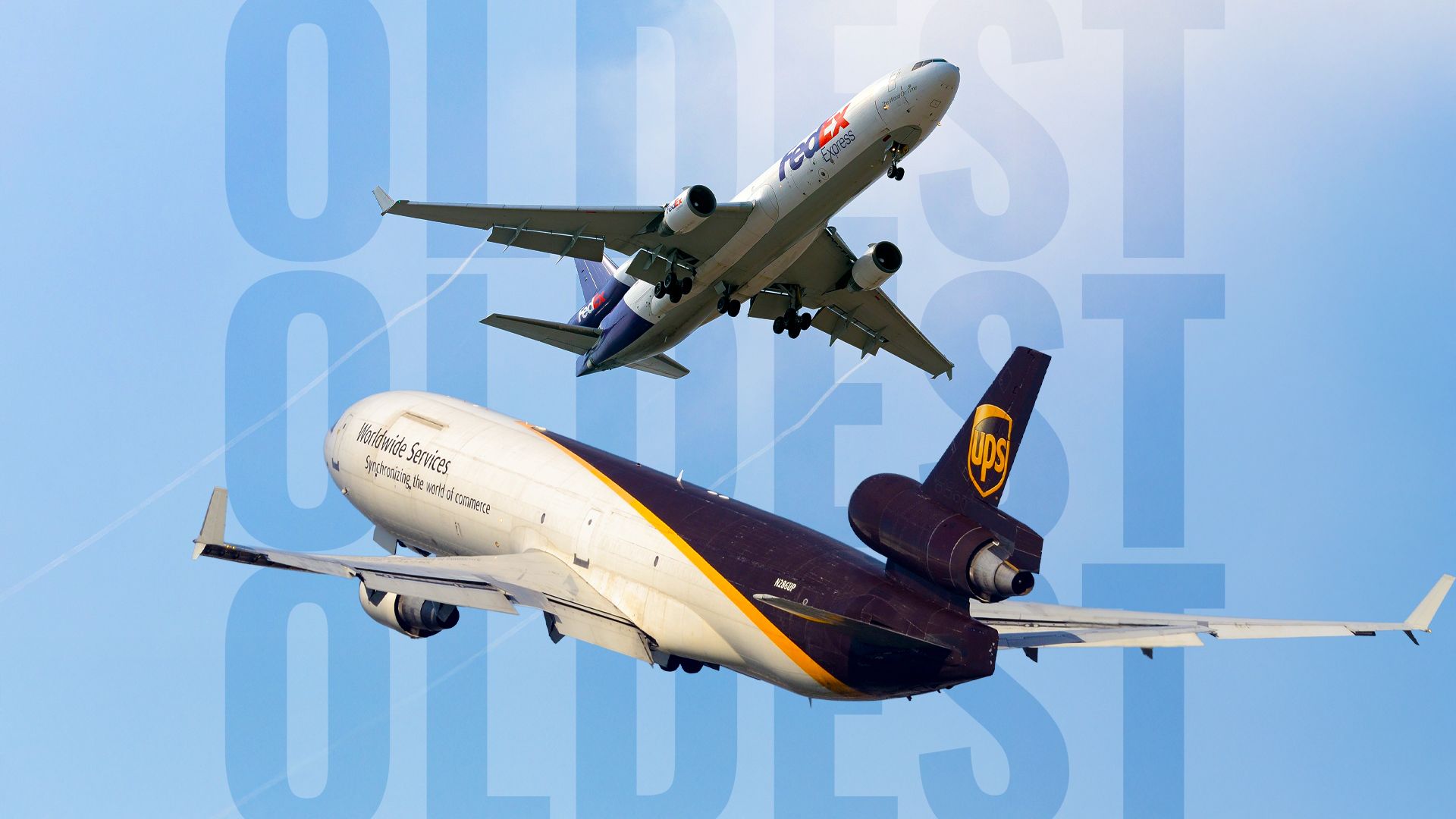
Many of you know that the average age of the global commercial aircraft fleet has been increasing in recent years. It now sits at around 14.8 years as manufacturers face persistent supply chain challenges and struggle to meet delivery schedules. According to the European Union Aviation Safety Agency (EASA), passenger jets are typically retired between 25 and 30 years of age, whereas freighters can remain active for 30 to 40 years.
This explains why aircraft such as the Airbus A300, McDonnell Douglas MD-10, and MD-11 remain in service with cargo operators even though they disappeared from passenger service years ago. Some commercial airlines, including Delta Air Lines, still fly older 757s and 767s over three decades old, but cargo operators like FedEx Express and UPS Airlines operate even older fleets, with some aircraft surpassing 40 years of age.
UPS’s Fleet Is Older On Average, Though FedEx Isn’t Far Behind

FedEx and UPS are two of the largest cargo carriers in the world, both in terms of fleet size and freight volume flown. They dominate much of the global air cargo market and operate hundreds of aircraft across their extensive international networks. Their fleets include a wide range of types, from the Airbus A300-600RF to the Boeing 747-8F. Fedex Express, which is the air delivery division of FedEx Corporation, is the world’s largest cargo airline by fleet size.
According to ch-aviation data, the carrier operates around 424 aircraft. The fleet includes 38 Airbus A300-600F, 20 A300-600R(F), five Boeing 737-800BCF, 85 Boeing 757-200SF, 147 Boeing 767-300F, 59 Boeing 777-200F, ten McDonnell Douglas MD-10-30F, and 58 MD-11F. The average fleet age is 23 years, with the oldest type, the MD-10-30F, at 43.6 years on average. However, this subfleet is now inactive. Therefore, the oldest active fleet is the A300-600R(F), which averages 34.2 years.
Meanwhile, UPS Airlines, which is based in Louisville, Kentucky, has a fleet of 295 aircraft. The carrier operates 52 Airbus A300-600F, two Boeing 747-400BCF, 11 Boeing 747-400F(SCD), 30 Boeing 747-8F, 75 Boeing 757-200PF, six Boeing 767-300ER(BCF), four Boeing 767-300ER(BDSF), 87 Boeing 767-300F, one Boeing 767-200ER(BDSF), and 27 MD-11F. The average fleet age is 25.3 years, with the oldest aircraft being the Boeing 767-200ER(BDSF) at 40.8 years. So, when comparing fleet age, UPS operates the older fleet overall.
From 14 Falcons To Hundreds: How FedEx’s Fleet Has Evolved

FedEx started as a small startup in 1973 when Fred Smith launched operations with only 14 converted Dassault Falcon 20s, linking 25 US cities. His idea was simple: combine air and ground transport into a single system, with a single organization handling every step, from collection to delivery. At the time, the Falcons proved ideal for the job, as they offered the speed, payload (up to 6,700 pounds), and reliability needed to make the model work. Later in 1977, deregulation in the US allowed all-freight airlines to operate more freely.
This gave FedEx the ability to buy larger aircraft and expand rapidly. The company acquired seven Boeing 727-100s, which opened routes to additional US cities and later introduced international flights to Canada. The airline eventually operated 29 727-100C, 42 727-100F, and 96 727-200s. Furthermore, by 1980, growing freight volumes had exceeded the capabilities of the 727s. Thus, the carrier turned to McDonnell Douglas for a widebody solution and introduced the DC-10-10, which gave higher payload and transcontinental range.
Over the years, FedEx operated more than 100 DC-10s (including DC-10-10, DC-10-10F, DC-10-10CF, DC-10-30F, and DC-10-30CF). Many of these aircraft were later converted into MD-10s under a joint FedEx-Boeing program. These included 72 modified jets with digital cockpits and structural upgrades, comprising 64 MD-10-10F and 18 MD-10-30F aircraft. According to ch-aviation, eight of the latter have since been retired, while ten remain inactive. Then, in 1989, FedEx acquired the US-based cargo airline Flying Tiger Line, which expanded its international footprint.
It also inherited long-haul aircraft to its fleet, including six Douglas DC-8-73CF and 22 Boeing 747-100B and 747-200 aircraft. These types operated until the mid-1990s, and at the same time, as demand grew, the cargo operator added Airbus A300 and A310 freighters. It has operated over 100 of these aircraft, and as mentioned previously, many of which remain active today. Besides, FedEx also once planned to become the launch customer for the Airbus A380 Freighter; it placed an order for ten with options for ten more aircraft.
However, Airbus only received 25 orders in total and eventually canceled the freighter program. FedEx then shifted its focus to the Boeing 777F. It ordered 15 of the type, with options for 15 more, and all were delivered between 2009 and 2011. Interestingly, one of FedEx’s more unusual proposals was a joint venture with  British Airways to use Concorde on a Memphis–Shannon route for express package transfers to Europe. But the plan was abandoned after it was deemed commercially unviable, and Concorde was later withdrawn from service entirely.
The Oldest Aircraft Still Flying For FedEx Is Over 40 Years Old

Currently, as noted, FedEx operates 424 aircraft, of which around 370 remain in active service. According to Planespotters.net data, the oldest active aircraft in the fleet is a Boeing 757-2T7(SF) registered as N935FD. The jet is around 42.7 years old and joined the airline in February 2009. Initially, the aircraft was delivered in 1983 to a British charter carrier, Monarch Airlines, which ceased operations in 2017. The aircraft remained with Monarch until 1995, and then it was leased to Argentina’s Dinar Líneas Aéreas.
It later returned to Monarch in 1996 and was retired from passenger service in 2008. FedEx then acquired the aircraft the following year, and data shows it was ferried in June 2010 for freighter conversion and finally entered service in November 2010. According to Flightradar24 data, the aircraft remains active on multiple routes from the company’s Memphis hub, including regular flights to Portland, Bloomington, and Fort Wayne.
|
10 Oldest Active Aircraft In FedEx’s Fleet |
|||
|---|---|---|---|
|
Aircraft |
Age |
Aircraft Type |
Delivered to FedEx |
|
N935FD |
42.7 Years |
Boeing 757-200(F) |
February 2009 |
|
N990FD |
39.4 Years |
Boeing 757-200(F) |
September 2011 |
|
N991FD |
39 Years |
Boeing 757-200(F) |
December 2010 |
|
N937FD |
38.5 Years |
Boeing 757-200(F) |
April 2010 |
|
N943FD |
38 Years |
Boeing 757-200(F) |
September 2010 |
|
N913FD |
37.7 Years |
Boeing 757-200(F) |
November 2008 |
|
N978FD |
37.7 Years |
Boeing 757-200(F) |
June 2012 |
|
N962FD |
37.5 Years |
Boeing 757-200(F) |
September 2011 |
|
N916FD |
37.5 Years |
Boeing 757-200(F) |
October 2007 |
|
N722FD |
37.1 Years |
Airbus A300-600(F) |
June 2002 |
Furthermore, another of the carrier’s oldest Boeing 757 freighters is N990FD, which is 39.4 years old. It was originally delivered to  Delta Air Lines back in 1986 and remained in passenger service until 2010. The cargo operator acquired the aircraft two years later, completed its freighter conversion, and entered service in February 2012. Similar to N935FD, the N990FD continues to operate domestic services from Memphis, flying to cities including Oklahoma City, Huntington, Fort Wayne, Orlando, South Bend, and New Iberia.
How UPS Airlines Took Shape After Deregulation

In terms of UPS, it all started back in 1970, when two teenage entrepreneurs, Claude Ryan and Jim Casey, started the American Messenger Company in a Seattle basement with a $100 loan. The business grew steadily and became United Parcel Service. After the airline deregulation act in 1978, UPS launched its own airline, as until then it had shipped freight as belly cargo on other carriers.
From 1980, UPS began acquiring used Boeing 727s, 747s, and Douglas DC-8s and set up its main base in Louisville, Kentucky. The dedicated air division, UPS Airlines, was officially formed in 1988 to handle an expanding domestic and international network. A year later, the company extended its reach to the Middle East, Africa, and the Pacific Rim, in addition to its growing operations across the Americas and Europe.
At the same time, the airline started taking delivery of new Boeing 757-200s in 1987, followed by 767-300 and McDonnell Douglas MD-11 freighters during the 1990s. Interestingly, for a brief period, UPS even operated some Boeing 727-100s in a passenger layout for weekend charter services. Between March 1997 and September 2001, these aircraft flew up to 113 passengers for vacation tour operators when freight demand was lower.
UPS’ Oldest Active Aircraft Is N402UP, A Boeing 757-200PF

The cargo operator currently flies to more than 800 destinations worldwide. Its main base remains Louisville, Kentucky, but the airline also operates from several regional and international hubs, including Anchorage Ted Stevens, Chicago Rockford, Cologne/Bonn, Columbia, Dallas/Fort Worth, East Midlands, Hamilton, Hong Kong, Kuala Lumpur International, Miami, Ontario, Philadelphia, Shanghai Pudong, and Shenzhen.
UPS has a fleet of more than 290 aircraft, with about 271 in active service. It is also expecting to receive 20 more Boeing 767-300F aircraft in the coming years. As noted earlier, the oldest aircraft in the fleet is a Boeing 767-200ER(BDSF); however, it has been wet-leased to Danish cargo operator Maersk Air Cargo. So, the oldest active aircraft in UPS’s fleet is a Boeing 757-200PF registered N402UP, which is around 38.2 years old, according to Planespotters.net.
|
UPS Airlines Fleet (as per ch-aviation) |
||
|---|---|---|
|
Aircraft |
Fleet |
Average Age |
|
Airbus A300-600F |
52 |
22.8 Years |
|
Boeing 747-400(BCF) |
2 |
32 Years |
|
Boeing 747-400FSCD |
11 |
22.5 Years |
|
Boeing 747-8F |
30 |
6.3 Years |
|
Boeing 757-200PF |
75 |
32.2 Years |
|
Boeing 767-200(ERBDSF) (Wet-leased) |
1 |
40.8 Years |
|
Boeing 767-300ER(BCF) |
6 |
21.9 Years |
|
Boeing 767-300ER(BDSF) |
4 |
28.4 Years |
|
Boeing 767-300F |
87 |
15.6 Years |
|
McDonnell Douglas MD-11F |
27 |
31 Years |
The aircraft was delivered to UPS in September 1987 and has remained in continuous service since (except it was stored at Victorville Southern California Logistics for a brief period in 2023). FlightRadar24 data shows that it is still regularly operating routes such as Chicago–Windsor Locks, Chicago–Kansas City, Chicago–New York, Dallas–New York, Portland–Dallas, and Louisville–Portland, along with other domestic services across the US, and some international flights to Canadian cities like Winnipeg.
Why Cargo Airlines Continue To Operate Older Aircraft

Indeed, both FedEx and UPS operate relatively old fleets and continue to fly some of the oldest aircraft still in commercial use, including the Airbus A300-600F, Boeing 757, MD-11F, and 767-200 freighters. We can conclude that, overall, UPS operates the older fleet, with an average age of 25.3 years compared to FedEx’s 23 years. However, when looking at individual aircraft, FedEx’s Boeing 757-2T7(SF) remains the oldest between the two carriers.
It is rare today to see commercial airlines flying aircraft of this age, but cargo operators have long relied on jets that were retired from passenger service years ago. There are several reasons behind this. Older aircraft are cheaper to buy, which allows cargo carriers to expand their fleets faster and turn a profit sooner. Lower acquisition costs also make it easier to invest more in maintenance while keeping overall operating expenses under control.
Additionally, cargo aircraft also tend to fly less frequently than passenger jets. A passenger aircraft might operate seven or eight sectors a day, while a cargo freighter typically flies four or five. This lower utilization rate means the aircraft accumulates fewer flight hours and can remain airworthy for much longer. That being said, the industry dynamics are now beginning to change.
Back in the day, freighter production capacity at Airbus and Boeing was limited, which meant cargo airlines had to rely on the second-hand market for converted passenger jets. However today, both manufacturers are producing dedicated freighter variants, and multiple conversion programs are underway to replace older aircraft with newer, more efficient models.
