


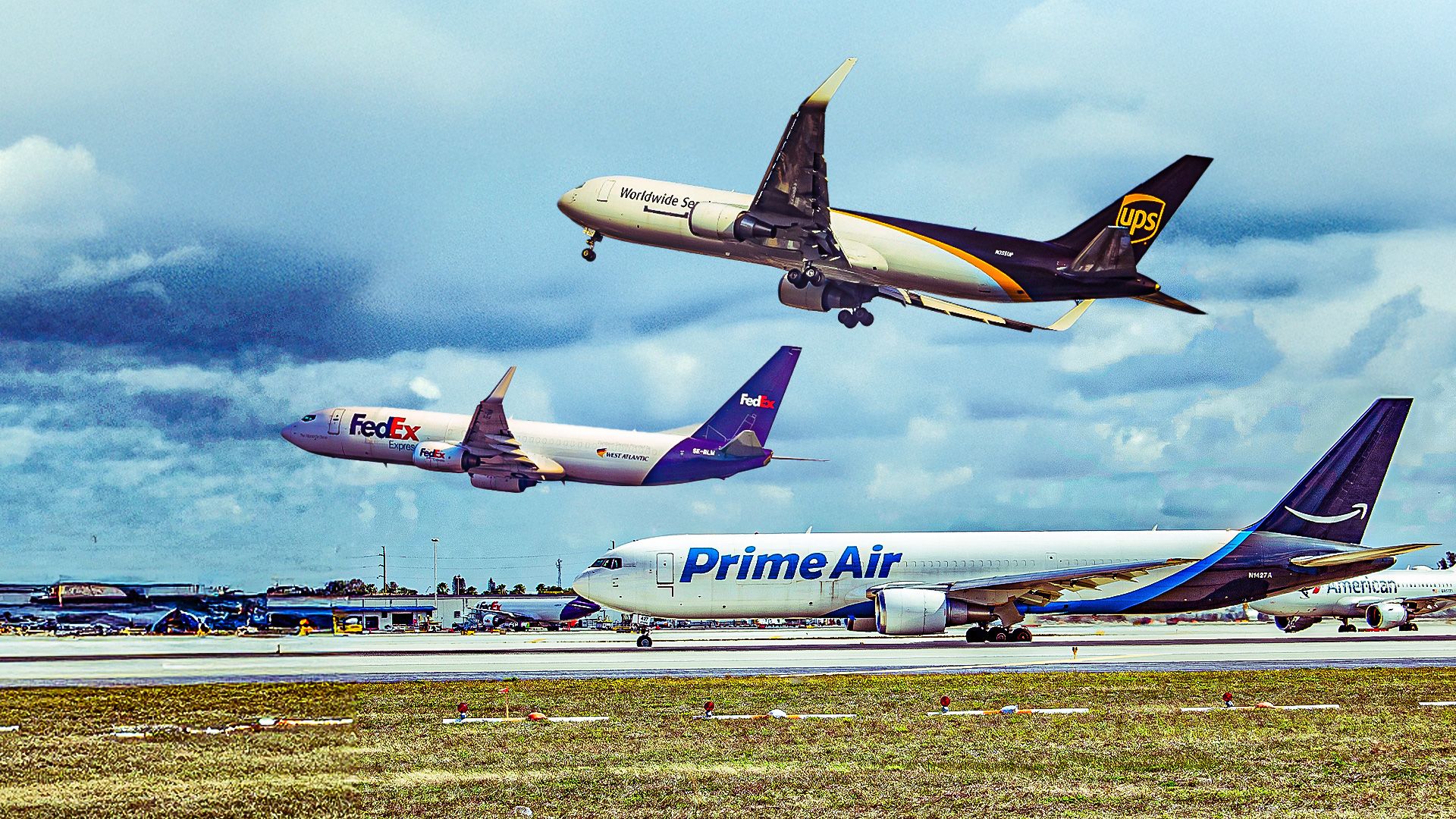
The world moves on cargo jets. Air transport carries less than 1% of the volume of world shipments, but represents around 33% by value because goods shipped by air are typically higher cost, often perishable, and almost always time-sensitive. In the modern era of e-commerce and global supply chains, the aircraft of the large cargo carriers like FedEx, UPS Airlines, and Amazon Air have become the backbone of the global economy.
These cargo airlines have been undergoing profound change in recent years, with the tailwinds of e-commerce growth and shifting global trade patterns leading to the global air cargo fleet growing by approximately 20% since 2020. Nowhere is this more evident than with the big three US cargo operators, where FedEx and UPS have long dominated, but the explosive expansion of Amazon Air is threatening to upend the market. But which of them has the largest fleet? Let’s take a closer look.
The Big Three US Cargo Carriers

The history of dedicated air cargo carriers in the US dates back to the post-war period, when surplus aircraft and trained pilots spurred the growth of civilian cargo operations. Flying Tiger Line, founded in 1945 by former air force pilots, became the first scheduled all-cargo airline and pioneered transpacific freight. But things really took off in 1973 when former US Marine pilot Fred Smith founded Federal Express with a fleet of 14 Dassault Falcon jets, and a vision to transform the shipping industry through the provision of overnight delivery.
UPS, which was founded in 1929, officially started its cargo airline in 1988 after years of operating with contracted carriers. For the next quarter of a century, FedEx and UPS were the two big heavyweights of the industry, and to this day are the largest cargo carriers by fleet size in the world.
|
Largest US Cargo Carriers By Size Of Jet Fleet |
||
|
Carrier |
Operational Fleet |
Average Age (Years) |
|
FedEx Express |
376 |
17.4 |
|
UPS Airlines |
295 |
22.3 |
|
Amazon Air |
101 |
26.3 |
In 2015, the industry added another player with the launch of Amazon Air. It operates a distinctly different business model from its rivals, relying heavily on leased aircraft rather than a large, owned fleet. This ‘virtual’ approach allowed Amazon to scale its air operations rapidly to meet the demands of its e-commerce business. By 2021, it had started to ship good for third parties, moving beyond a pure in-house fulfillment role and placing it in direct competition with FedEx and UPS.
Managing Fleet Expansion: Convert Or Buy?

Most of us have cast curious stares at the cargo facilities of major US airports, if only to spot a distinctly different fleet of aircraft. Unlike the gleaming new Airbus A350s and Boeing 787s of most US passenger airlines, cargo carriers typically operate older fleets, and less-common types such as Airbus A300s and McDonnell Douglas MD-11s are still very much on show. That’s because the majority of US cargo aircraft spend their first decade or two as passenger aircraft, before taking on a new life with cargo.
Deciding between purchasing factory-new freighters or converting passenger aircraft (P2F conversions) is a key decision for any cargo airline. New aircraft built specifically for cargo have longer service lives, while offering superior fuel efficiency and advanced avionics and designs, which enhances flexibility and reduces long-term operating costs. However, they incur high upfront costs (typically $150 million+ per aircraft) and often have lead times of 5+ years due to production backlogs.
In contrast, P2F conversions are older aircraft and therefore costlier to operate, but they have proven more popular with US cargo carriers because they cost a fraction of a new build (typically $30–60 million) and aircraft are available far sooner. Most importantly, there is an abundance of appropriate aircraft, such as Boeing 757s and 767s that are being retired from major US passenger fleets. This preference for P2F is set to continue, as Boeing’s 2025 Commercial Market Outlook predicts demand for 2,900 new freighters over the next two decades, with two-thirds of those being P2F conversions.
FedEx: The Largest Cargo Fleet In The World

FedEx Express operates the world’s largest dedicated cargo fleet, with a total of 376 jet aircraft currently in service. This places it ahead of both UPS and Amazon Air in terms of fleet size, but with an average age of 17.4 years, it also has the youngest fleet of the three carriers. It is worth noting that the company also has a further 91 aircraft operating at its FedEx Feeder subsidiary, made up of 15 ATR 42s, 43 ATR 72s and 33 Cessna 408 SkyCouriers.
|
The FedEx Fleet: October 2025 |
|||
|
Type |
Number In Service |
Orders |
Average Age (Years) |
|
Airbus A300-600RF |
51 |
– |
29.6 |
|
Boeing 737-800F |
8 |
– |
20.1 |
|
Boeing 757-200SF |
82 |
– |
33.7 |
|
Boeing 767-300F |
147 |
5 |
6.4 |
|
Boeing 777F |
59 |
8 |
9.8 |
|
McDonnell Douglas MD-11F |
29 |
– |
31.8 |
|
Total |
376 |
13 |
17.4 |
FedEx has had a major shift in focus after it lost its contract with the US Postal Service in September last year. It is now flying a lot less within the US, and is leaning into its strategy of pursuing premium international air cargo that is traditionally consolidated and booked on airlines by freight forwarders. This is increasing its need for widebody freighters, and no doubt played a part in its recent decision to delay the retirement of some of its MD-11s.
The company also has 13 widebody orders that are still to be delivered, including five remaining aircraft from its large Boeing 767 order placed a few years ago. These are gradually being used to replace the oldest A300s and MD-11s, and with 147 of the type in service, FedEx is now the world’s largest 767 operator. It also recently exercised its purchase options for eight more Boeing 777Fs that are scheduled to be delivered in 2026 and 2027.
UPS: The Largest Boeing 747-8F Fleet

UPS has the world’s second-largest dedicated cargo fleet with 295 aircraft in operation. Like FedEx, it still makes extensive use of older A300s, with more than 50 in the fleet used primarily for heavy regional loads. The type is so important to UPS that earlier this year, the carrier announced that it only plans to fully retire its A300 fleet by 2035, projecting up to 35 years of service per aircraft.
By contrast, the carrier’s MD-11s are eight years older on average, and are being gradually retired and replaced with 767 freighters. UPS is still awaiting delivery of 12 more examples from Boeing over the next two years, and is also likely to pick up some P2F examples as more 767-300s from the likes of Delta and United head into retirement.
|
The UPS Fleet: October 2025 |
|||
|
Type |
Number In Service |
Orders |
Average Age (Years) |
|
Airbus A300-600RF |
52 |
– |
22.8 |
|
Boeing 747-400F |
13 |
– |
23.9 |
|
Boeing 747-8F |
30 |
– |
6.2 |
|
Boeing 757-200SF |
75 |
– |
32.1 |
|
Boeing 767-300F |
97 |
12 |
16.6 |
|
McDonnell Douglas MD-11F |
28 |
– |
30.9 |
|
Total |
295 |
12 |
22.3 |
Where UPS differs substantially from FedEx is that it has chosen to go with the Boeing 747 instead of the 777 as its platform of choice for long-haul operations. The carrier operates 13 aging Boeing 747-400Fs, but more recently it completed the delivery of a fleet of 30 Boeing 747-8Fs, making it the largest operator of the type in the world. The -8F offers UPS capacity and range advantages over other widebodies, allowing it to operate the world’s longest scheduled 747 route from its primary base at Louisville to Dubai.
Amazon Air: The Market Disruptor

Amazon Air has grown rapidly since its founding a decade ago, and it now operates a fleet in excess of a hundred aircraft. As with other areas of the Seattle giant’s business (such as AWS), what started out as an endeavor to service its own needs is converting into a service made available to third parties. This puts it in direct competition with its two larger legacy competitors.
|
The Amazon Air Fleet: October 2025 |
|||
|
Type |
Number In Service |
Orders |
Average Age (Years) |
|
Airbus A330-300P2F |
10 |
– |
11.9 |
|
Boeing 737-800BCF |
31 |
– |
22.9 |
|
Boeing 767-300F |
60 |
– |
30.5 |
|
Total |
101 |
– |
26.3 |
However, unlike its competitors, Amazon Air’s primary strategy is an asset-light, leasing-focused model. As a result, it works with multiple partners that operate aircraft on its behalf, including:
- Air Transport Services Group: ATSG provides the bulk of the 767s (41) via its Air Transport International subsidiary. As part of the deal, Amazon was granted warrants to acquire nearly 20% of ATSG’s common shares.
- Atlas Air: The world’s largest 747 operator and the recipient of the 1,574th and final 747 ever made, Atlas Air provides Amazon Air with eight 737s and 17 767s.
- Sun Country: The low-cost leisure airline also has significant charter operations, and is a contract cargo operator for 12 of Amazon Air’s 737s.
-
Hawaiian Airlines: The A330s are the latest additions to the fleet, with the most recent delivery in July this year. They are operated for Amazon Air by
Hawaiian Airlines
.
Amazon Air is reportedly planning further fleet investments focused on network expansion. It is targeting capacity growth of 10–15% annually through 2030, which will likely mean the acquisition of additional A330s and B767s in the near-term.
How Do Other Global Cargo Fleets Compare?

The US cargo airlines have fleets that are almost unmatched elsewhere in the world. The only true comparison on a global basis is DHL Aviation, a group of six airlines that are either owned, co-owned, or chartered by German logistics giant, DHL Express.
Collectively, DHL Aviation has a diverse fleet of 211 aircraft, including some of the first 767-200s ever produced that are now more than 40 years old. It operates its largest European hub in Brussels, and has made substantial investments at its hub in Cincinnati, which handles 90% of its traffic to and from the US.
Numerous traditional passenger airlines also operate substantial cargo fleets, including:
- Qatar Airways Cargo has a fleet of 28 Boeing 777Fs, with orders for 34 of the new Boeing 777-8F. It is the largest cargo arm of a commercial passenger airline.
- Korean Air Cargo has a total of 23 dedicated cargo aircraft, including 12 777Fs, seven 747-8Fs, and four 747-400Fs. It also has orders for eight 777-8Fs.
- Cathay Pacific Cargo has 20 dedicated 747 freighters, made up of 6 -400Fs and 14 -8Fs. It has orders for 6 A350Fs as replacements for the 747-400Fs.
- Turkish Airlines Cargo has 18 aircraft, split between 10 A330-200Fs and eight 777Fs. It also has five of the new Airbus A350Fs on order.
- Emirates SkyCargo has a fleet of 12 Boeing 777Fs, with orders for a further 11. It also has orders for 10 of the 777-300ER/SF, the P2F conversion of the larger -300ER passenger series.
What is notable is that the sum of the fleets of all six of the global cargo operators mentioned here, all considerable operations in their own right, is roughly the equivalent of UPS, and still falls considerably short of the FedEx fleet size. This only serves to emphasize the sheer scale of the US operators and just how much they dominate the global cargo business.
