


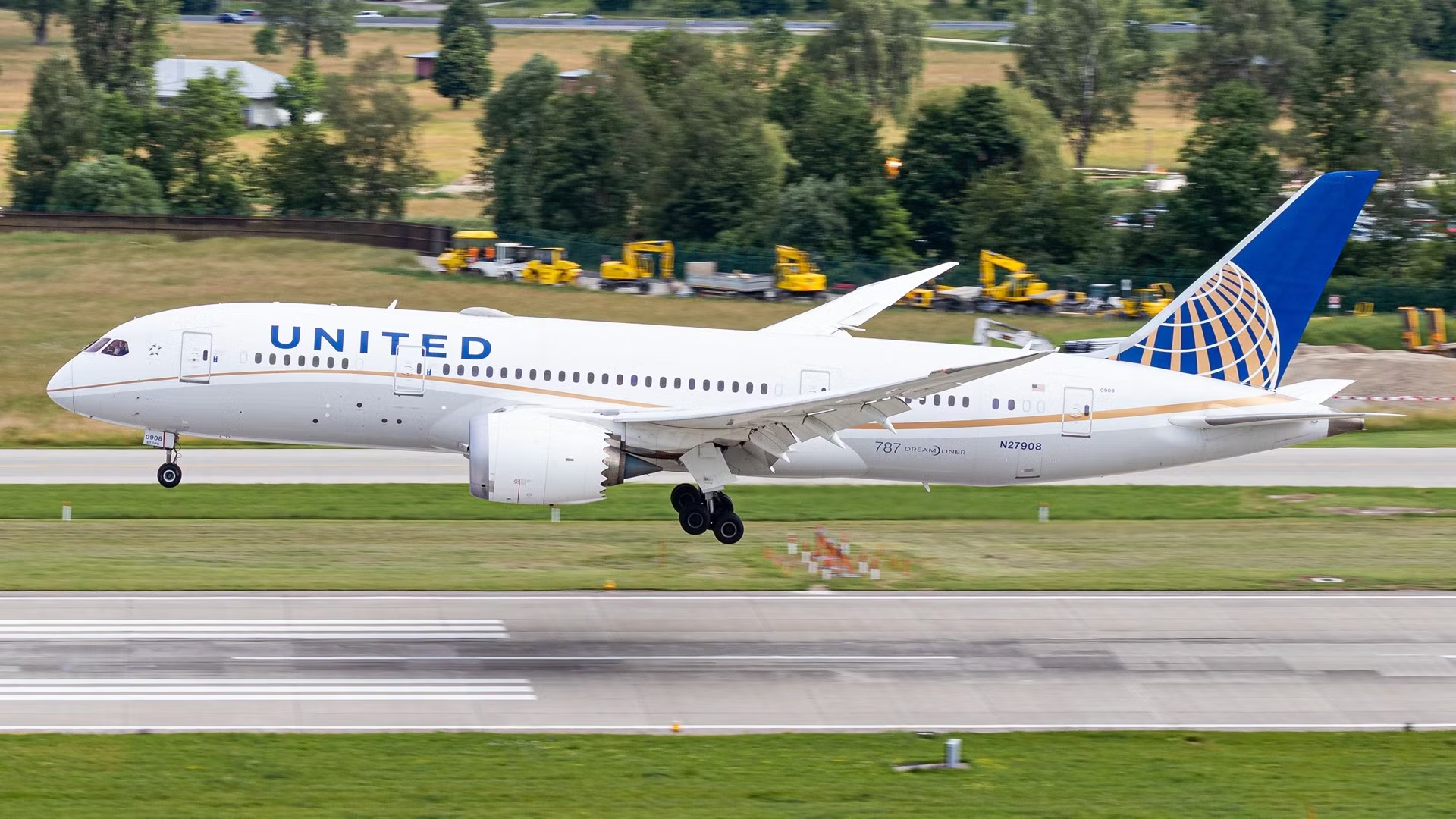
American plane maker  Boeing could be set for an airworthiness directive, which would relate to all Boeing 787 variants (787-8, 787-9, and 787-10). The directive, which is proposed to be published on Monday, November 17, relates to the uncommanded changes for the Mode Control Panel (also known as MCP) selected altitude. This altitude setting can currently change without pilot input. The directive from the Federal Aviation Administration would request that all MCPs (between part numbers 4091640-901, 902, and 903) be replaced with an updated MCP, in addition to an installation test.
This action is needed due to software, hardware, and internal power supply issues, which have previously led to the unintended altitude changes on two flights, namely United Airlines and LATAM, where passengers and crew experienced dramatic changes in altitude mid-flight.
165 Airplanes Affected

As detailed in the FAA report (Docket No. FAA-2025-3426; Project Identifier AD-2025-00342-T), the directive would relate to 165 Boeing Dreamliners, and the estimated time to undertake the works would be approximately two hours per aircraft, at a cost of around $85 per hour, plus parts. Honeywell International Inc., the manufacturer of the MCP, has already indicated that some or all of the replacement parts may be covered under the manufacturer’s warranty.
All operators of the Dreamliner would be expected to comply with the actions set out, including replacement and testing, unless the work is already complete. Alternative methods of compliance may be considered on a case-by-case basis only and approved only via the FAA’s Continued Operation Safety Branch (AIR-520).
Fortunately for aircraft operators, the proposed directive would have a low economic impact, given the short amount of time the MCP would take to replace and test. Data per ch-aviation identifies that there are currently 1,098 787’s currently active, across the three variants.
LATAM Flight 800

On March 11, 2024, LATAM Airlines was operating its fifth freedom flight between  Sydney Kingsford Smith Airport (SYD) and Auckland Airport (AKL). The flight was two hours into its three-hour flight to New Zealand when the Dreamliner operating the flight experienced a sudden drop in altitude. This movement was unexpected, leaving passengers and crew unprepared for the drop.
This led to widespread injuries to multiple passengers and crew and triggered a major emergency response. The flight was met by Auckland Airport’s apron by emergency services, including 14 ambulances and other rapid response teams. 50 passengers were reported injured, one classed as serious, resulting in 13 being transported to nearby hospitals. The connecting flight from Auckland to Santiago, was subsequently canceled.
Shortly after the incident occurred, the pilot spoke to the passengers to advise that the plane had experienced an equipment failure, noting the ‘gauges went down for one or two seconds’. New Zealand’s Transport Accident Investigation Commission was joined by the Chilean Aviation Authority to investigate what had happened, including the NZ commission seizing the black boxes of the airplane.
United Airlines Flight 613

Earlier this year, a United Airlines flight traveling between  Lagos Airport, Nigeria, and Washington Dulles International Airport was forced to make an emergency landing back in Nigeria’s largest city, due to an in-flight movement. The flight, which was operating as UA613, had 245 passengers onboard, in addition to eight flight attendants and three pilots. The unexpected movement in the aircraft caused chaos throughout the cabin, with passengers’ meals, drinks, and personal belongings spilling across the airplane after the Dreamliner experienced an unexpected jolt mid-flight.
Simple Flying, which reported on the event earlier this year, analyzed the flight data from Flightradar24, which identified that the airplane dropped more than 1,000 feet in altitude just 93 seconds after the flight was airborne. This resulted in the pilot returning to Lagos out of an abundance of caution, where the flight was met by emergency personnel on landing. According to the Federal Airports Authority of Nigeria (FAAN), 38 passengers and crew sustained injuries, of which four passengers and two crew were classed as serious.  United Airlines initially noted that the incident was caused due to an unexpected technical problem, and turbulence was quickly ruled out as the cause.
The proposed directive, if published on Monday, would apply to the 787-8, 787-9, and 787-10, and currently does not extend to other Boeing aircraft models.
