



BERLIN — Estonia has begun installing the first concrete bunkers along its southeastern border with Russia as part of the Baltic Defense Line, marking a key milestone for the trilateral fortification project despite delays.
Seven bunkers were awaiting installation as of this week, with Estonian officials targeting 28 bunkers in the ground by year’s end, according to Krismar Rosin, press officer for the Estonian Centre for Defence Investments. The initial batch represents the first phase of a 600-bunker network designed to strengthen the European Union’s and NATO’s eastern flank.
In an interview with Defense News, Rosin acknowledged the timeline remains uncertain. The bunkers are being deployed in Setomaa municipality and southeastern Estonia, with 27 situated on government or municipal land and only one on private property.
The deployment comes a year later than originally planned, following procurement complications that forced Estonian officials to restructure their approach. An initial tender for all 600 bunkers received bids exceeding legal cost limits because construction companies couldn’t accurately assess installation challenges without knowing the exact locations, which defense officials kept confidential for operational security, Rosin said.
“Since those companies did not know … does it have a boggy terrain, does it have some kind of forest terrain, how is the access – they offered very expensive bids,” Rosin explained.
Estonian officials solved the problem by scaling back to a 28-bunker pilot program and revealing approximate locations to bidders to obtain realistic cost estimates while gathering implementation lessons before the larger procurement. The remaining 572 bunkers are meant to be tendered by year’s end.
As of Friday, Nov. 12, the bunkers were “currently being deployed but not yet fully ready,” the Estonian Center for Defense Investments said in an email.
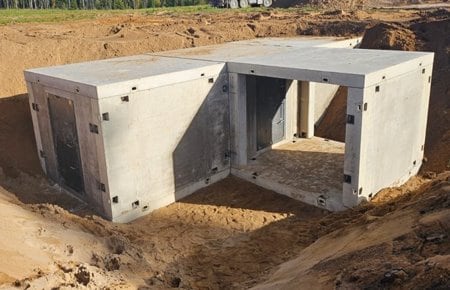
The bunkers, each approximately 35 square meters, are designed to withstand 152mm artillery shells. They represent one part of a layered defense system meant to stop a possible Russian invasion. All barbed wire and dragon’s teeth obstacles have been delivered and stored in pre-positioned areas awaiting installation if the need arises, Rosin said.
Beyond procurement issues, the project faces coordination challenges requiring approval from multiple stakeholders, including the Estonian Defence Forces, Police and Border Guard, municipalities, and private landowners – all while adhering to peacetime environmental and safety regulations.
“We are building it in peacetime, which means that we have to follow the peacetime law,” Rosin said, contrasting this with wartime scenarios where military engineers could do things like digging anti-tank trenches “fast, within a few hours, probably.”
Coordinating the project with the Border Guard, whose patrol road requirements and tactical plans must align with the Defence Forces’ bunker and anti-tank ditch placements, has added to the overall complexity.
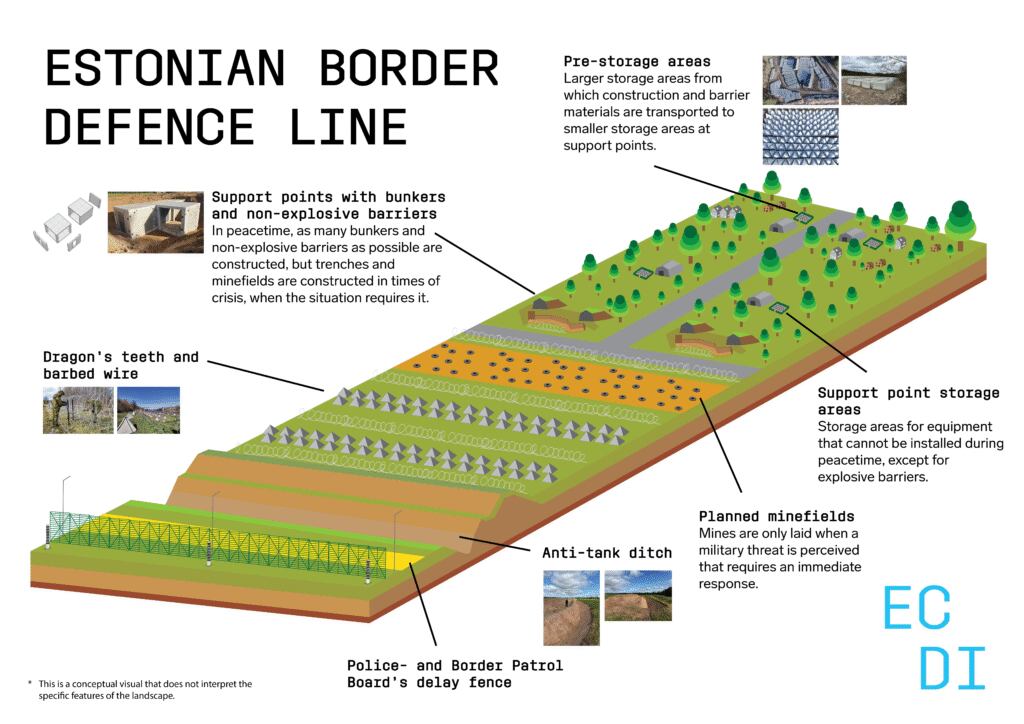
For instance, only 500 meters of a planned 3.4-kilometer test anti-tank trench has been completed, with additional construction delayed pending Border Guard approval, whose area of operations the test trench would cross through, said Rosin.
Despite the setbacks, Estonia remains ahead of Latvia and Lithuania in physical implementation, according to Rosin. All three countries announced the coordinated Baltic Defense Line project, but are executing their national portions independently based on varying terrain and threat assessments, although they cooperate on concepts and knowledge-sharing.
Estonia’s €60 million ($70 million) budget for the project – with approximately €30 million spent to date – is significantly lower than Lithuanian and Latvian allocations, reflecting Estonia’s shorter border length and natural obstacles, including Lake Peipus and extensive bog areas. The Estonian project excludes air defense systems and advanced firepower that neighboring countries are incorporating.
The Estonian Border Guard has already deployed a separate “drone wall” detection system along portions of the border, which is often confused with the Defence Forces’ Baltic Defense Line project but is a separate measure, Rosin said.
Linus Höller is Defense News’ Europe correspondent and OSINT investigator. He reports on the arms deals, sanctions, and geopolitics shaping Europe and the world. He holds a master’s degrees in WMD nonproliferation, terrorism studies, and international relations, and works in four languages: English, German, Russian, and Spanish.
