


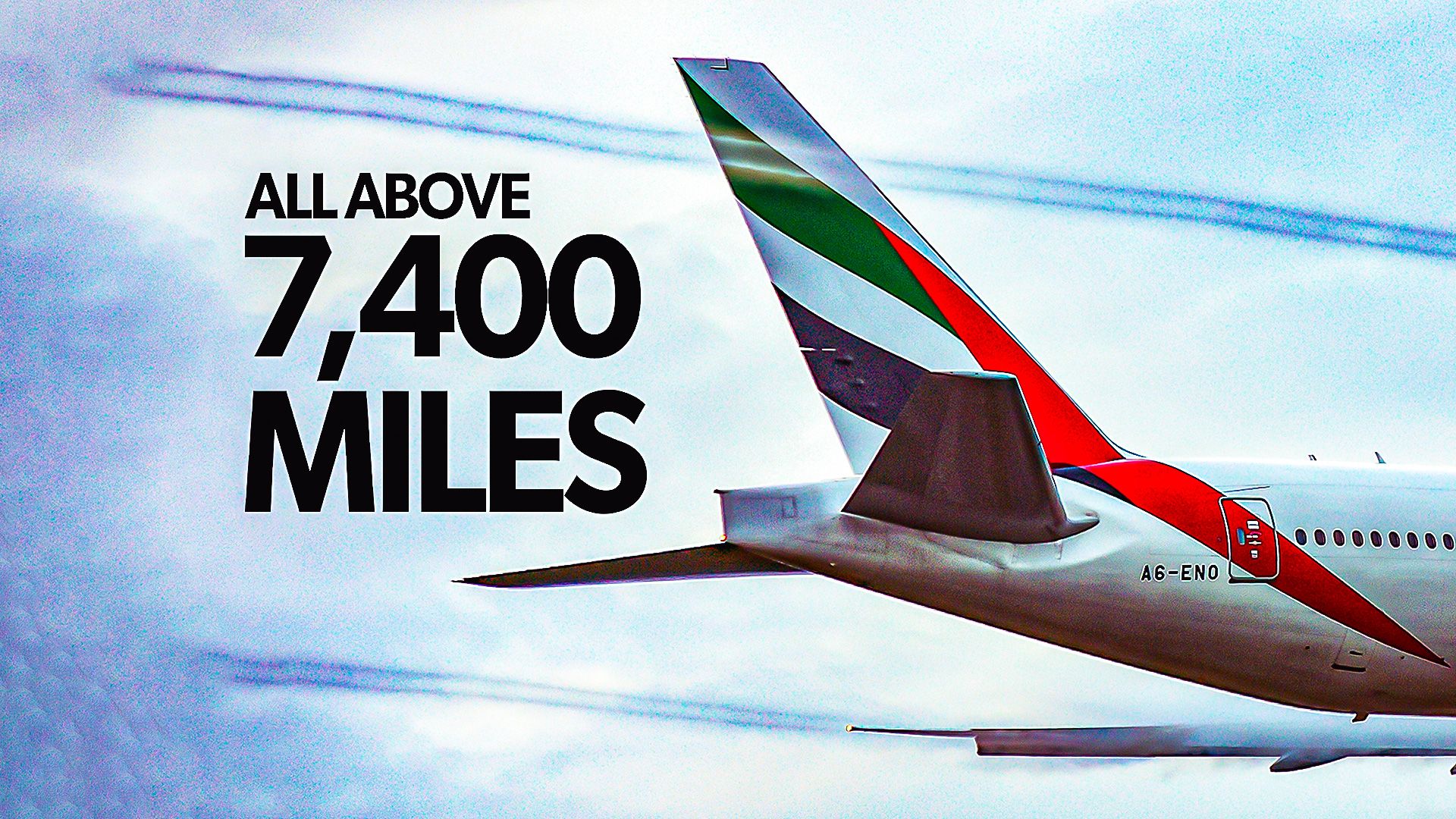
 Emirates is the largest airline in the Middle East, and one of two flag carriers of the United Arab Emirates. From its hub at Dubai International Airport (DXB), it flies to about 165 destinations in 70 countries across all six inhabited continents. According to IATA, Emirates is the third-largest airline in the world by scheduled revenue passenger-kilometers flown.
Emirates uses a fleet of over 250 aircraft, all of which are widebodies that specialize in flying long-haul routes. The airline is also the largest user in the world of the two plane types that nearly make up its entire fleet. One is the iconic double-decker Airbus A380, with 116 aircraft in service, and the other is the Boeing 777, with 133. This article investigates the longest non-stop routes flown by the airline in 2025.
The Longest Non-Stop Routes

The data for the scheduled flights operated by Emirates in 2025 has been retrieved from Cirium, a flight analytics company. It shows the equipment to be used and the length of routes, along with origin and destination. The number of flights is also recorded, along with total seats on said flights and the average length of these routes in miles. Without any further ado, below are the Emirates routes for this year with a length above 7,400 miles, with return flights omitted:
|
Emirates Routes above 7,400 miles (2025) |
||||||
|
Route |
Destination Airport |
Destination Country |
Aircraft |
Flights |
Seats |
Average Length (Miles) |
|
DXB – AKL |
Auckland Airport |
New Zealand |
A380-800 |
365 |
176,644 |
8,810 |
|
DXB – LAX |
Los Angeles International Airport, California |
United States |
A380-800 |
365 |
176,596 |
8,334 |
|
DXB – IAH |
George Bush Intercontinental Airport, Texas |
United States |
A380-800 |
365 |
176,644 |
8,165 |
|
DXB – SFO |
San Francisco International Airport, California |
United States |
A380-800 |
365 |
176,660 |
8,101 |
|
DXB – DFW |
Dallas Fort Worth International Airport, Texas |
United States |
777-300ER |
365 |
119,992 |
8,038 |
|
DXB – MIA |
Miami International Airport, Florida |
United States |
777-300ER |
366 |
121,786 |
7,844 |
|
DXB – MCO |
Orlando International Airport, Florida |
United States |
777-300ER |
261 |
92,394 |
7,754 |
|
DXB – GRU |
São Paulo/Guarulhos International Airport |
Brazil |
A380-800 |
365 |
176,612 |
7,591 |
|
DXB – SYD |
Sydney Kingsford Smith Airport |
Australia |
A380-800 |
1,095 |
531,722 |
7,480 |
|
DXB – BNE |
Brisbane Airport |
Australia |
A380-800 |
663 |
324,791 |
7,442 |
|
DXB – BNE |
Brisbane Airport |
Australia |
777-300ER |
66 |
23,338 |
7,442 |
|
DXB – SEA |
Seattle-Tacoma International Airport, Washington |
United States |
777-300ER |
365 |
120,220 |
7,425 |
The longest routes flown by the airline are evenly split between the Airbus A380-800 and the Boeing 777-300ER. US-based destinations dominate the dataset, with the lengthiest route being from the Emirates hub at Dubai International Airport to Auckland Airport in New Zealand. Overall demand for US travel is high, with two routes to cities in Texas, California, and Florida.
Most routes operate a return flight once per day, with a few exceptions. The least demand is for Orlando, Florida, with 261 -300ER flights in the year. Australian routes are the most frequently flown, with Sydney seeing around three A380 flights per day, and Brisbane seeing roughly two, with occasional -300ER flights. When the seat numbers of the A380 are seen side-by-side with those of the 777-300ER on similar routes, the advantage of the double-decker and its massive capacity becomes apparent.
Why These Two Planes?

The -800 is the only variant of the A380, and was first delivered to Singapore Airlines in October 2007. As shown in the table above, the aircraft really comes into its own when operated on hub-and-spoke routes, and DXB really is a hub for long-haul travel, being a convenient layover location between Europe and Asia. In the last couple of years, DXB has risen to become the second-busiest airport in the world, according to CNBC, only beaten out by Hartsfield-Jackson Atlanta International Airport (ATL).
The -300ER is the best-selling 777 variant, with 831 built, and Emirates owns a large portion of these. It was first delivered to Air France in April 2004 and is the newest 777 variant aside from the upcoming 777X. The -300ER is an economically sound choice as a complementary plane to the A380, carrying 392 passengers in a two-class seating arrangement, with its improved fuel capacity giving it a range of 7,370 nautical miles (13,650 kilometers or 8,480 miles).
|
Operating Costs of Large Passenger Aircraft Compared (AirInsight) |
|
|
Aircraft |
Cost per Seat Hour |
|
Airbus A380 |
$50 |
|
Boeing 777-300ER |
$44 |
|
Boeing 747-400 |
$90 |
As shown above, the 777-300ER and A380 offer both offer decent cost of operation per seat hour when compared to the 747-400, an older high-capacity jumbo jet. While the 777-300ER is beginning to show its age in some areas, the A380 is loved around the world for its spacious cabin and the unique double-decker passenger experience it provides. The passengers’ opinions of the two planes were summed up nicely in the Reddit post below:
“Yeah, I love the 777-300ER and its still one of my top 5s, the hum is amazing sitting right by the GE90s, but, beyond that it hasn’t aged as well and that’s only because of how quickly aviation has evolved since its inception. Fortunately the 777X is just around the corner and should improve on that big time. My preference for long haul has always been the A380 and the A350. Deathly quiet, a joy to fly in and roomy as heck.”
The Emirates Fleet Is Evolving

The A380 and 777 are great planes, no doubt, but no good thing can last forever. Technological advancements have drastically improved fuel efficiency in recent decades, and even when new, more efficient, high-bypass turbofans and winglets are added to older planes, newer clean-sheet designs are much lighter and have better aerodynamic properties than other planes of the early 2000s. This gives them drastically better fuel efficiency at cruise, and therefore on long-haul routes that Emirates primarily serves.
While the airline used to fly exclusively the A380 and 777, the Emirates fleet has begun to evolve. It ordered 50 Airbus A350-900s in 2019, raising this to 65 in 2023. The first A350 delivery happened in November 2024, and as of now, 11 are on the roster, with the remaining 54 on order. The A350-900 represents the cutting edge of long-haul travel, carrying 325 passengers in a three-class layout over a distance of 8,100 nautical miles (15,000 kilometers or 9,300 miles).
|
Emirates Aircraft On Order |
|||
|
Aircraft |
Delivered |
On Order |
Expected Delivery From |
|
Airbus A350-900 |
11 |
54 |
Started November 2024 |
|
Boeing 777-8 |
– |
35 |
2030 |
|
Boeing 777-9 |
– |
170 |
2027 |
|
Boeing 787-8 |
– |
20 |
2025 |
|
Boeing 787-10 |
– |
15 |
2025 |
Data from Emirates (1, 2, 3) and Flight Global.
While the A350 is the natural replacement for Boeing 777-300ER variants, Emirates also has several current-generation 787 Dreamliners on order. The 787 Dreamliners have been wildly popular in the passenger aviation industry, with 1,222 being delivered as of September, and will help fill the gap until the new 777-8 and -9 variants finally begin deliveries in 2027.
Is The Quadjet Era Coming To An End?

With Emirates moving away from the A380 and no new quadjet replacement on the horizon any time soon, the era of the quad-jet passenger jetliners is unfortunately coming to an end. The aforementioned efficiency-improving advancements have changed the face of long-haul travel, with twin-engined widebodies, such as the 787, now being able to make long-haul routes comfortably thanks to their improved range. Even narrowbody aircraft these days come with a far better range than their older siblings. A post on a Reddit thread on the A380 confirms:
“More fuel efficient engines on modern narrow bodies are allowing them to travel further than ever before. As the older 737 and 320s age out and get replaced by newer ones, you’ll see them flying more transocean routes. There’s still a place for wide bodies, but the super heavies for passenger service no longer make sense financially for most routes.”
Unfortunately for fans of the luxurious A380, other aircraft just don’t cut it in terms of comfort, and so while the fuel-efficiency improvements are great for airlines, passengers will no longer be able to experience long-haul flights on the quadjet behemoths of the previous aircraft generation in the coming decades. Such aircraft find it hard to compete with more fuel-efficient aircraft, as their larger air displacement requires more thrust, therefore more engines, which means more fuel burned.
“This [A380] is a marvel of modern aviation ever since it came out in 2007. I can’t believe jumbo jets are going to become a thing of the past in the near-future. Other than cargo planes of course.”
“Then it will remain a glorious footnote in aviation history. It’ll become the new airship in terms of things that once were but no longer exist.”
For airlines, it is starting to become more economically viable to offer multiple flights on two-engine airplanes rather than one dense daily flight with a larger plane. For customers, it also offers more choice, giving more convenient connection windows and potentially shorter layovers. Overall, large aircraft like the A380 and 747 will be missed in the passenger market, but some years of viability remain on the busy long-haul routes that Emirates offers, and also in the freight aviation industry.
