


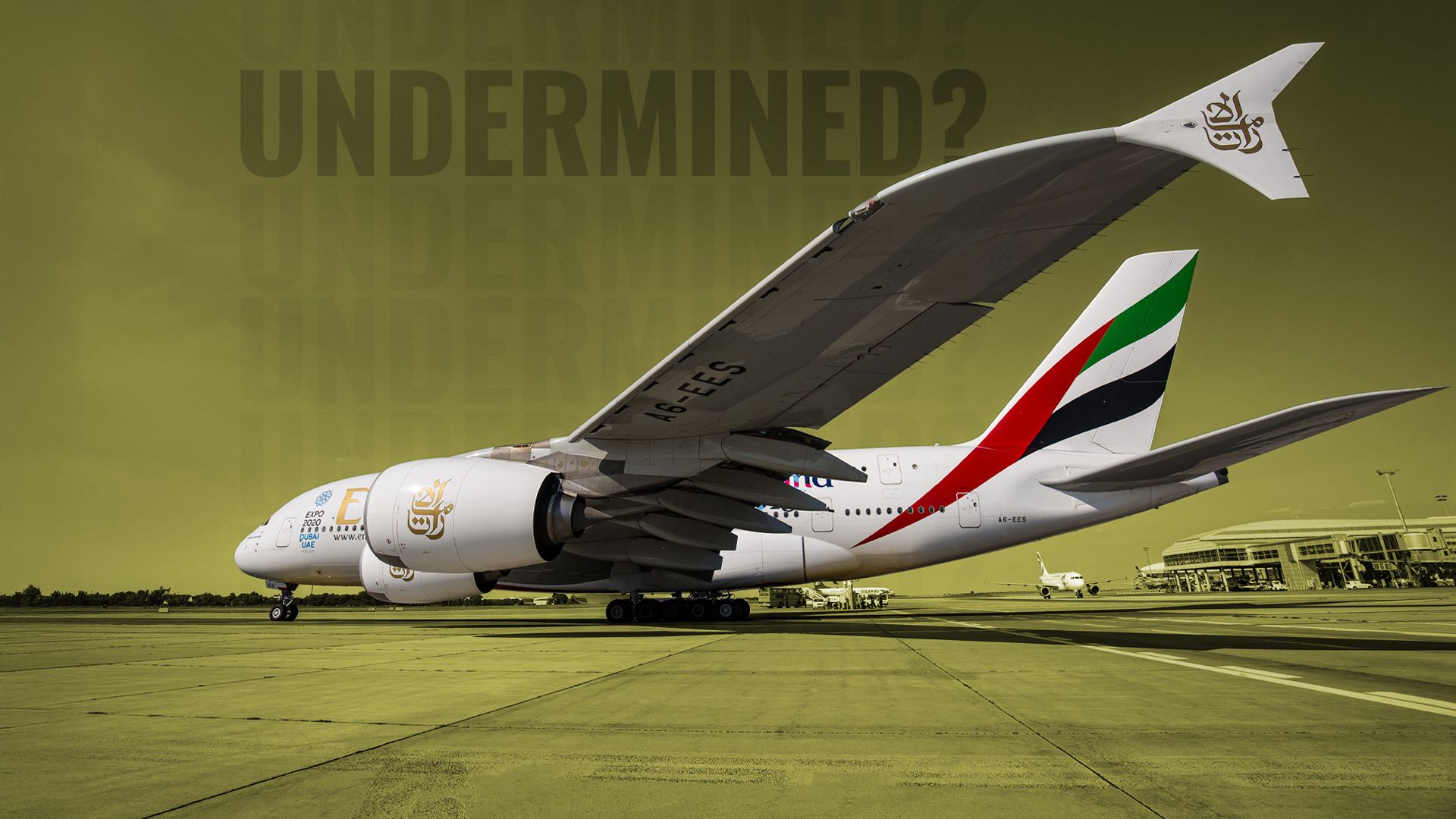
The Airbus A380is an engineering, technological, and aviation marvel. Planned to revolutionize the industry and the hub-and-spoke model of flying, it arrived with the promise of redefining long-haul travel. Unmatched in scale, aura, and comfort, surely this aircraft would be the absolute future of modern aviation, or at the very least, be a basis for the industry to innovate and grow from? In a way, it did, but not how Airbus and many other market stakeholders and aviation enthusiasts had hoped.
The A380 did set the direction for long-haul travel, but instead of championing the hub-and-spoke model, it helped cement the future of point-to-point flying. Some critics argue that carriers misused the jet, failed to adapt networks around it, or abandoned it too quickly in favor of smaller, trendier aircraft. Others counter that airlines were responding to shifting economics and passenger behavior that Airbus failed to anticipate. The truth lies somewhere in between, as we shall now explore.
The Birth Of The Superjumbo

The roots of what would eventually become the Airbus A380’s development began around 35 years ago. Airbus began studying and planning an ultra-large aircraft in 1988 to challenge the Boeing 747’s dominance. That dominance started when the Boeing 747 first entered commercial passenger service on January 22, 1970, with Pan Am on its New York to London route. Airbus’s aim wasn’t just to match Boeing. Instead, it wanted and needed to outperform its US rival in every way possible.
Airbus formally launched the A380 program on December 19, 2000, marking the culmination of more than a decade of studies and projections. At launch, Airbus secured 50 firm orders and commitments from major carriers, including Emirates, Qantas, Singapore Airlines, Air France, and Virgin Atlantic. These early orders provided the financial confidence needed to proceed with what became the most expensive commercial aircraft program of its era. Indeed, the total development cost is estimated at US$25 billion.
After years of design, development, and engineering, the A380 first took flight on April 27, 2005, from Toulouse. The aircraft was certified by both EASA and FAA in December 2006 after the certification process was delayed due to production and wiring issues, and the final certification was a significant milestone after multiple delays. The A380 saw its first customer, Singapore Airlines, launch with its inaugural service from Singapore to Sydney on October 25, 2007.
A Massive Aircraft With Massive Figures

The Airbus A380 truly is a giant, in all respects. From its giant development cost to its giant price tag of around $450 million, the aircraft is sure to turn heads and get passengers and aviation enthusiasts buzzing with excitement. How does the A380 measure up? The length comes in at a whopping 238 feet 7 inches (72.72 m), an even larger wingspan of 261 feet 8 inches (79.75 m), and an impressive height (tail) of 79 feet 1 inch (24.09 m).
Designed for sheer capacity, the A380 boasts the ability to carry 525 passengers in a typical 3-class layout, 615 passengers in a typical 2-class layout, and it has a maximum certified capacity of 853 passengers (all-economy). The Maximum Takeoff Weight of the aircraft is 1,268,000 lb (575,000 kg), compared to the Boeing 747-8, which has an MTOW of 987,000 lb (447,700 kg).
The A380 offers a significant range of 8,000 NM (14,800 km), and can carry up to 571,000 lb (259,000 kg) of fuel. The two engine options, the Rolls-Royce Trent 900 and the Engine Alliance GP7200, provide around 70,000–76,000 lbf (310–340 kN) of thrust per engine, with the A380 having four turbofans in total.

Why Did Airbus Build The A380 With 4 Engines?
Here’s why this modern double-decker has an outdated configuration and why it failed.
Where It All Went Wrong

The A380 was supposed to be a huge success, and it might be considered a success, depending on how you measure it. In terms of engineering and the sheer physics behind it, the A380 was more successful than anyone could’ve imagined, but commercially and financially, it fell slightly short. To narrow down the many contributing factors, the main issue was likely the shift to point-to-point flying, alongside the A380’s monumental operating costs at lower load factors.
Airlines, passenger demand, and the industry as a whole moved from the hub-and-spoke model to point-to-point travel, favoring smaller, long-range jets like the Boeing 787 and Airbus A350. Because of this, the A380’s capacity became unnecessary and inefficient on most routes. In many cases, on specific routes and load levels, the A380 could be just as efficient as smaller, alternative aircraft. The issue is, those stipulations for profitability don’t allow for widespread application, making the aircraft extremely inflexible.
|
Specifications (Per AviatorJoe) |
Airbus A380‑800 |
Boeing 747‑8I |
|---|---|---|
|
Length |
238 feet 7 inches (72.72m) |
250 feet 2 inches (76.25m) |
|
Wingspan |
261 feet 8 inches (79.80m) |
224 feet 7 inches (68.45m) |
|
Wing Area |
9,096 ft² (845.00 m²) |
5,963 ft² (554.00 m²) |
|
Height (Tail) |
79 feet 1 inch (24.10m) |
63 feet 6 inches (19.35m) |
|
Engines |
4 |
4 |
|
Thrust per Engine |
75,152 lbf (334 kN) |
66,500 lbf (296 kN) |
|
Total Thrust |
300,608 lbf (1,336 kN) |
266,000 lbf (1,184 kN) |
|
Maximum Takeoff Weight (MTOW) |
1,288,000 lb (575,000 kg) |
988,000 lb (448,000 kg) |
|
Range |
8,000 NM (14,800 km) |
7,370 NM (13,650 km) |
On top of this, the sheer size of the aircraft meant it was also limited in airport compatibility. Airports often had to invest a lot of time, effort, and a significant amount of capital to handle the aircraft. Only major hubs could justify the cost, limiting the A380’s operational network, and dual-deck boarding caused longer boarding and deplaning times compared to conventional aircraft.
Furthermore, airlines needed extra staffing to manage two decks simultaneously, and only airports with sufficient runway length and pavement strength could accommodate the A380 at full MTOW. This restricted airlines to a small set of premium routes, reducing revenue opportunities and compounding costs to make the aircraft even less efficient and financially viable.
Did Airlines Undermine The A380?

The ultimate success of the A380, like the majority of commercial aircraft, depended on airline adoption and utilization, but this never happened with the A380. Canceled or reduced orders and early retirements tarnished the A380’s appeal to new customers and left Airbus trying to market a forgotten dream.
Initially, Airbus had predicted that it would produce around 1,500 examples of the type. Unfortunately, it only managed to produce 254, including three test aircraft. The decision not to integrate the A380 long-term, or in some cases at all, by airlines was a conscious decision, but not necessarily an attack on Airbus or the A380. Instead, it was simply business, as the jet didn’t work for everyone. Many airlines have, and still do, operate A380s successfully.
Several airlines have successfully operated the A380, but generally only on high-demand routes. Emirates is the largest operator, using it on busy international flights with large premium cabins. Singapore Airlines, Qantas, Lufthansa, and British Airways also ran profitable services on dense, long-haul routes. Success required high passenger loads, hub-and-spoke networks, and premium seating, so airlines that used the A380 on smaller or secondary routes struggled financially.

It’s 2025, But Why Do Some Airlines Still Love The Airbus A380?
Popular with passengers but airlines have gradually phased them out.
A Future For The A380?

The Airbus A380 may no longer be in production, with production ending in 2021 with the final delivery made to Emirates in December of that year, but it still has a niche future. Emirates has expressed interest in an A380neo, which would be a modernized version with more efficient engines. However, with no official option for this, or any indication from Airbus that it would consider this, it is currently focused on extending the life of its existing fleet into the 2040s using spare parts and long-term maintenance programs.
Other operators, such as Lufthansa, have also reactivated A380s on high-demand, premium-heavy routes. Meanwhile Global Airlines has begun refurbishing older airframes for ad-hoc charter services, showing that the aircraft can still find a role in new markets.
Success for the A380 depends on high passenger loads and slot-constrained airports. Its size makes it ideal for dense international hubs, where multiple flights can be consolidated into a single high-capacity service. Life-extension programs, refurbishments, and selective route deployment allow airlines to operate it profitably despite higher fuel and maintenance costs compared to newer twinjets.
However, the aircraft faces challenges. There’s no new production, resale options are limited, and sustainability pressures favor more fuel-efficient twin-engine planes. While the A380 won’t return to mass adoption, it is likely to remain in service for a few dedicated airlines, particularly Emirates, serving as a high-capacity, specialized jet for at least the next 15–20 years.
The Bottom Line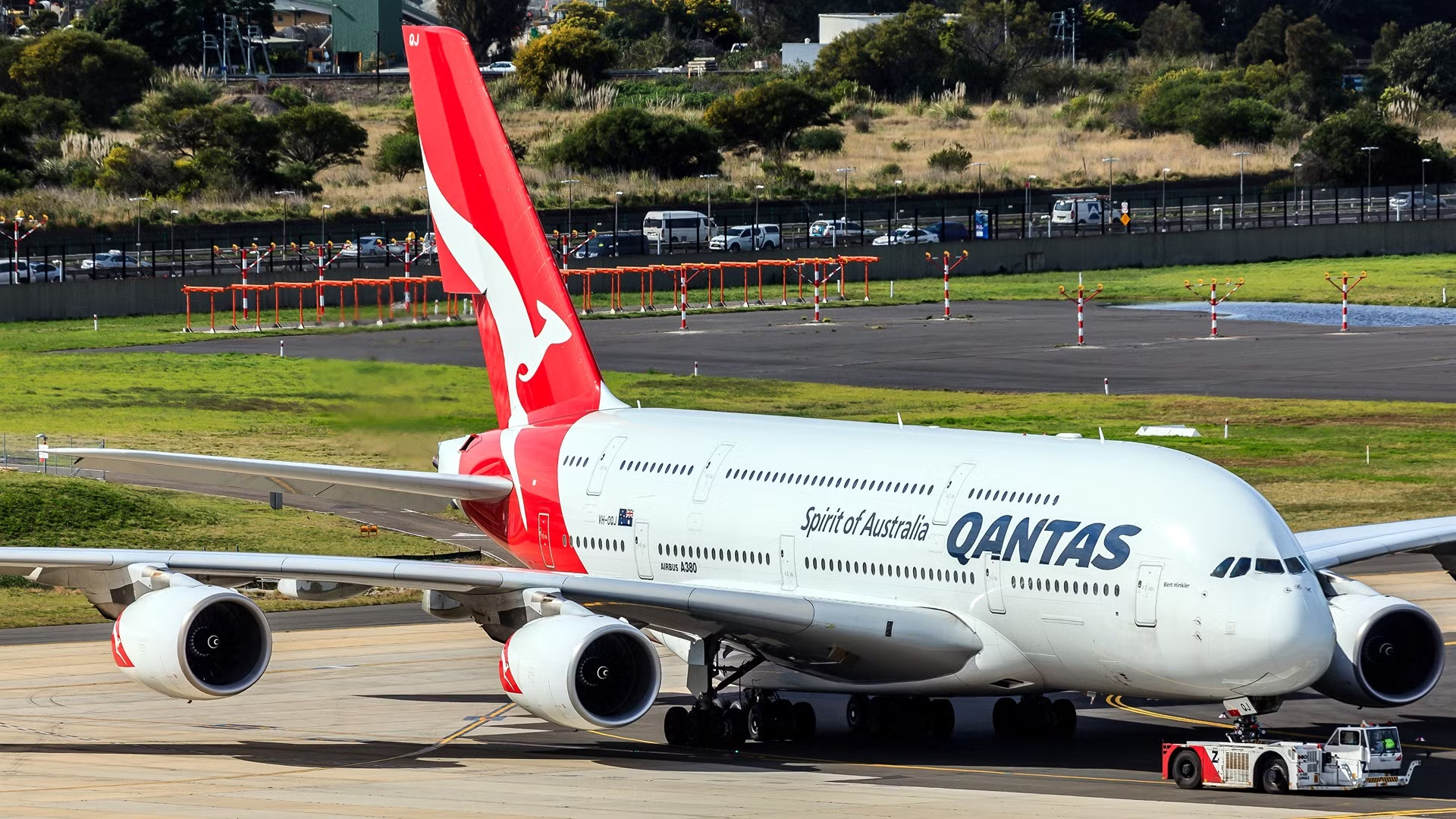
The A380 was a marvel of engineering, designed to carry hundreds of passengers over long distances in unmatched comfort. It represented decades of ambition, cutting-edge technology, and bold predictions about the future of air travel. For a brief time, it captured the imagination of airlines and passengers alike, promising a new era of ultra-large aircraft dominating major hubs around the world. Despite early enthusiasm, the A380’s struggles were largely a result of changing market conditions, not deliberate undermining.
Airlines naturally shifted toward smaller, more flexible twin-engine aircraft that could fly point-to-point routes profitably and adapt to evolving passenger demand. Its massive size and capacity required specialized gates, longer runways, and consistently high passenger loads, which only a few operators, like Emirates, could sustain. In that sense, airlines didn’t actively undermine it. Rather, they simply operated within economic realities that made the A380 impractical for most networks.
Ultimately, the A380’s design philosophy became its undoing. Its enormous capacity, once seen as the future of long-haul travel, was the very factor that limited its adoption and profitability. While some carriers continue to operate and even refurbish these superjumbos, the aircraft remains a niche marvel: celebrated for its ambition, but a stark reminder that in aviation, bigger isn’t always better.
