


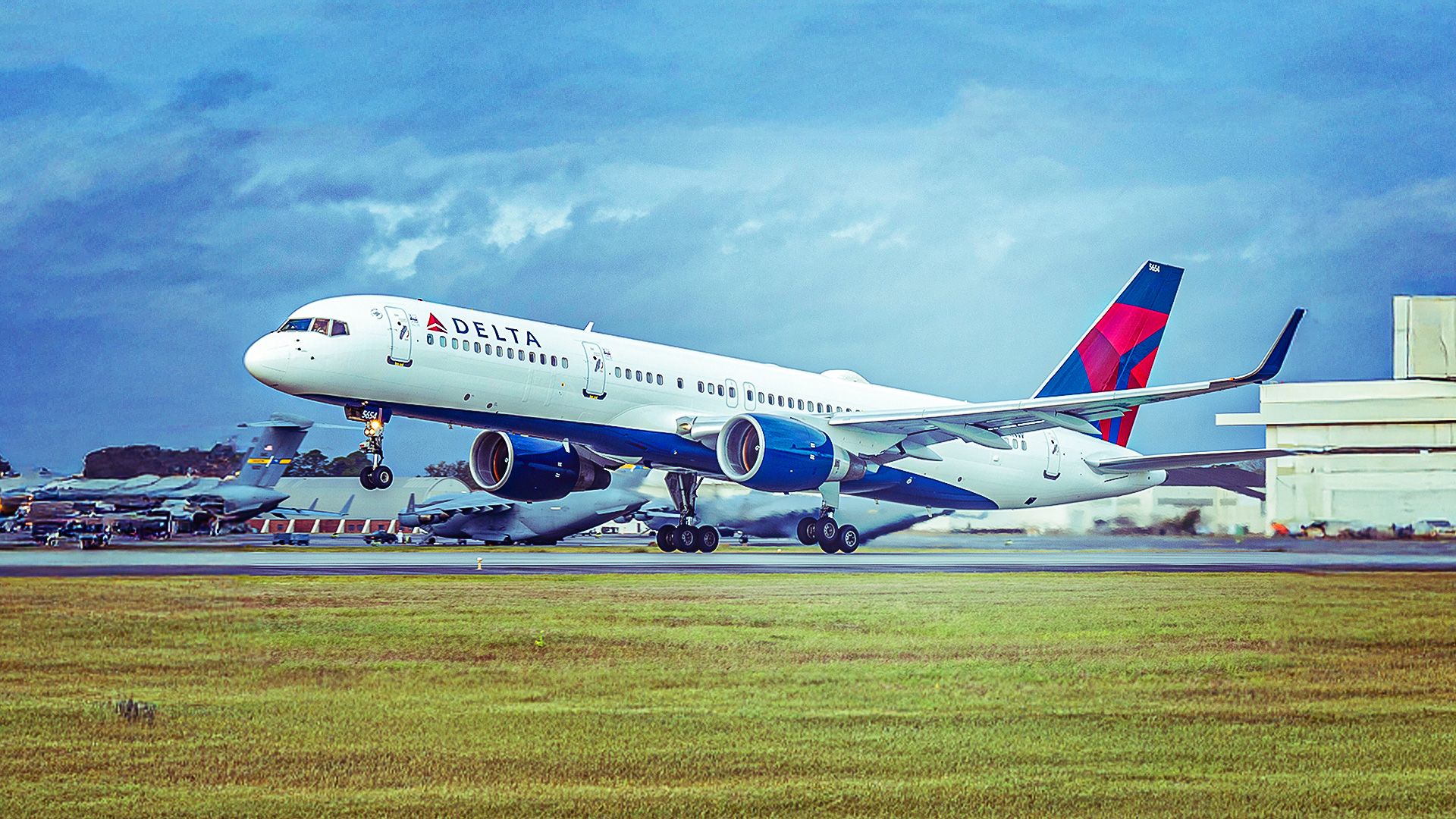
 Delta Air Lines is one of the three major operators in the United States aviation market. The Atlanta-based airline flies to over 300 destinations in more than 50 countries across six continents. It operates a large network with around 5,000 daily flights (including regional), employs around 100,000 staff, and served a total of 200 million passengers in 2024, according to its own corporate data.
Delta currently operates a fleet of almost 1000 aircraft across multiple manufacturers and types, from short-haul narrowbodies like the Airbus A220 and A320 to larger widebodies such as the Boeing 767 and the range-topping Airbus A350. One aircraft among them stands out as a significant backbone of the airline’s fleet history, providing Delta with versatility, longevity, and reliability. Delta’s Boeing 757-200. Join us as we explore the longest routes the 757-200 is deployed on in Delta’s network through 2025. Data provided by Cirium for routes above 1300 miles.
The History Of Delta Air Lines

Delta Air Lines was founded in Macon, Georgia, in 1924 as Huff Daland Dusters, becoming the first commercial crop-dusting company in the world. In 1928, the airline was purchased by C.E. Woolman and renamed Delta Air Service, “Delta” referring to the Mississippi Delta region. The airline first began carrying passengers on June 17, 1929, with the first route connecting Dallas, Texas, to Jackson, Mississippi.
In 1959, Delta introduced McDonnell Douglas DC-8s and Convair 880s to service in 1960, firmly establishing the airline in the jet age. In 1965, Delta became the first airline to fly the Douglas DC-9, operating a total of 165 by the time the type was retired from the fleet. In 1972, Northeast Airlines merged with Delta. This merger gave Delta gateway access to the busy Northeast corridor, especially Boston and New York.
In recent decades, throughout the 1980s and 1990s, Delta established key hubs in Atlanta,Cincinnati, andSalt Lake City, with Atlanta growing into the world’s busiest airport, and Delta becoming its largest carrier. Following its collapse in 1991,Delta purchased most of Pan Am’s transatlantic routes, transforming it into a major international airline. More recent years have been more turbulent for the airline; Delta filed for Chapter 11 bankruptcy in 2005. It emerged successfully from bankruptcy in 2007 following restructuring and cost-saving measures. In 2008, Northwest Airlines merged with Delta, creating the world’s largest airline at the time.
The 757 At Delta Air Lines

The Boeing 757 had its first flight on February 19, 1982, and entered service with Eastern Air Lines on January 1, 1983. Production ran from 1981 until 2004, with the final aircraft delivered in late 2005. The Boeing 757 quickly established itself as a reliable workhorse, with a dispatch reliability rate of around 99.98% and the versatility to operate efficiently on both shorter and longer routes.
Delta received its first 757-200 in 1984, and it became one of the largest operators of the aircraft. The airline operated a total of 98 757-200s and 16 757-300 variants as of early 2025. Delta configures its 757-200 fleet in a 199-seat, three-class configuration, with all seats featuring in-seat power, and free Delta Studio entertainment, plus WiFi. The 757-200 has a cruising speed of 525 mph (844 km/h) and a range totaling 3,370 miles (5,424 km).
|
Category (Delta Air Lines) |
Specification |
|---|---|
|
Cruising Speed |
525 mph (844 km/h) |
|
Range |
3,370 miles (5,424 km) |
|
Wingspan |
134 ft 9 in (41.1 m) |
|
Tail Height |
44 ft 6 in (13.56 m) |
|
Length |
155 ft 3 in (47.32 m) |
|
Seat Configuration (example layout) |
199 seats: 20 First, 35 Comfort+, 144 Main |
Although this type is aging, Delta and several other operators utilize this type for a number of reasons. The 757-200 is highly versatile: it has good takeoff performance, which makes it useful at airports with short runways or hot/high conditions. Despite its age, many airlines find it economically valuable on certain routes: slot-constrained airports or routes that are too lean for widebody but too demanding for smaller narrowbodies.
Distance Topping: 2500 To 3000 Miles

Forming the longest distance section on the Boeing 757-200 network, the 2500–3000-mile range contains 18 total flights. The longest of these routes is  Minneapolis-St. Paul International Airport (MSP) – Keflavik International Airport (KEF) at an average of 2,944 miles (4,737 km). This route offers 109 flights, 21,037 seats, and just under 62 million available seat miles (ASMs) each way. On this route, the 757-200’s range and mid-size capacity make it ideal for a “long, thin” transatlantic route that cannot support a widebody aircraft year-round.
Another contender incorporating the “Land of Fire and Ice” and offering the largest number of flights in this segment,  Detroit Metropolitan Wayne County Airport (DTW) — Keflavik International Airport (KEF) covers a slightly shorter average distance of 2,792 miles (4493 km) but has more flights at 121 each way. Offering 23,533 seats and over 65 million ASMs on each leg.
From one island destination to another, and the least number of flights available in this segment is Delta’s  Los Angeles International Airport (LAX) – Kona International At Keahole Airport(KOA) covers an average of 2,504 miles (4,029km) and has seen the 757-200 utilized on 39 flights each way, offering 7,527 seats.
Mid-Range: 1700 To 2500 Miles

Originating in Delta’s Atlanta hub, Hartsfield-Jackson Atlanta International Airport (ATL) —  Harry Reid International Airport(LAS) provides travelers with 97 flights each way on the 757-200, across an average distance of 1,747 miles (2,811km).
Another strong contender in this distance grouping, the most frequent out of all the routes in this analysis, connects two of Delta’s hubs.  Hartsfield-Jackson Atlanta International Airport (ATL) —
  Seattle-Tacoma International Airport (SEA) covers an average distance of 2,182 miles (3511km) and offers a total of 170 flights on the outbound leg and 168 on the return. Delta benefits from using the 757-200 on hub-to-hub routes such as this because the aircraft efficiently carries a high volume of connecting passengers while also allowing Delta to reposition the jet where it’s needed for international and long-range missions.
After analyzing the most frequent route in this distance grouping, what is the least frequent route? Hartsfield-Jackson Atlanta International Airport (ATL) –  San Francisco International Airport (SFO) covers an average of 2,139 miles (3,442km) and has seen the 757-200 utilized just once, with 193 seats available.
Lower End: Below 2000 Miles

The under 2000 miles segment displays some of the shortest uses of the 757-200 in Delta’s fleet network. The shortest route in this section sees the 757-200 deployed for 24 flights in each direction.  Orlando International Airport (MCO) — Minneapolis–Saint Paul International Airport (MSP) measures in at 1,310 miles (2,108km), supplying a total of 4,623 seats each way. The 757-200’s application on this route allows Delta to feed strong seasonal demand, and the aircraft’s capacity and efficiency let Delta handle heavy leisure traffic while feeding connections into its Minneapolis hub.
The most frequent and longest route in this distance section sees the 757-200 utilized between Hartsfield-Jackson Atlanta International Airport (ATL) – Los Angeles International Airport (LAX), covering a total distance of 1,916 miles (3131km) and providing 99 flights on the outbound and 100 flights on the inbound, offering passengers over 19,000 seats.
The routes in this shorter segment show how the 757-200 is versatile enough to be deployed on short routes, despite being designed for longer missions. It offers ample capacity during peak travel periods, and fits easily into Delta’s scheduling system. This flexibility lets Delta use the aircraft where demand surges, such as leisure markets or hub-to-hub routes, without needing to dedicate an additional smaller or larger replacement aircraft.
Future Of The 757

Delta’s 757-200s are aging, but the airline continues to value them because they fill a niche that few modern narrowbodies can fully replace. Their combination of long-range capability, strong performance at challenging airports, and mid-size capacity makes them useful on both transcontinental and select transatlantic routes. As long as these missions remain part of Delta’s network, the 757 still has a role.
At the same time, Delta is gradually modernizing its fleet, and the 757-200 will be retired in phases rather than all at once. Newer aircraft like the Airbus A321neo and Airbus A321XLR will eventually take over many 757 missions. Still, the transition will take years because no single model can seamlessly match the 757’s unique performance profile. This makes the 757 one of the slower fleets to phase out compared with others.
In the near term, Delta will likely continue operating refreshed 757s on key routes where their strengths matter most, thin transatlantic flights, high-demand domestic trunk routes, and airports with hot-and-high or short-runway challenges. While the fleet’s long-term future is limited, the aircraft still plays an important strategic role, ensuring it remains a core part of Delta’s schedule for the foreseeable future.
