

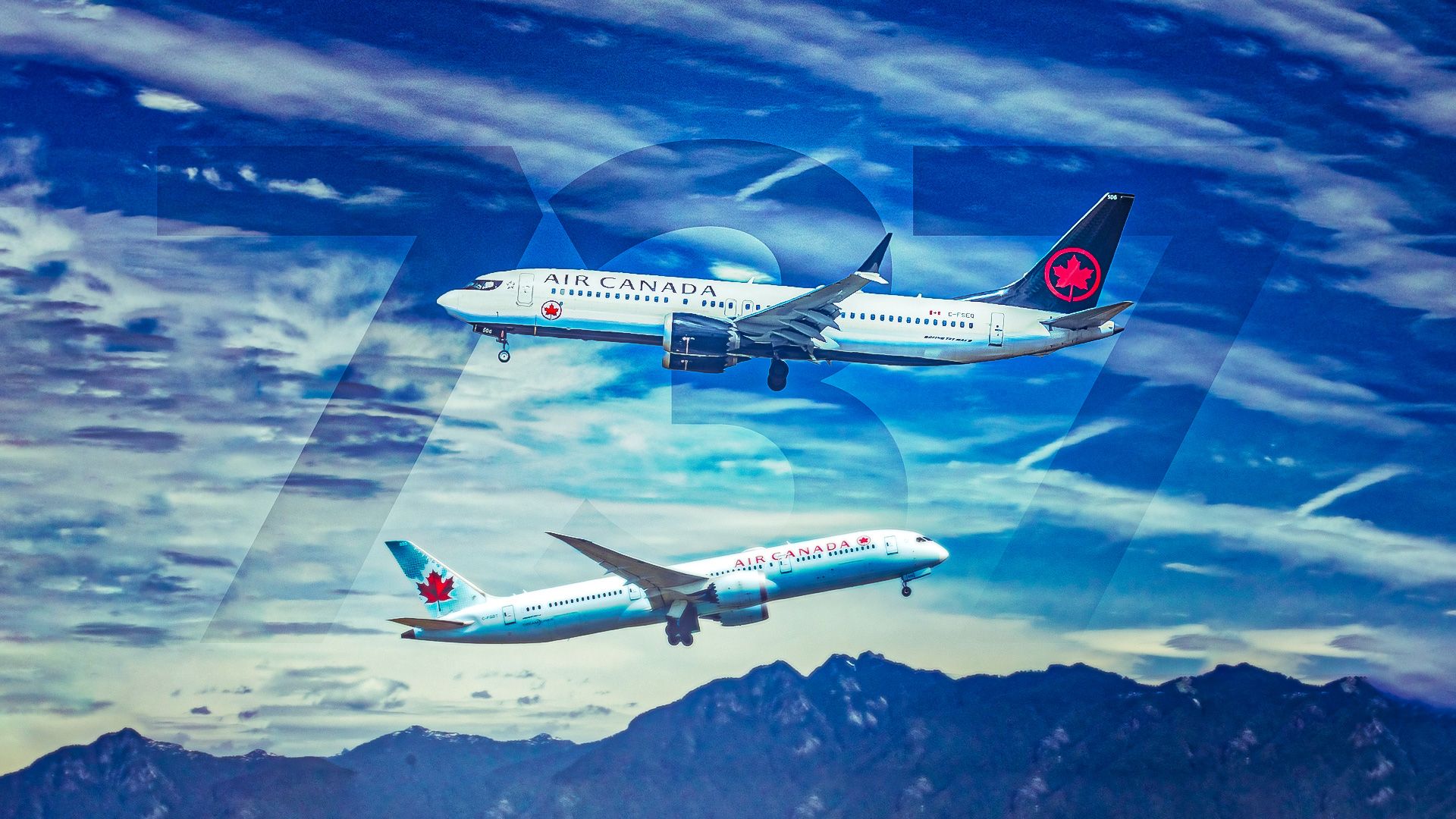
This past Saturday, October 11, a Boeing 737 MAX 8 was towed directly into an Airbus A321 at  Toronto Pearson International Airport (YYZ). Video shows the driver trying to “shoot the gap” between two parked planes, as if they forgot that they were towing a plane themselves.
The two jets were both owned by Air Canada (AC). From the video angle, it appears that the wingtip of the 737 MAX impacted the horizontal stabilizer of the A321 with visible damage apparent afterward, according to Flying Report.
Air Canada’s Mauled Jetliners

The Airbus A321 is an 18-year-old jet registered as C-FGKN that AC acquired from Air France in 2015, as the Daily Mail identified. Public records on Planespotters.net do not list any other mishaps in the plane’s history since it first flew in 2007. Schedule activity on FlightAware shows that C-FGKN had been parked overnight before the incident after arriving in the late hours of Friday, October 10.
The other aircraft is not identifiable from photos or video at this time. Comment has been requested from Air Canada and any additional information will be updated as received. Fleet data from Planespotters.net shows that the average age of the MAX 8 aircraft owned by AC is less than 6-years-old.
Unfortunately, the veteran Airbus and shiny, new Boeing were bloodied as a result of essentially inadequate ground crew training or lack of proper operations management. Whether the driver was simply careless or not, the result reflects poorly on the AC team at Toronto.
Jason Mann, general manager of Western Jet Aviation, remarked to Aviations Pros on his experience with the most common causes of ground damage:
“I have found that haste, inattention and inadequate training are some of the leading causes of ground damage. Factors include staffing, staffing talent, GSE capabilities, traffic… ramp design, weather, [and others].”
Statistically Bad Luck For AC

The European Aviation Safety Agency (EASA) reports that for every 5,000 commercial flights, there is one ground towing accident on average. The damage usually occurs as ground support equipment (GSE) is being hooked up or released and not during the actual tow itself, according to the EASA. The report found that 90% of damage was caused by GSE issues or ground handlers, while 10% was due to aircraft issues or aircrew actions during ground activities.
Terry Yeomans, director, IS-BAH (International Standard for Business Aircraft Handling) Program, told Aviation Pros that about half the time a ground damage mishap occurs, it is because of someone not paying attention. The other half of the accidents are typically due to cutting corners. In his experience, about half of incidents happen during GSE service, towing, or pushback activities.
Yeomans also said that the most commonly damaged areas on aircraft are the extremities, with wingtips and leading edges being the most frequently damaged. Empennage and swept, low wings are among the most often victims of ground strikes. All of which matches up with the AC incident on Saturday.
A Pricey Mistake

Until all the jet is fully repaired and safe to fly, it will be stuck on the ground and not earn any money for its operator, which factors into the over cost of the mishap because of the lost revenue. Aviation Pros reports even minor scrapes and dents can cost several thousand dollars to repair. A 737 MAX winglet can be as much $1 million, and the A321’s horizontal stabilizer will likely be even more as a powered control surface.
Some damage is more obvious than others. The two AC jets will be grounded for investigation, inspection, and diagnostics to determine any internal repairs that may be necessary on top of the obvious control surface damage. Scrapes, dents, and dings in metal surfaces can be just the tip of the iceberg. Composites may not appear damaged at all to the naked eye, but conceal an imminently high risk of failure.
The increasingly aggressive push for maximum lightness and efficiency in commercial jets means that more and more composite material is found throughout the structure of airliners today. That demands thorough inspection after any incident to ensure the integrity of a jet is not compromised.
