



Subscription Required
Open to All Readers
By Scott Hamilton
Background
April 6, 2026, © Leeham News: Depending on what starting point you want to choose, it will be about 30 years between brand new, clean sheet airplane designs at The Boeing Co.
Boeing announced its 787 program in December 2003, with a formal launch the following spring. The entry-into-service goal for the 787 was May 2008. Boeing planned to design a replacement for the aging 737 platform after the 787 entered service. A new design for replacing the 777 was supposed to come after that.
The 787’s EIS date came and went as design and production problems added up to 3 ½ years of delay.
With cost overruns, deferred production, and deferred tooling costs totaling more than $50bn, plus several billion more dollars written off for research and development and abnormal production costs, the 787 still has more than $14bn in deferred costs to recover.
Delays and cost overruns hurt the 747-8 program. The 2019 21-month grounding of the 737 MAX resulted in billions more in charges. The January 2024 door plug blowout on a new Alaska Airlines 737-9 hurt recovery. Scrutiny by the Federal Aviation Administration (FAA) continues to this day. Production rates for the 737 and 787 are well below those that predate the MAX grounding. Certification of the 737-7, 737-10, and 777X remains a hope, not a reality, so far.
A plethora of losses, charges, and delays in defense and space programs added to the losses. Boeing’s long-term debt in 2018, its last normal year, was over $10bn. Today, it’s over $54bn, with big repayments coming soon.
Boeing’s next new airplane program remains years away.
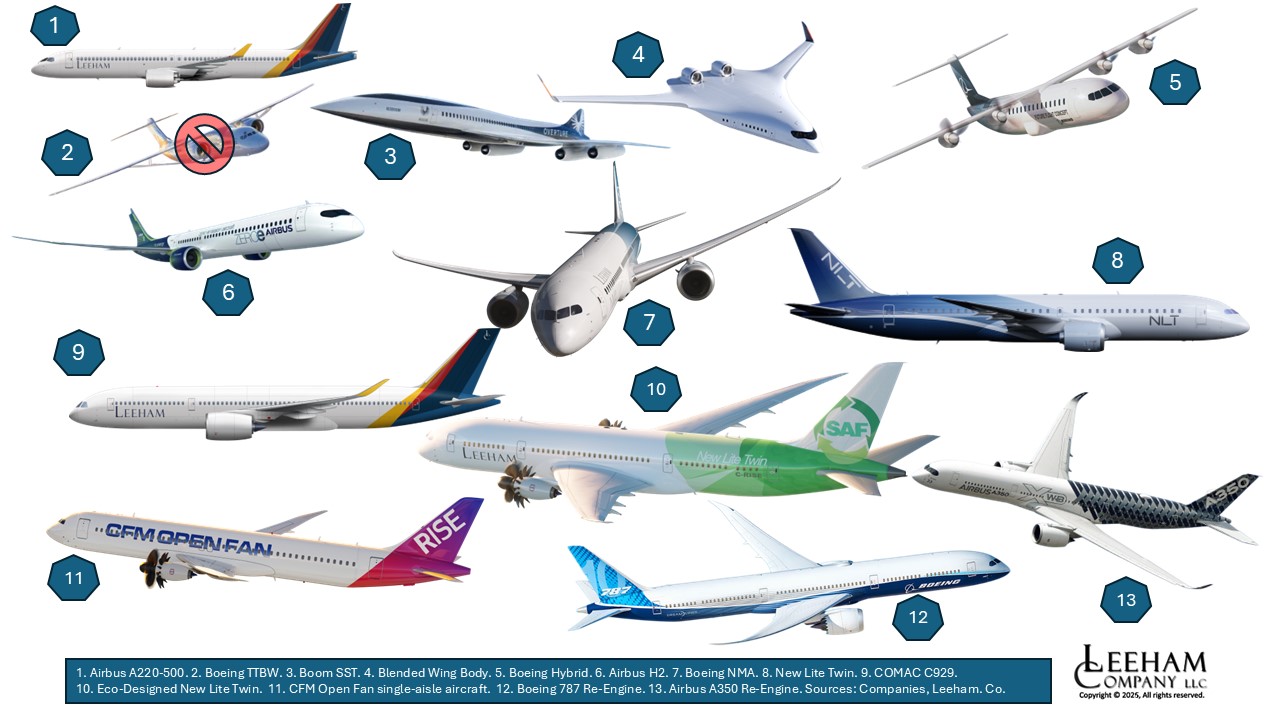
What will Boeing’s next new airplane be? We have a pretty good idea. A new series beginning Thursday explores this question. Credit: Leeham News.
A multi-part series
LNA begins a multi-part series about Boeing’s new airplane program on Thursday. We explain when we expect Boeing to launch not one, but two new airplane programs. LNA reveals what new technology will be applied, what the issues and challenges are, and how Boeing is already, quietly and publicly, implementing processes that will go into its new airplanes.
How we went about this
LNA has spent more than three years gathering information to put this series together. However, the foundations go back to the era of former CEO Jim McNerney (2005-2015). It was during his tenure that Boeing began talking not just about a replacement for the 737 NG, but about a new twin-aisle widebody aircraft about the size of the 767-200ER and 767-300ER, which officials called the Middle of the Market aircraft (MOM). The MOM evolved into the New Midmarket Airplane (NMA), a controversial proposal that split its own executive ranks.
Jim Albaugh, then the CEO of Boeing Commercial Airplanes (BCA), and Mike Bair, the program manager for the 787 and later the 737, wanted the MOM airplane. Ray Conner, then the top salesperson for BCA, wanted a replacement for the 757. Eventually, the MOM won out.
Even then, there was opposition at the highest levels. Greg Smith, EVP and CFO of The Boeing Co., opposed it. So did David Calhoun, the lead director. When McNerney retired, his successor, Dennis Muilenburg, favored the NMA. To implement the anticipated launch of the NMA, he hired Kevin McAllister of GE to replace Conner, who retired in 2017 after replacing Albaugh, who resigned abruptly in 2012. Despite Conner’s advocacy for the 757 replacement, BCA had gone too far down the path toward the NMA. Muilenburg was nearing board approval for the NMA in 2019. This plan was derailed with the March 13, 2019, grounding of the MAX.
There’s more to this background (told principally in my books, Air Wars, The Global Combat Between Airbus and Boeing, and The Rise and Fall of Boeing and the Way Back).
Our research
LNA’s dedicated research for this article series includes ancient history, public statements by McNerney, Muilenburg, Calhoun, Boeing officers and spokespersons, aerospace analyst reports, and our own reporting.
It includes information in the public domain via the Internet. There is a lot of information out there if you know where to look and what to look for. And we did. Additionally, suppliers proved to be another valuable avenue of research. We pretty much hate going to the Paris and Farnborough air shows and conferences, but these venues are gathering spots where suppliers are plentiful.
Boeing’s executives declined requests for interviews about product development, as did BCA’s VP of Production Development and the leaders of the Research and Technology group. But even here, there’s a lot more information in the public domain than Boeing’s own corporate communications people realize.
In December, Boeing’s R&D partner, NASA, provided an update about new wing research recently done at a NASA wind tunnel. The model airplane was clearly a widebody aircraft with a larger turbofan engine—the NMA, not a single-aisle aircraft.
In March alone, the current corporate CFO, Jay Malave, revealed some critical details at a Bank of America event. A week later, Brian Yutko, the VP of Product Development, appeared at the Pacific Northwest AIAA semi-monthly meeting to discuss new technology while studiously avoiding specific airplane programs. His information provided the final pieces of the jigsaw puzzle LNA was putting together to get the picture of the new airplane programs.
Lots of Caveats
Whenever LNA is asked about the progress of Boeing’s long recovery, we always place the caveat on any predictions that unknowns can upset the apple cart for Boeing at any time.
Here, in no particular order, are the caveats that precede our series.
- Global or regional events, such as pandemics and conflicts that have global implications. The Iran War is an example of the latter, in which the full implications have yet to be understood.
- A global recession, such as the one beginning in 2008.
- Trade wars, notably the one with China, began in 2017 under the first Trump Administration. The Biden Administration didn’t ease this trade war, and Trump, in his second term, intensified it.
- Economic sanctions, notably, Biden against China in connection with its support of Russia in the Ukraine war.
- How long the FAA continues its intense scrutiny of Boeing.
- Another “Alaska 1282” event (the door plug blowout) or any other event that raises safety questions over Boeing.
- What happens if Airbus, or even Embraer, forces Boeing’s hand prematurely by launching a new single-aisle airplane program?
- Engine development: new engines must achieve double-digit reductions in fuel consumption compared to today’s engines. They must demonstrate maturity to ensure reliable, durable in-service operations. An entirely new engine is needed for the MOM-category airplane. GE must satisfy the industry that its proposed RISE Open Fan engine isn’t a pipe dream. Pratt & Whitney must regain customers’ confidence that the decade-long debilitating problems with its GTF engine are over. Rolls-Royce must finance the development of not just one but possibly two new engines.
Undoubtedly, we’ve missed some factors that go into the caveats, but readers will get the point.
With that, our series begins on Thursday behind the paywall.
Related
