


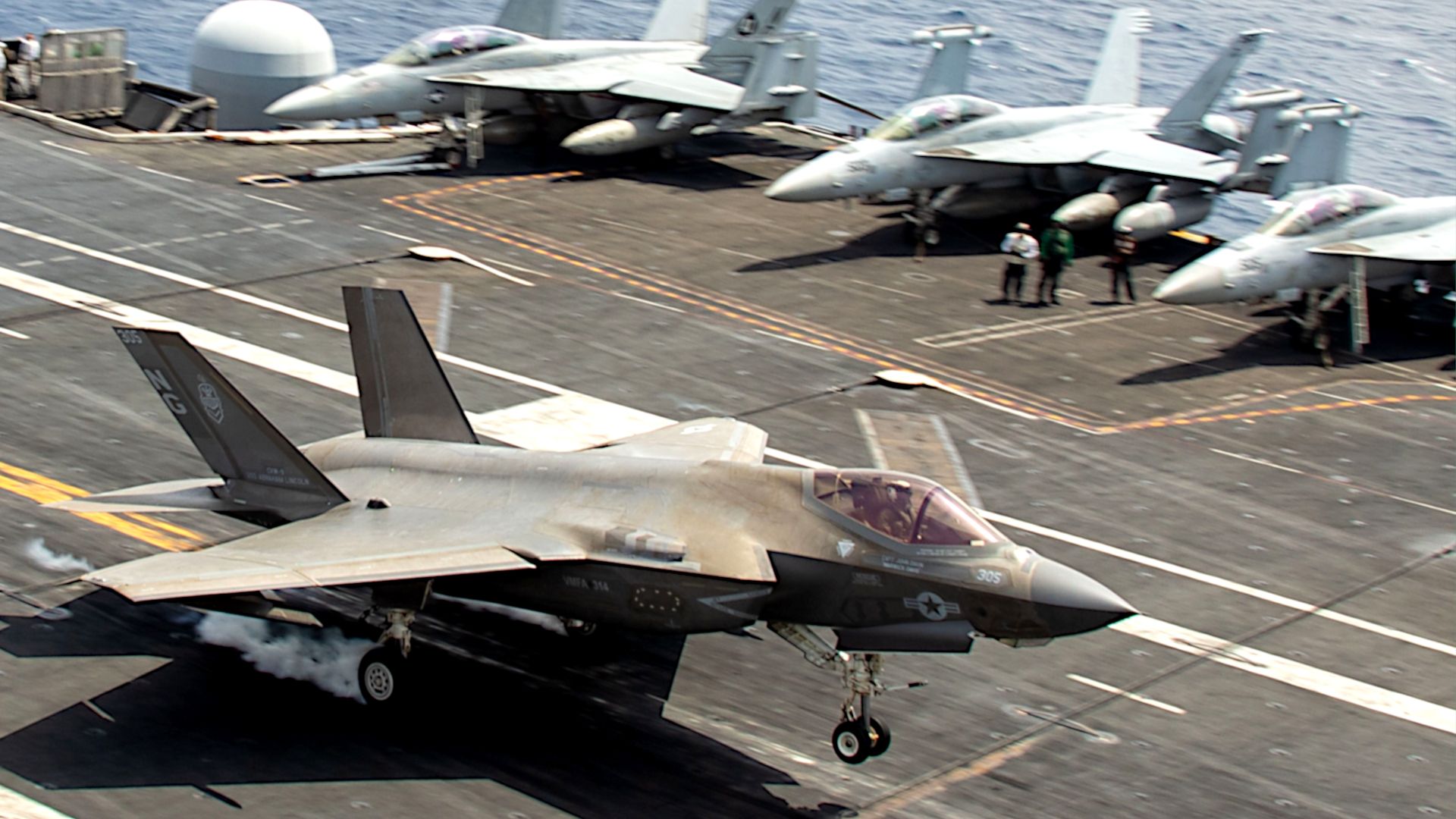
The question of who is winning the military aircraft battle in 2025, Boeing or Lockheed Martin, is one that resonates far beyond the aviation sector. It is a contest of technological supremacy, defense policy, and national security. Both aerospace giants have been shaping military aviation for decades, and their competition defines the aircraft fleets of the United States and allied nations worldwide.
- Stock Code
-
BA
- Business Type
-
Planemaker
- Date Founded
-
July 15, 1916
- CEO
-
Kelly Ortberg
- Headquarters Location
-
Chicago, USA
This article explores the rivalry between Boeing and Lockheed Martin in 2025, analyzing key aircraft programs, defense contracts, and global market dynamics. We will assess which company currently holds the upper hand in the fight for dominance in the skies, and why it matters for both military strategy and aviation history.
Lockheed Vs. Boeing: The Fierce Military Market In 2025

At the surface level, Lockheed Martin appears to be leading the military aircraft market in 2025, thanks largely to the continued global success of the F-35 Lightning II program. Boeing, however, is far from out of the game, sustaining critical roles with the KC-46 Pegasus tanker, the P-8 Poseidon maritime patrol aircraft, the F-15EX Eagle II, the C-17 Globemaster III , and the enduring B-52 Stratofortress.
Lockheed’s dominance is visible in terms of revenue and international market share. Yet, Boeing continues to position itself strategically in programs vital for USAF modernization. Thus, while Lockheed may be considered the winner in terms of stealth fighters, Boeing remains indispensable in bombers, transports, refueling, and maritime patrol.
Moreover, in March 2025, Boeing won the Next Generation Air Dominance (NGAD) contract, giving it responsibility for the USAF’s future F-47 fighter. Boeing is also competing in the Navy’s F/A-XX program, where Lockheed has already been ruled out. Combined with its KC-46 tanker, P-8 Poseidon patrol aircraft, and upgraded fighters, Boeing is securing a long-term stake in nearly every mission profile.
Historically, the balance of power has shifted repeatedly: Boeing (once McDonnell Douglasbefore the acquisition by Boeing) commanded the skies with aircraft like the F-15, F/A-18, and C-17, while Lockheed transformed global air forces with the F-16, F-22, and now the F-35. The competition remains fierce, with both companies shaping different aspects of military aviation today.
What Factors Influence Who’s “Winning” In Defense Aviation?

When asking which company has the advantage in the aerospace and defense sector, the answer isn’t straightforward. Success isn’t measured by a single contract or aircraft program, it’s shaped by a mix of strategic, technological, and operational factors. Several key elements consistently influence the balance between Lockheed Martin and Boeing:
- Aircraft portfolio strength: breadth and global appeal across mission types.
- Defense contract awards: the scale and frequency of new US and allied government deals.
- Global partnerships: integration with allied nations and defense ecosystems.
- Technological innovation: investment in next-generation capabilities like stealth, drones, and AI.
- Program execution: delivering complex projects on time and within budget.
Lockheed’s F-35 program remains the backbone of its dominance, with over 20 nations committed to the jet, making it the most widely adopted fifth-generation fighter in the world. For Boeing, the real story is momentum: winning the NGAD F-47 program puts it back at the technological cutting edge, while participation in the US Navy ’s F/A-XX competition positions it as the only US prime spanning both Air Force and Navy future fighter programs. That gives Boeing influence over the direction of sixth-generation combat aviation in a way Lockheed no longer has.
|
Category |
Lockheed Martin |
Boeing |
|---|---|---|
|
Fighters |
F-35 Lightning II, F-22 (legacy support) |
F-15EX Eagle II, F/A-18E/F Super Hornet |
|
Bombers |
N/A |
B-52 Stratofortress, B-1B (support), B-2 (support) |
|
Tankers |
N/A |
KC-46A Pegasus, KC-135 (legacy support) |
|
Patrol/Recon |
N/A |
P-8A Poseidon |
|
Transport Aircraft |
C-130J Super Hercules |
C-17 Globemaster III |
|
Helicopters |
Sikorsky UH-60 Black Hawk (via Lockheed) |
AH-64 Apache, CH-47 Chinook |
|
Drones / Advanced Tech |
Loyal Wingman concepts |
MQ-25 Stingray |
In other words, Lockheed holds the present advantage in exports and interoperability, but Boeing has carved out the future advantage in cutting-edge design and long-term Air Force commitments. That tension is exactly why it’s difficult to declare a single “winner” in defense aviation.
Both companies excel in different domains, making them indispensable to the overall US and allied defense strategy.
How Are Governments And Militaries Making Their Choices?

Government procurement is often the clearest signal of who is shaping the future of military aviation. In 2025, the US Department of Defense doubled down on Lockheed Martin’s F-35 Lightning II, making it the backbone of allied air power. Multi-billion-dollar contracts from the Air Force, Navy, and Marine Corps are echoed abroad by European partners like the UK, Italy, and Poland, as well as Asian allies like Japan and South Korea.
Boeing, however, anchors many mission-critical programs. The United States Air Force (USAF) reaffirms reliance on the KC-46A Pegasus and continues to modernize the B-52 fleet. Japan and Australia have invested in the P-8 Poseidon, while Saudi Arabia and Indonesia are committed to Boeing fighters. The C-17 Globemaster III, though no longer in production, remains vital to US and allied mobility, with sustainment contracts ensuring decades of service. These trends underscore three recurring factors shaping procurement decisions:
- Cost and lifecycle management: whether governments can justify long-term sustainment expenses.
- Mission requirements: matching platforms to operational needs, from stealth dominance to maritime patrol.
- Alliance politics: the importance of aligning with US and NATO forces for joint operations.
These procurement trends highlight how governments weigh cost, mission needs, and alliance politics. Lockheed benefits from widespread adoption of the F-35, while Boeing maintains a vital foothold through platforms that allies need to fill operational gaps. Instead of one company “winning,” both are positioned as indispensable players in different mission spaces.
The Global Competition Beyond The US Giants

Some might argue that Boeing’s diversified portfolio across both military and civilian aviation gives it an edge. Some argue Boeing’s diversified portfolio, spanning military and commercial aviation, gives it resilience. Others point to European firms such as Airbus, Dassault, and Saab as competitors.
Airbus has achieved tanker success with the Airbus A330 MRTT, while Dassault Rafale and Saab’s Gripen continue to win export deals. Yet, the scale of Lockheed’s F-35 program and Boeing’s enduring role in bombers and transports dwarf these successes.
|
Rank |
Manufacturer |
Fighter Model(s) |
Estimated Export Units (2025) |
Key Importing Countries |
|---|---|---|---|---|
|
1 |
F-35 Lightning II |
800+ |
USA, UK, Japan, Australia, Poland, Finland, Israel, South Korea, Italy, Netherlands |
|
|
2 |
Dassault Aviation |
Rafale |
250+ |
India, Egypt, Greece, UAE, Indonesia, Qatar |
|
3 |
F-15EX, F/A-18E/F Super Hornet |
200+ |
Saudi Arabia, Indonesia, Kuwait |
|
|
4 |
Gripen E/F |
100+ |
Brazil, Sweden, Czech Republic, Thailand |
|
|
5 |
Eurofighter Gmbh |
Typhoon |
90+ |
Germany, Spain, Italy, UK, Austria, Qatar, Saudi Arabia |
|
6 |
J-10C, J-20 (limited exports) |
Pakistan (confirmed J-10C orders), potential interest from Middle East (UAE reportedly considered but no deal), African partners (Egypt and Nigeria floated in media reports, but unconfirmed) |
||
|
7 |
Su-30, Su-35 |
India (Su-30MKI, license-built by HAL), Algeria, Vietnam, limited sales to China (Su-35) |
 Boeing
Sources: SIPRI , FlightGlobal , TheAviationist .
Ultimately, Lockheed outpaces competitors in the stealth fighter domain, while Boeing secures its importance in US Air Force sustainment and modernization. European options remain relevant but not dominant compared to the American giants.
The Hidden Risks Both Companies Face

Both Boeing and Lockheed face significant risks. For Lockheed, the F-35’s sustainment costs remain controversial. The US Government Accountability Office (GAO) has warned that maintenance costs could strain defense budgets for decades. If allies begin to question affordability, Lockheed’s dominance could waver. Allies that signed on for interoperability may eventually start questioning whether the cost of upgrades, spare parts, and training is sustainable. If a critical mass of partners pauses or scales back purchases, Lockheed’s airpower monopoly could face cracks.
Boeing, meanwhile, is walking a tightrope of its own. The KC-46 Pegasus, though now entering steady service, has carried years of delays and technical problems, from its refueling boom to vision systems. That history has dented trust, even if the US Air Force insists the aircraft will be indispensable. On the fighter side, Boeing’s mainstays, the F-15EX Eagle II and F/A-18 Super Hornet, are modernized but still rooted in fourth-generation designs. As the world’s air forces move toward stealth and sensor fusion, Boeing risks looking like yesterday’s solution.
The company’s big counterpunch is, of course, the NGAD F-47 win. On paper, it vaults Boeing back to the cutting edge, promising sixth-generation stealth, range, and advanced networking. But history shows next-generation fighter programs are notoriously prone to delays and budget overruns. And unlike the F-35, the NGAD may never become a mass-export product, limiting Boeing’s ability to replicate Lockheed’s global network effect.
The Big Picture

So, who is winning the military aircraft battle in 2025? The short answer: Lockheed Martin. Its F-35 program continues to dominate both US and allied procurement, making it the backbone of NATO’s air forces and beyond.
But Boeing’s role is far from secondary. By leading in tankers, maritime patrol, and upgraded fourth-generation fighters, Boeing ensures that US air power remains flexible and sustainable. Without Boeing, the US military machine would face major operational gaps.
Looking ahead, the real contest will be the sixth-generation fighter market. The NGAD program, along with similar efforts in Europe and Asia, will determine whether Lockheed or Boeing shapes the next era of combat aviation. Until then, Lockheed may be ahead, but the race is far from over.
