



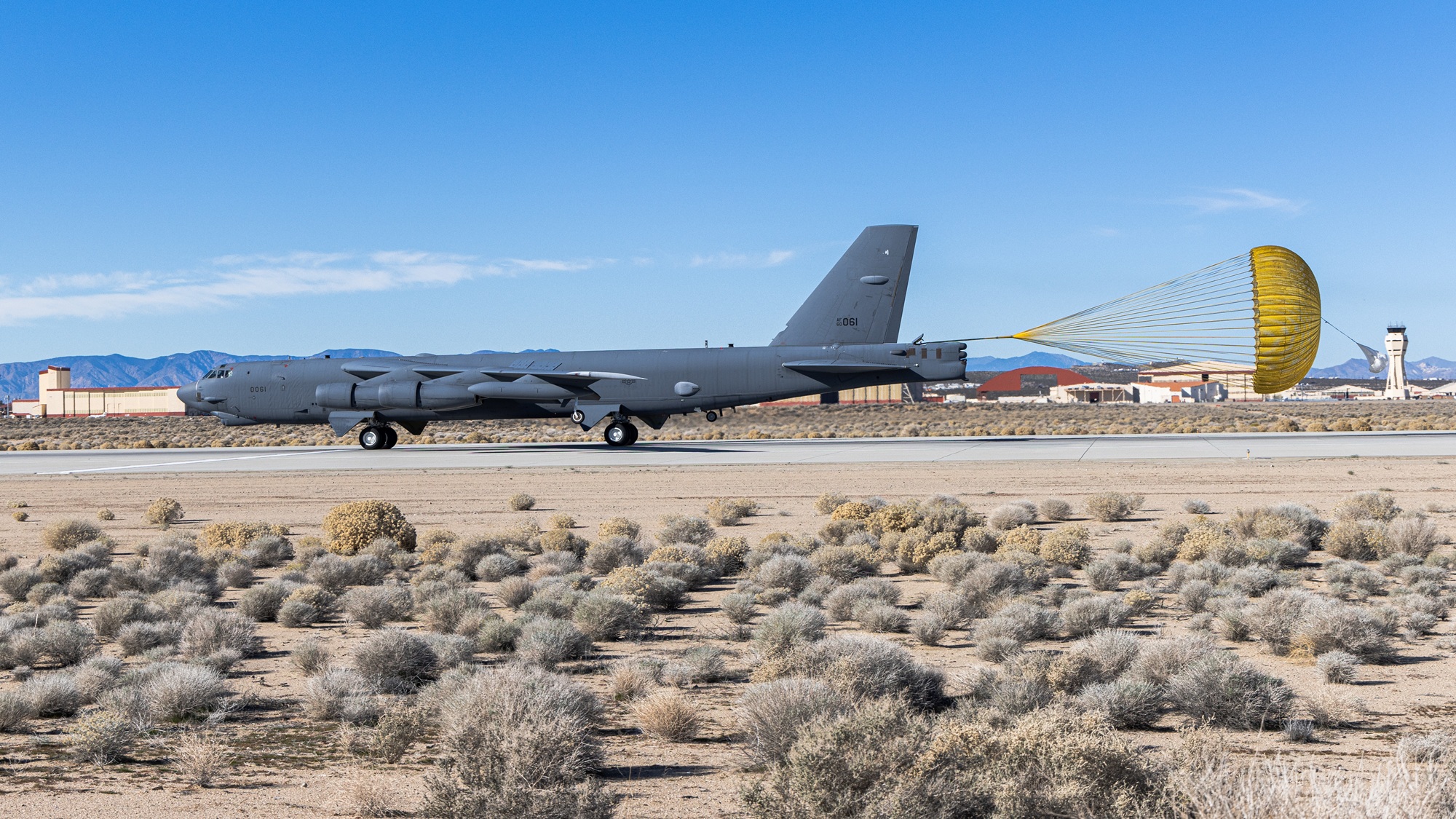
The B-52H received the AN/APQ-188 AESA radar at Boeing’s San Antonio facility and has now arrived at Edwards AFB for the ground and flight testing planned throughout 2026.
The U.S. Air Force has announced that the B-52H Stratofortress modified with the new AN/APQ-188 Active Electronically Scanned Array (AESA) radar has been ferried to Edwards Air Force Base, California, on Dec. 8, 2025. The bomber received the new system at Boeing’s San Antonio, Texas, facility as part of the B-52 Radar Modernization Program (RMP).
“This milestone marks a significant step forward in the aircraft’s ongoing modernization efforts to ensure it remains a critical component of the United States Air Force’s conventional and nuclear long-range strike capabilities,” says the service. The arrival also follows comments in August by Lt. Gen. Andrew J. Gebara, Deputy Chief of Staff for Strategic Deterrence and Nuclear Integration, who said the service was “very close to getting that first radar to Edwards Air Force Base to begin flight test.”
Arrival at Edwards
The Air Force explained in a press release that a crew from the 49th Test Evaluation Squadron at Barksdale AFB, Louisiana, and the 419th Flight Test Squadron at Edwards AFB, transferred the aircraft from Boeing’s facility. Together with the photos of the bomber landing at Edwards, the service also released a photo showing the new radar installed in the radome.

“The ferry flight of this upgraded B-52 marks an important moment in our efforts to modernize the bomber force,” said Secretary of the Air Force Troy Meink. “This radar modernization ensures that the B-52 will continue to serve as a cornerstone of American airpower well into the future. We are committed to extending the life of this vital platform, allowing it to operate alongside next-generation fighter and bomber aircraft.”
The service further described the RMP as “a key element of the broader strategy to modernize the B-52 as its planned service life now extends through 2050 and potentially beyond, as it becomes the long-range strike complement to the Air Force’s newest strategic bomber, the B-21 Raider.” Raytheon’s modern AESA radar system replaces the aircraft’s antiquated and failing legacy AN/APQ-166 radar, providing an upgraded all-weather navigation and targeting capability.
“This milestone ensures our future Airmen inherit a modernized, ready Air Force,” said Air Force Chief of Staff Gen. Ken Wilsbach. “The B-52 Radar Modernization Program is about more than technology, it’s about readiness, deterrence and the ability to fight and win. The B-52 remains a powerful example of how we fly, fix, and fight to sustain global strike capability.”
The Radar Modernization Program
The radar upgrade is a cornerstone of the broader B-52J configuration, which also includes new engines, updated avionics, and structural improvements intended to keep the bomber fleet in service through 2050. The new radar, Raytheon’s AN/APQ-188 – also referred to as the Bomber Modernized Radar System – is meant to replace the obsolete mechanically scanned AN/APQ-166 that has been in use since the Cold War.
The AN/APQ-188 is an active electronically scanned array (AESA) radar derived primarily from the AN/APG-79 found on the U.S. Navy’s F/A-18E/F Super Hornet and EA-18G Growler, with additional elements from the AN/APG-82 of the U.S. Air Force’s F-15E and F-15EX. By leveraging existing, proven designs, the Air Force aimed to control costs while giving the B-52 access to modern multi-mode AESA capabilities.
As Lt. Gen. Gebara explained during a Mitchell Institute event in August 2025, the radar was intentionally based on the F/A-18’s design because it was readily available on the market. “It would actually cost us more if we asked to design a new radar,” he said.
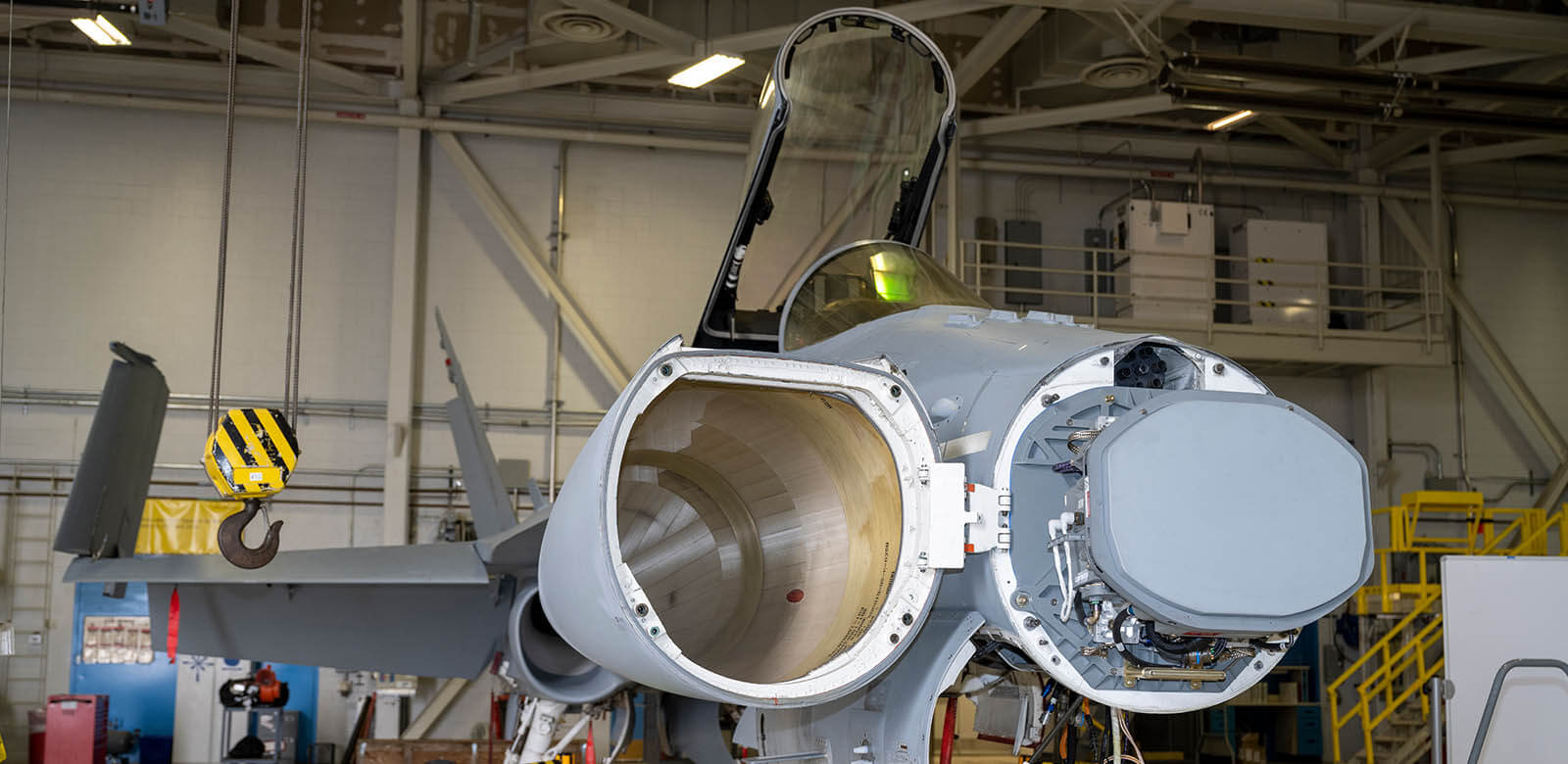
However, this approach also meant reassessing which features were truly necessary for the B-52’s mission. With the F/A-18 being a multirole aircraft, many of its radar’s functions – especially air-to-air – would not be needed by the B-52, and removing them would mean reducing the complexity, although additional functions could be added later if funding allows.
AESA radars bring significant advantages over mechanically scanned systems. Among these are increased detection range, improved resolution, greater resistance to jamming, and multifunctional capabilities that can also support electronic warfare.
For the B-52, the new radar is expected to enhance target acquisition, potentially with ground moving target indication and synthetic aperture radar functions. Additionally, although it is optimized for air-to-ground roles, the new radar could still retain air-to-air capabilities to the bomber defend against air-to-air threats.
Delays And Cost Growth
Despite these ambitions, the program has faced serious difficulties. Raytheon delivered the first radar to the Air Force nearly two years ago, but flight testing, initially planned for Fiscal Year 2024, was postponed to Fiscal Year 2026. This delay also shifted the expected initial operational capability from 2027 to a window between 2028 and 2030.
A June 2025 report from the Government Accountability Office (GAO) attributed the setbacks to challenges with environmental qualification, software development, and parts procurement, while the Pentagon’s Director of Operational Test and Evaluation (DOT&E) flagged difficulties in physically integrating the radar into the B-52’s nose section.
The delays were consequently accompanied by cost growth that triggered a Nunn-McCurdy breach earlier this year. Under U.S. law, a significant breach, defined as a cost increase of at least 15% from baseline, requires the service to notify Congress and review the program.
While the B-52 radar breach was not deemed critical, which would have required the Department of Defense to certify the program as essential to national security, the Air Force nonetheless examined the radar’s requirements to identify possible cost savings.
A rare view of B-52’s open nose. In 2023, Boeing initiated a major radar upgrade program for the B-52. The Radar Modernization Program (RMP) will equip the venerable B-52H with new, fighter-like radar capabilities. This upgrade will enhance navigation accuracy, targeting,… pic.twitter.com/IIIM1iqWPi
— Air Power (@RealAirPower1) December 13, 2024
The B-52J Modernization
The radar upgrade is just one part of a wider modernization push for the Stratofortress, one of the Air Force’s oldest yet most enduring platforms. Another critical effort, the Commercial Engine Replacement Program (CERP), is replacing the B-52’s eight TF33 engines – out of production since the 1980s – with Rolls-Royce F130s.
Like the radar program, the engine initiative has experienced schedule slips, with operational use now not expected before 2033, three years later than originally planned. Full fleet re-engining may not be completed until 2036, according to The War Zone.
Despite these delays, the modernization programs reflect the Air Force’s long-term commitment to the B-52. With its large payload capacity, global range, and adaptability to modern weapons, the Stratofortress remains central to the U.S. nuclear and conventional strike mission.

In fact, as previously reported, the Air Force plans to move to a two-type bomber fleet, based on the new B-21 Raider stealth bomber and the upgraded B-52J. The upgrades would allow the B-52J to complement the B-21 with long-range stand-off attack capabilities, while the stealth bomber would focus on penetrating heavily defended airspaces.
