


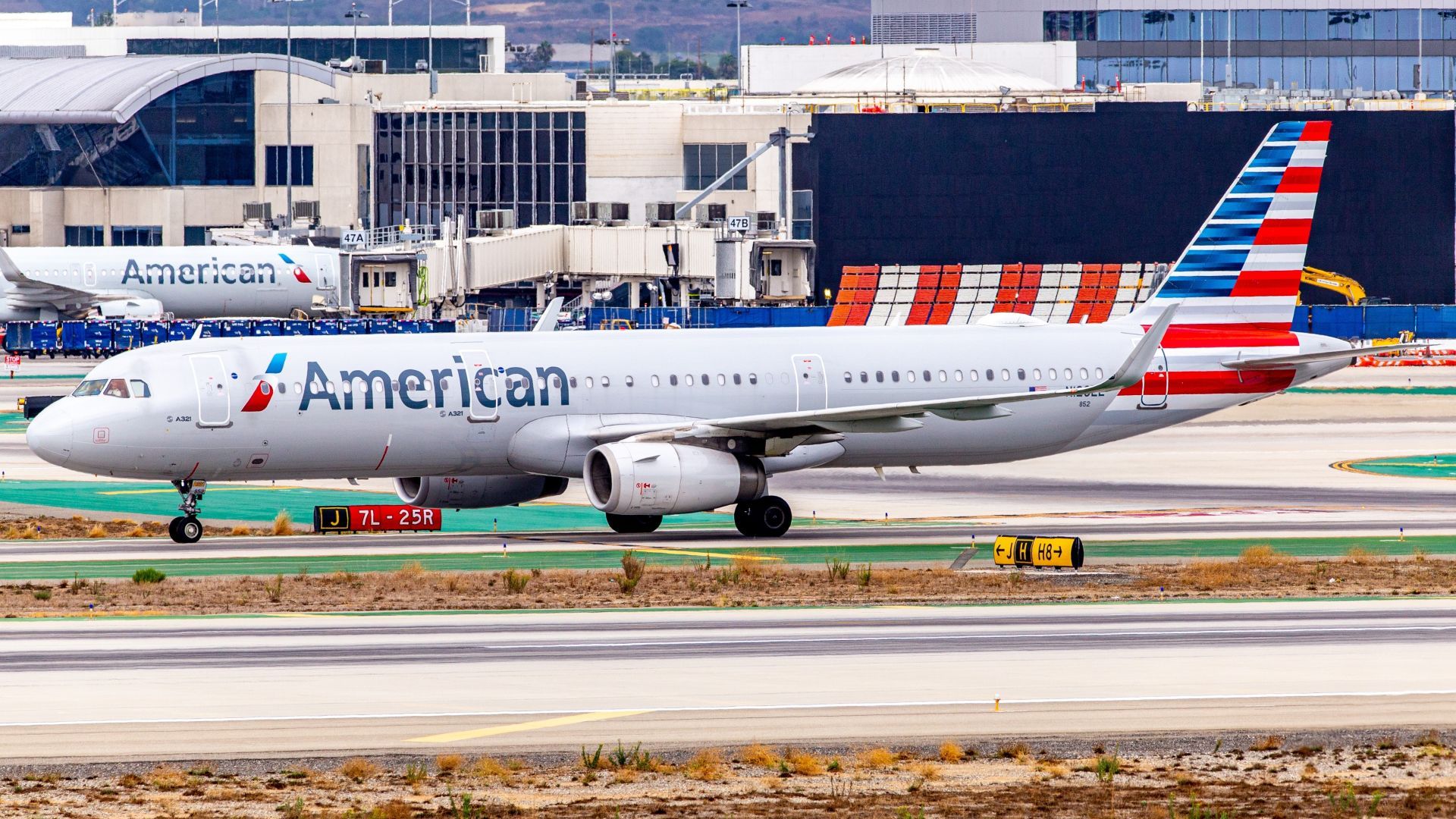
Passengers aboard an American Airlines Airbus A321-200 at Los Angeles International Airport were delayed by over two hours on Sunday night after the pilots had to initiate a rejected takeoff. As per CNN, the flight, AA2453, was taking off for Boston in the evening of September 28 when an AeroLogic Boeing 777F entered the same runway ahead.
The air traffic controller subsequently canceled AA2453’s takeoff clearance, and the pilots performed a high-speed rejected takeoff. The aircraft returned to the gate before departing two and a half hours late, and the rejected takeoff prevented what could have become a catastrophic collision. The 777F had just arrived and also proceeded to its gate after the incident.
A Look At The Incident That Occurred

American Airlines AA2453 was an Airbus A321-200 registered as N110AN operating from Los Angeles to  Boston Logan International Airport. The flight was scheduled to depart at 22:15 local time and would have flown overnight to land at Boston at 06:47 local time. N110AN is one of American’s “transcon” A321s with 10 first class seats, 20 business class seats, and 72 economy seats for a total capacity of 102.
AeroLogic 3S619 was a Boeing 777F registered as D-AALL operating from  Shanghai Pudong International Airport to Los Angeles. The flight departed Shanghai at 03:00 local time and arrived at Los Angeles at 22:33 local time. AeroLogic 3S619 had landed on Runway 25L and took a high-speed exit on the right side, ending up between Runway 25L and Runway 25R, where AA2453 lined up for takeoff.
Los Angeles Tower control cleared AA2453 for takeoff and reportedly instructed 3S619 to cross Runway 25L, as the cargo apron is located south of Runway 25L. However, 3S619 instead turned right again and crossed Runway 25R, where AA2453 was already taking off. As the aircraft entered the runway, Los Angeles Tower canceled AA2453’s takeoff clearance, requiring the pilots to perform a high-speed rejected takeoff.
The Aftermath Of The Incident

Data from Flightradar24.com indicates that the Airbus A321 rejected takeoff at roughly 124 knots. This is classified as a high-speed rejected takeoff, and the aircraft was likely inspected after returning to the gate to check for potential damage. No injuries were reported among the passengers or crew, and the aircraft was seemingly undamaged, as it operated the delayed flight to Boston at 00:55.
The 777F crossed Runway 25R and ended up taxiing parallel to the runway. The aircraft then received clearance to cross Runway 25R and Runway 25L before arriving at the cargo apron, where Ground control directed it to the gate. While it’s unknown what, if any action, was taken against the pilots, the aircraft departed LAX for Frankfurt a few hours later at 02:25.
|
Flight |
American Airlines AA2453 |
AeroLogic 3S619 |
|---|---|---|
|
Date |
September 28, 2025 |
September 28, 2025 |
|
Origin |
Los Angeles International Airport |
Shanghai Pudong International Airport |
|
Destination |
Boston Logan International Airport |
Los Angeles International Airport |
|
Aircraft |
Airbus A321-200 (N110AN) |
Boeing 777F (D-AALL) |
The FAA has indicated that the AeroLogic crew had crossed Runway 25R without permission. While no one was harmed, a high-speed rejected takeoff is a dangerous maneuver to execute. Furthermore, had the two aircraft collided, this would have resulted in one of the worst aviation disasters in recent history. Luckily, this was averted due to the sharpness of the air traffic controller and the  American Airlines pilots.
A Recent Rise In Runway Incursions

The 2020s have seen a noticeable rise in publicity regarding runway incursions and airborne near-misses. However, much of this is due to an increase in attention and awareness about such incidents rather than an actual rise in these events. That being said, there still exists a risk that airports are becoming more congested, infrastructure is aging, and the FAA continues to struggle with staffing.
The incident bears an eerie resemblance to a 2023 runway incursion at New York-JFK Airport, in which a Delta 737 performed a rejected takeoff after an American 777-200ER crossed the same runway without permission. Reportedly, the American Airlines pilots were given new taxi instructions by controllers but were distracted by paperwork in the cockpit, and as such, followed their original instructions.
The expected investigation will reveal exactly what transpired, but given the time of day this occurred, airport congestion is unlikely to have played a factor. The AeroLogic aircraft had just performed a ten-and-a-half-hour flight from Shanghai, so it’s highly possible that fatigue played a factor, given the length of the flight and the time zone difference.
