



Jet fuel prices have more than doubled since the start of Operation Epic Fury, but the financial damage is landing unevenly across the global airline industry. The difference comes down to a single question: who hedged, and who didn’t?
Since hostilities began on February 28, 2026, spot prices have surged from roughly $96 a barrel to as high as $197, driven by the near-total closure of the Strait of Hormuz and the loss of refinery output across the Persian Gulf. On April 3, 2026, northwest European jet fuel hit $1,840 per metric ton on the Platts assessment, a new record.
Fuel typically accounts for 20% to 35% of an airline’s operating costs. At current prices, many flights booked before the conflict are now losing money on every departure.
The carriers that locked in fuel prices months or years ago through hedging contracts are absorbing the shock. Those that did no’t, particularly the major US airlines, are flying into a financial headwind with no protection.
The crude oil hedge does not cover the jet fuel price
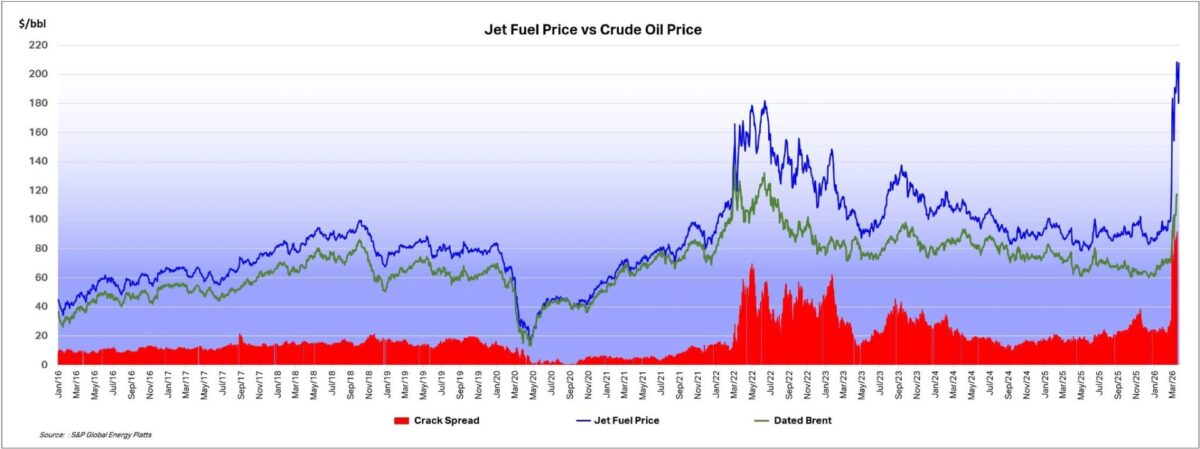
Before examining individual airlines, there is a structural caveat that applies across the board. Most airline hedging programs are tied to crude oil benchmarks, not to the refined jet fuel that actually goes into aircraft. Under normal market conditions, crude and jet fuel prices move in close correlation, so hedging crude serves as a reasonable proxy.
The Iran crisis has broken that correlation. While crude oil prices have risen by roughly a third since late February 2026, jet fuel prices have more than doubled. In Asian markets, the refining margin, the gap between crude and refined jet fuel, surged from about $21 per barrel before the conflict to as high as $144 per barrel before settling around $65.
This means that even airlines reporting high hedge coverage ratios are only partially shielded. A carrier hedged at 80% on crude benchmarks may still face significant exposure to the refined fuel premium.
European airlines: protected for now, exposed by autumn
European carriers entered the crisis in the strongest hedging position of any region. According to the Financial Times, the continent’s airlines have, on average, hedged around 80% of their 2026 fuel requirements. But that protection is front-loaded, and coverage thins as the year progresses.
Ryanair holds the strongest position among major carriers. CEO Michael O’Leary said in January 2026 that the airline had locked in 84% of the current quarter’s fuel at $77 per barrel and secured about 80% of next financial year’s requirements at roughly $67 per barrel. At current spot prices above $190, those contracts represent enormous savings. O’Leary has nonetheless warned of potential supply disruptions in Europe from May onward, estimating that 10% to 25% of Ryanair’s fuel supply could be at risk through May and June.
Lufthansa has paused all new hedging activity but remains well covered in the near term, with 82% of the current quarter and 77% of the rest of 2026 hedged at pre-crisis rates. Its decision to halt new contracts signals a bet that current prices are a peak rather than a plateau.
IAG, the parent company of British Airways, Aer Lingus, and Iberia, is hedged at 60% to 70% for the remainder of 2026 at pre-crisis levels. Industry sources suggest IAG has roughly five to six weeks of fuel supply before shortages begin to affect its operations.
Among Europe’s low-cost carriers, easyJet hedged 84% of its fuel needs for the first half of 2026 at an average of $715 per metric ton, declining to 62% for the second half. CEO Johan Lundgren has indicated that passengers should expect fare increases by the end of the summer as those contracts roll off.
Wizz Air hedged 83% for its financial year ending March 2026 at $681 to $749 per ton, but coverage drops to 55% for the following year. The airline has already warned of a projected €50 million (~$58 million) profit hit.
Finnair extended its hedging horizon from 18 months to 24 months in December 2025, targeting a 70% to 95% coverage ratio for the nearest quarter. The airline’s financial disclosures show that a 10% swing in fuel prices could alter its annual operating result by as much as €34 million (~$39 million).
Norwegian Air Shuttle hedged roughly 45% of estimated 2026 jet fuel consumption and 25% for 2027, leaving it more exposed than most of its European peers.
The outlier is SAS. The Scandinavian carrier adjusted its hedging policy in 2025 due to uncertain market conditions and entered 2026 with zero percent of fuel consumption hedged. It has since implemented what it described as a “temporary price adjustment” and passed costs directly to passengers, but the damage has been immediate: the airline cancelled nearly a thousand flights in April, ceding market share to Norwegian Airlines. The fallout extends beyond SAS itself. Air France-KLM plans to raise its stake in SAS from 19.9% to 60.5% in the second half of 2026, meaning SAS’s unhedged fuel exposure could flow directly into the Franco-Dutch group’s consolidated results. AlphaValue analyst Yi Zhong estimates the price surge could shave “several hundred million euros” off SAS’s EBIT.
AirBaltic may be in an even more precarious position. The Latvian flag carrier has hedged only 6% of its fuel requirements for the current quarter, the lowest reported figure among European airlines. The airline was already operating at a loss before the crisis, and its €380 million (~$436 million) bonds due in 2029 dropped roughly 16 cents in a single day on March 19, trading at around 67 cents on the euro. On March 31, the Latvian government approved a €30 million (~$34 million) emergency loan repayable by the end of August, pending parliamentary approval. The airline’s planned IPO, which was intended to refinance its debt and fund fleet expansion, has been suspended indefinitely. Management expects it will need an additional €100 to €150 million (~$115–172 million) to finance operations through the 2026/2027 winter season.
US carriers: a decade without hedging meets the worst fuel shock in years
The contrast with the US airline industry is stark. Delta Air Lines, American Airlines, and United Airlines all abandoned fuel hedging roughly a decade ago, reasoning that the cost of premiums and the accounting volatility under US GAAP rules outweighed the benefits. For years, with oil prices relatively stable, the strategy paid off.
Southwest Airlines, long the most committed hedger among US carriers, ended its fuel hedging program in early 2026 as part of a broader cost-cutting push. CEO Bob Jordan said at a JPMorgan investor conference in March 2025 that hedging had not been beneficial for “the past 10 to 15 years” with a few exceptions. The timing proved unfortunate: jet fuel prices roughly doubled within weeks of the program’s termination.
Delta retains a partial buffer through its ownership of the Trainer oil refinery south of Philadelphia, which can supply a portion of its fuel needs at production cost. But the refinery’s capacity covers only a fraction of Delta’s total consumption, and the carrier remains heavily exposed to spot prices on the rest.
The financial impact is already visible: fuel costs have nearly doubled while revenues from tickets sold before the crisis are fixed. United, American, and Delta shares fell between 4.6% and 6.6% on April 2, 2026.
United Airlines CEO Scott Kirby told the Financial Times that the carrier is preparing for fuel prices to remain elevated and has already cut roughly 5% of planned flights, with reductions in May and June confirmed and further summer cuts under review.
The upcoming Q1 earnings cycle, beginning with Delta’s report in the week of April 9, 2026, will be closely watched. Carriers are expected to disclose what percentage of their Q2 and Q3 fuel needs are hedged and at what price, a direct signal of margin confidence for the rest of the year.
Asia-Pacific: a supply crisis layered on top of a price crisis
Asian and Australasian airlines face a compounding problem. In addition to the price shock, carriers in the region are contending with actual fuel supply shortages driven by their dependence on Gulf-origin crude transiting the Strait of Hormuz.
Qantas hedged 81% of its fuel for the second half of its financial year ending June 2026. CEO Vanessa Hudson told the Australian Financial Review that the airline has solid hedging in place but is monitoring the situation closely. Australia imports roughly 90% of its refined fuel, and Sydney Airport has warned there are “no assurances” it will receive scheduled jet fuel shipments.
Singapore Airlines hedges fuel up to five years out, with 49% covered for the quarter ending December 2025, declining to 47% for the quarter to March 2026 and 24% for the second half of 2027.
Cathay Pacific’s hedge coverage extends into Q2 2027 but covers only about 30% of costs through mid-2026. The airline has flagged the crude-vs-jet-fuel mismatch as a key limitation. The operational consequences are already visible: Cathay has suspended passenger and freighter services to Dubai and Riyadh through the end of Aprill 2026, and its cargo division is searching for mid-point stops on the Asia-Europe trade to compensate for the capacity lost to Middle East route adjustments, while warning customers of further fuel surcharge increases.
China Eastern carried no outstanding jet fuel hedging contracts as of June 2025, leaving it fully exposed to spot prices.
At the operational level, the crisis is already forcing schedule changes. Vietnam Airlines has suspended 23 weekly flights across seven domestic routes in response to fuel supply pressures. Korean Air entered what it described as “emergency management mode” from April 2026, with rising oil costs weighing on the carrier’s cost base. Air New Zealand suspended its financial outlook for 2026, citing uncertainty over the conflict.
What comes next
With spot jet fuel near record levels, some carriers have made the deliberate choice not to lock in prices for 2027, betting that a ceasefire or de-escalation could bring costs back down. Ryanair CEO Michael O’Leary told the Financial Times on late March 2026 that the airline does not expect to do any hedging for the next three months, noting that long-term prices for summer 2027 remain in the $75 to $80 range and that Ryanair would prefer to wait for rates to fall below $70. Lufthansa has similarly paused all new hedging since the conflict began.
The logic is not without basis. If the conflict ends quickly and Hormuz shipping resumes, oil prices could fall substantially, and airlines that hedged at $100-plus per barrel would be locked into above-market rates. But if the conflict drags on, or widens, carriers that failed to hedge will face months of elevated costs with no protection. Previous Middle Eastern fuel price spikes have historically remained elevated for months, and the pattern may hold again.
Beyond price, the crisis is now raising questions of supply. Major European hubs have begun warning airlines to prepare for potential fuel exhaustion within days. The International Air Transport Association warned that European jet fuel security is resting on a thin margin of commercial inventory. If the Strait of Hormuz remains effectively closed through April 2026, no hedging contract or fare increase will matter if the fuel is simply not there.
The Q1 earnings season beginning in the week of April 9, 2026, will provide the first comprehensive look at how the fuel shock is translating into financial results. Hedge coverage ratios for Q2 and Q3, updated guidance on capacity cuts, and any revisions to full-year outlooks will determine how the market prices the risk from here.
For airlines that hedged aggressively, the crisis validates years of paying premiums that critics called unnecessary. For those that walked away from hedging, the next few months will test whether operational flexibility and pricing power can compensate for a bet that went wrong at the worst possible time.
