

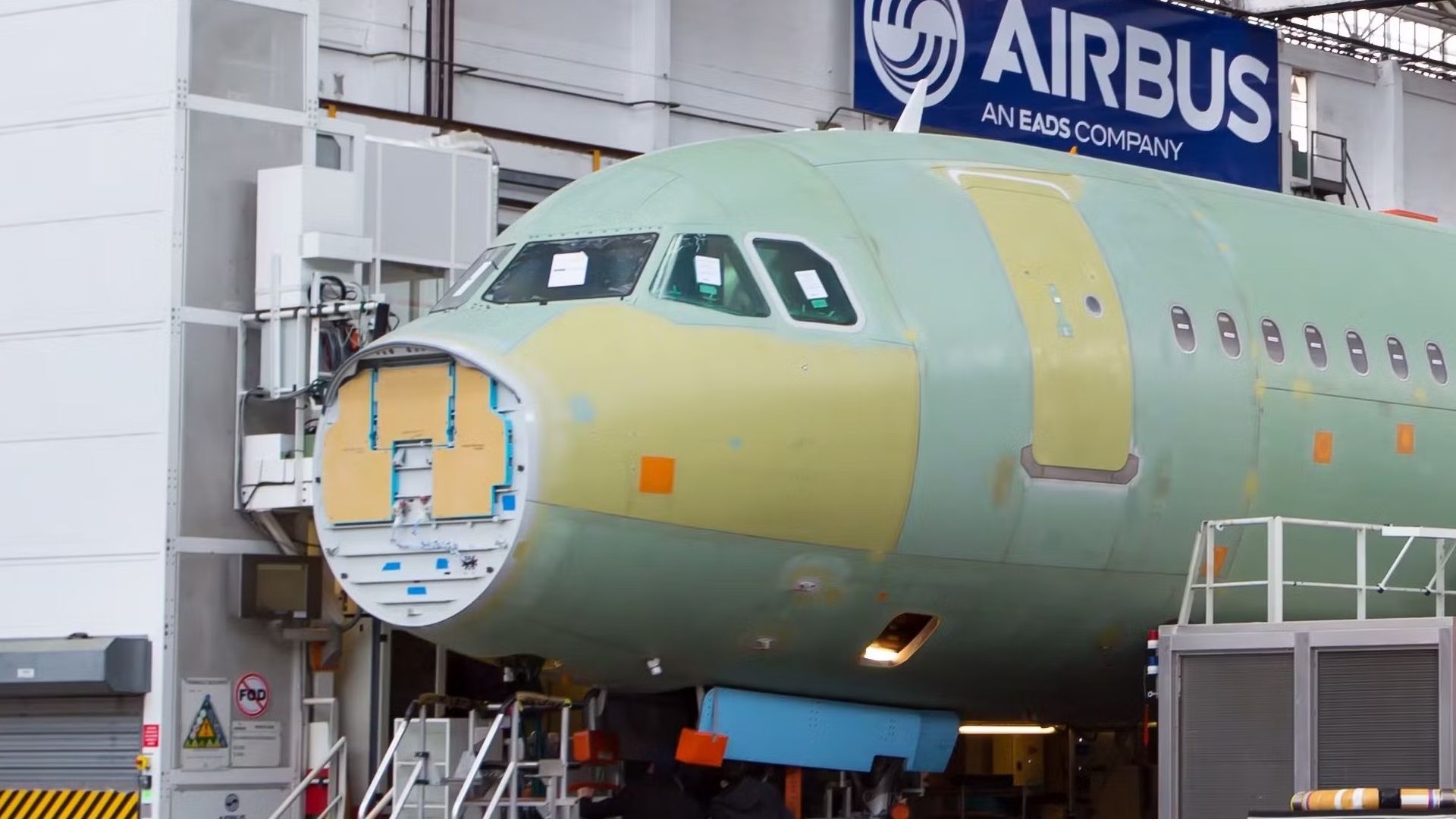
Airbus is currently in the process of inaugurating a second Airbus A320-family final assembly line (FAL) in Tianjin, China, just days after adding a new line in Mobile, Alabama. This lifts the Airbus A320neo family’s output to 75 jets per month by the time 2027 comes around. These back-to-back final assembly line openings are carefully choreographed in order to navigate tensions between the United States and China.
Airbus has to balance its reliance on US-based suppliers and a customer base that increasingly tilts towards China. The company is also in the process of negotiating what could be a 500-jet order with the Asian superpower. China is Airbus’ largest individual market, with more than 2,200 aircraft in service in the country and a broad industrial footprint there. This includes the development of a final assembly line in Tianjin, which first opened in 2008, and a widebody aircraft completion center. These expansions are part of continued efforts to ease the manufacturer’s backlog and position production capacity closer to visible market growth.
A Deeper Look At What Is In The Works

European manufacturer Airbus has opened a second Airbus A320-family final assembly line in Tianjin, with a low-key inauguration ceremony held just days after the company added a second manufacturing line across the Pacific in the United States. These twin moves immediately expand the company’s narrowbody build capacity while supporting Airbus’s plan to increase Airbus A320neo output to around 75 units per month by the time 2027 comes around, according to the latest reports from Reuters.
This event in Tianjin was deliberately subdued, with no Western media involved in the proceedings. Airbus is slowly in the process of navigating US-China trade sensitivities while relying on support from US-based suppliers. At the same time, the company is also in the midst of a negotiation process with China for what has been rumored to be a large narrowbody order. Expectations are currently that only a portion of that order will be announced soon. No significant statements were provided from the event to Western media.
What Does All Of This Mean For Airbus?

From a strategic perspective, the opening of a second Airbus A320-family line in Tianjin helps tighten Airbus’s grip on the overall narrowbody cycle. An increase in final assembly line (FAL) capacity near end markets gives the company delivery-slot control where demand is the strongest (in North America and China). This also helps hedge against geopolitical risk and strengthens the industrial conglomerate’s bargaining power with airlines and suppliers.
This also helps create a local-based handover and support loop in China that could anchor a multi-hundred-jet order that has been rumored and further deepen the industrial ties between the European Union and the Asian superpower. Financially, the near-term effects are somewhat mixed. Analysts will highlight higher learning-curve inefficiencies and supplier synchronization costs that could put pressure on Airbus’ margins and working capital, while incremental Airbus A320neo deliveries convert revenue with cash conversion.
As overall throughput begins to stabilize, fixed-cost absorption continues to improve. This eases overall unit costs and supports the company’s path to a consolidated free cash flow picture beyond the initial production ramp. Slot scarcity will continue to sustain pricing discipline while proximity to customers will reduce logistical frictions across the board.
What Is Our Bottom Line?

At the end of the day, aircraft like the Airbus A320neo are clearly the future of the market. This kind of model offers exceptional performance, both financially and operationally. The aircraft is also extremely comfortable, improving the passenger experience in an era where customers value comfort above pretty much everything else.
The challenge for Airbus, at the end of the day, is ramping up supply to meet this visible increase in demand for its product. This is a challenge, as Airbus is an industrial conglomerate with slow-moving supply chains.
This second FAL opening in China is a good opportunity for the company to continue highlighting its commitment to the East Asian market. This, hopefully, will help the company secure more orders for its best-selling narrowbody family.
