


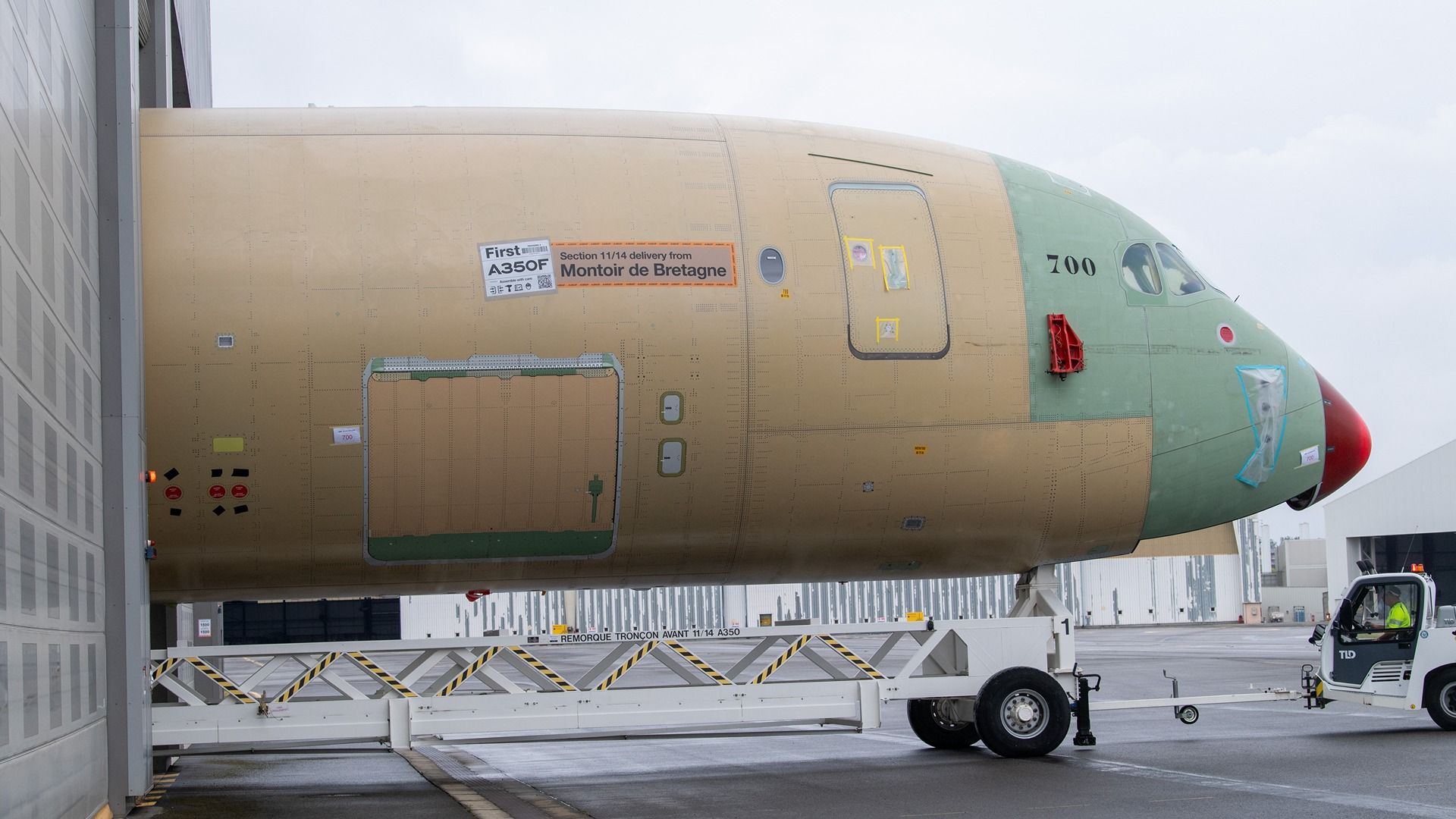
Today, Airbus dispelled rumors that the entry into service of its much anticipated A350 cargo variant, the A350F, would slip to 2028. The titanic planemaker expects its projected EIS in the second half of 2027 to remain accurate.
Despite the annual production goal of 2025 dropping, the Airbus A350F supposedly remains unaffected, but supply chain issues that have slowed the current model line up. The first two aircraft are still in assembly and will begin certification trials after completion.
The A350F Road Map

After the two prototypes are fully assembled, Airbus will begin pursuing type certification for the A350F with the European Union Aviation Safety Agency (EASA) and Federal Aviation Administration (FAA) in the United States. The A350F is based on the stretched A350-1000 and powered by the same Rolls-Royce Trent XWB-97.
Powerplants have been an issue for Airbus recently as both delayed deliveries have slowed output and on-wing time between maintenance checks have been lower than promised for some carriers. The XWB-97 has specifically fallen short of maintenance time for operators in the Middle East and Asia-Pacific where the environmental factors are tougher.

Despite the doubts cast by some observers, Airbus remains firm with its current timeline. The plane is behind the lunch timeline that set EIS to late 2025, but as of now will hit the market around the same time as Boeing’s 777X-F. Leeham News and Analysis quoted Crawford Hamilton, head of freighter marketing for Airbus:
“[We] are going toward that to meet the requirements from both the EASA and the FAA. So, as I stated, the EIS is in the second half of 2027 and remains so.”
The Next-Gen Freighter

As the A380 was never successfully brought to market as a freighter and the last 747 cargo haulers have already been built, twinjets are the way forward for air cargo carriers. The A350F will be a bit smaller than the Boeing 777X-F, but the tumultuous struggles at Boeing in recent years and half-decade-delayed 777X program have bruised confidence with customers.
As Airbus looks like a safer bet from a high-level, the A350F itself is very promising in an era when e-commerce continues to drive demand for air cargo higher, year over year. The plane will provide a 15% fuel-efficiency and emission improvement, as well as have a smaller noise footprint like its passenger counterpart. That will make is cheaper to fly but also open up new airfields and increase operational flexibility for owners.
The promise of reduced maintenance will not only keep operating costs down, but profits up as the plane stays in service more often. The engine issues described by some carriers with the XWB-97 may be troublesome for a handful of airlines, but Airbus says that the powerplant still has 99.9% reliability in the field.
Airbus Stays Ahead Of Boeing

The delay of approximately one year is certainly frustrating for cargo haulers seeking to capitalize on the surging air freight market in the post-COVID era. On the other hand, for  Boeing operators that have flown the 747 freighter family for decades, the problem is even more troublesome. In the 2020s, Airbus has been consistently ahead of Boeing both in terms of development timelines and production output.
Only recently, Airbus surpassed Boeing to claim the best-selling airliner of all time when the A320 family broke 12,250 units and clinched the title from the iconic 737 series. Additionally, although Airbus may have dropped its annual delivery quote from a bit over 800 to the high 700s, it’s still outperforming its US counterpart by hundred of planes a year since 2020.
The trend is largely a result of the disastrous 737 MAX debut, which saw two fatal crashes at the beginning of its service and experience the longest fleet-wide grounding and production halt in commercial aviation history. The long-delayed 777X has only exacerbated that production issue for the legendary planemaker. The era of “if it’s not Boeing, I’m not going,” has been well and truly put to rest.
