



By Karl Sinclair
 Oct 30, 2025, © Leeham News: Airbus (AB) CEO Guillaume Faury is still confident that the commercial aircraft maker can hit this year’s target of 820 aircraft deliveries, despite the snarls it is dealing with in the supply chain.
At the end of 1H2025, Airbus had a whopping 60 aircraft sans moteurs. That number dropped to 32 by the end of the third quarter. Faury says that number will hit zero by year-end.
Engine issues at both GE and Safran, which power the workhorse A320neo family under the CFM International joint venture, put deliveries badly behind schedule. It was revealed today during the earnings call that the snags are distributed about 50/50 across the engine OEMs. Typically, Safran provides the LEAP 1A engines to Airbus for delivery to European and other non-US airlines and lessors. GE provides them to Airbus for delivery to US airlines and lessors.
Through the first nine months of 2025, Airbus delivered 507 aircraft to customers, up from 497 over the same period in 2024. That leaves a whopping 313 aircraft to be delivered over the final quarter, to meet the guidance figures.
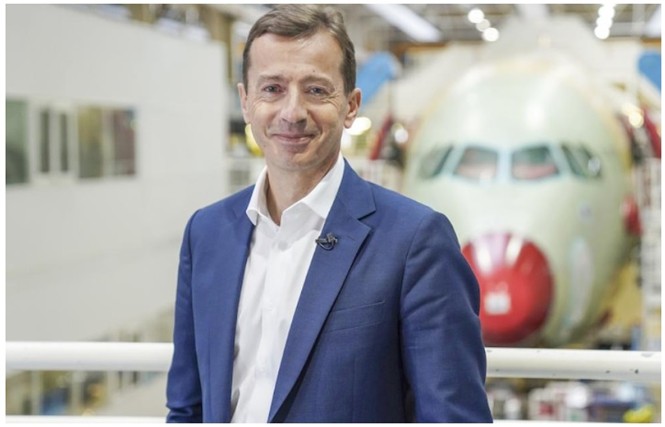
Guillaume Faury, CEO, Airbur Group. Source: Airbus.
To put it all into context, if Airbus were to hit its future targeted rate increases, for the next three months, it would produce:
- 75/mo for the A320neo family in 2027 = 225 aircraft
- 12/mo for the A220 family in 2026 (guidance changed from 14/mo) = 36 aircraft
- 12/mo for the A350 family in 2028 = 36 aircraft
- 5/mo for the A330 family in 2029 = 15 aircraft
Airbus would deliver 312 jets to customers, one shy of the target.
It must deliver on those rates, now.
2026 Targets Modified
As indicated above, Airbus plans to increase the A220 production rate to 12/mo in 2026, up from 14/mo. However, according to the Cirium database, the A220 backlog doesn’t support a rate of 12/mo, let alone 14. LNA detailed this in a post on Oct. 20.
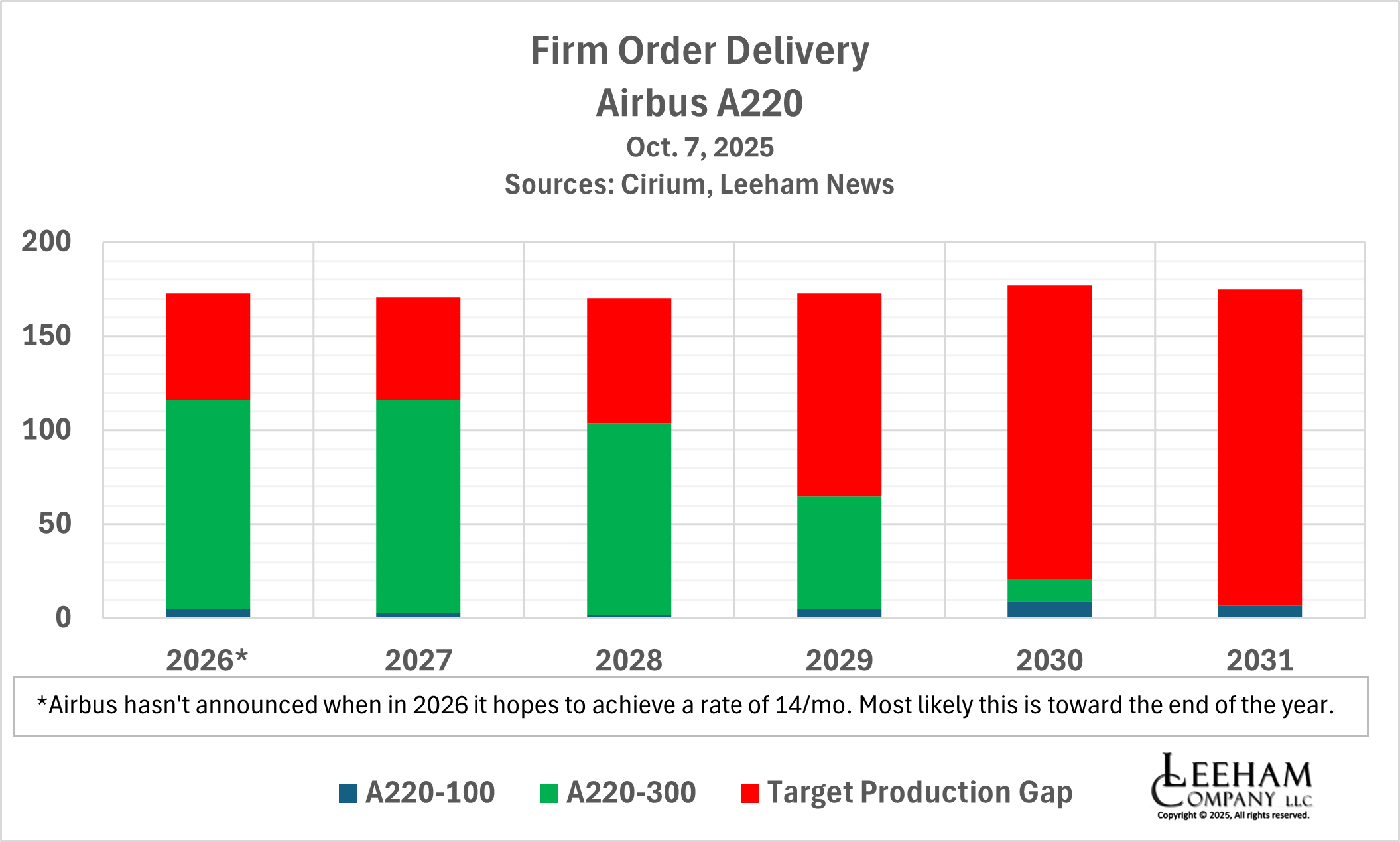
“We are in a steep ramp-up on the 220, and now target to reach the rate (of) 12 for next year, which is still a very steep ramp-up. But we believe this is the best balance between the different constraints we have on the A220 to get there by next year, including the integration of the wings and other work packages that will come from the integration of Spirit (Aerosystems of Wichita),” explained Faury.
In what he calls a “steep hump” for the A220 program, Faury pointed to the increased workload shouldered by both Mirabel (QC) and Mobile (AL), as a result of the wing integration and other work packages that will come with the acquisition.
While he termed that rate trim a “good balance”, Faury also addressed the future derivative A220-500. The current models are the 110-seat A220-100 and the 135-seat A220-300.
“When it comes to the third variant, which is also nicknamed the Dash 500…, that’s something we believe the program will need and benefit from. We have demand from airlines and from the airline customers for these variants, that on paper looks really good as a very competitive product. We have to say that the Dash 500 is not a question of if, but it is a question of when,” he said.
Financial Results
Airbus earnings for the nine months ended 3Q2025 were €4.1bn (EBIT Adjusted), based on reported earnings of €3.4bn (EBIT). This was up over 2024, when €2.8bn (EBIT Adjusted) and €2.7bn (EBIT) were reported.
Company revenues were up €2.9bn to €47.4bn for the first three quarters of 2025, with Airbus Commercial gobbling up a 70% share. Defense and Space accounted for 19% with Helicopters bringing up the rear at 11%.

Airbus Group CFO Thomas Toepfer. Credit: Airbus.
Free Cash Flow (FCF) for the period was (€0.9bn) before Customer Financing. Airbus had an additional €2.3bn in Industrial Capex during the period, which accounted for the negative FCF. Airbus declared a net cash position of €7.0bn at the end of 3Q2025, after starting the year with €11.8bn.
As highlighted during the earnings call, the cumulative R&D spend for 2025 was €2.1bn, a drop off from 2024, when the company spent €2.4bn.
“We’re up to ~200 million (Euros) below the 2024 numbers for the first nine months of the year,” Airbus CFO Thomas Toepfer said. “That is mainly a function of our lead improvement program, where we’re focusing on the things that really matter. But we have the courage to also terminate some projects where we think they’re simply not yielding the results that we feel they should, and that means less external consultants [and] less spending on all kinds of things. It’s not trimming R&D with a lawnmower approach, but it’s really very specific and focused with the program where we focus on the things that matter most to the company.”
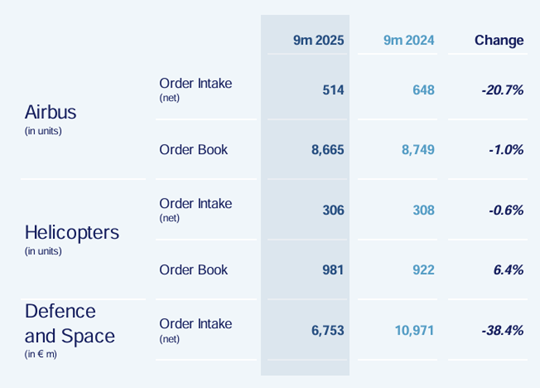
Airbus Commercial’s positioning saw almost universal drops across the board compared to the same period last year. Only the Helicopters order book maintained positive momentum in the first nine months of 2025.
The most significant declines were in Airbus and Defense and Space net order intake, which dropped 20.7% and 38.4%, respectively, year-over-year (YoY).
Segment Analysis
 Commercial Aircraft
Airbus delivered 507 aircraft to customers by the end of 3Q2025. This included:
- 62 A220 – 12%
- 392 A320 Family – 77%
- 20 A330 – 4%
- 33 A350 – 7%
The higher revenues (€33.886bn versus €32.879 in 2024) were detailed as a function of increased deliveries and a growth in services. Services revenues are not broken out into a separate division at Airbus.
EBIT Adjusted jumped 8%, YoY, earning the company €3.27bn and a margin of 9.7%.
The supply chain was reported to be improving, but some concerns remained.
“On the supply chain, the main areas of attention and concern are engines, as we mentioned earlier. The rest of the supply chain is actually doing much better than in 2024 and previous years. Significantly better. The number of missing parts and the depth of delays is significantly better than it was before. We continue to have issues and delays on cabin equipment, interiors, seats, and that’s probably more of a mid-term issue than a short-term one,” said Faury.
Helicopters
Airbus Helicopters had an external revenue split of 53% in Defense and 47% in Civil, for the period ended 3Q2025.
Deliveries, revenues, and EBIT and EBIT Adjusted all grew during the timeframe, climbing 14.7%, 15.9% and 17.9% for both EBIT and EBIT Adjusted, respectively.
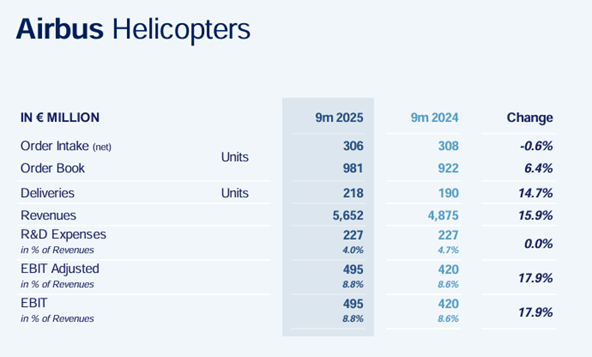
One of the better showings was in the order book and deliveries. Both increased through 3Q2025, 6.4% and 14.7%, respectively.
Defense and Space
The biggest news coming out of Defense and Space was that Airbus was forging ahead with the creation of a new European corporation, along with partners Leonardo and Thales. The recently signed MOU will entail breaking up parts of Airbus to form the new entity, ~35% of which will be owned by Airbus. This gives Airbus slightly more ownership than the other companies.
“On the Space consolidation, what we have to do is go from an MOU to signing, and then from signing to closing. Closing means that in order to be ready for that, we have to carve out the business. The business is spread over many legal entities and countries. We have the task as Airbus to create an operationally and legally standalone separate business until 2027, which can be then put into the new legal entity. That will come with not insignificant separation costs,” detailed Toepfer.
For comparison, it cost Embraer more than US$100m to carve off Embraer Commercial Aircraft in 2015-2016 for the proposed Boeing Brasil joint venture with Boeing. After Boeing walked away from the JV during the 21-month 737 MAX grounding and the beginning of the COVID-19 pandemic, an arbitrator eventually awarded Embraer US$140m in a break-up fee for its costs.
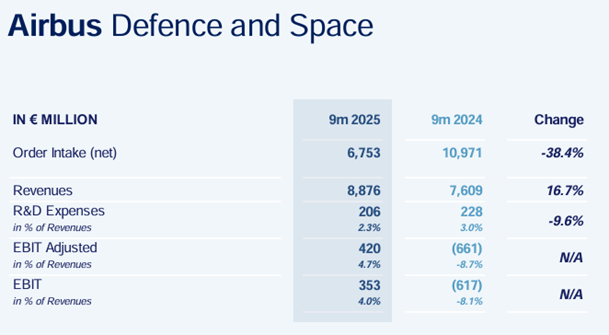
For the first nine months of 2025, the division reported a 16.7% increase in revenues, which climbed to €8.876bn. Revenues were split 34% to services and 66% to platforms.
EBIT and “EBIT Adjusted” both clawed their way back into the black, posting small but meaningful earnings of €420m and €353m. It was meaningful in the manner that the results were no longer negative and dragging down the company.
Order Intake, however, dropped precipitously to €6.753bn.
Airbus maintains a full-year guidance of 820 commercial deliveries, ~€7bn in EBIT Adjusted and €4.5bn in free-cash-flow, before customer financing.
It estimates that the Spirit Aerosystems deal will close in 4Q2025 and the impact of the integration remains broadly in line with projections.
Liquidity at the company remains strong, with some €30bn available. During September 2025, Moody’s upgraded the Airbus credit rating to A1, with a stable outlook.
*****************************
The Rise and Fall of Boeing and the Way Back
 Boeing CEO Kelly Ortberg says one factor in the company’s considerations before launching a new airplane is its own recovery. Boeing, too, must be ready—and there is a long way to go before it is.
The Rise and Fall of Boeing and the Way Back, published last month by LNA editor Scott Hamilton, examines how Boeing got itself into industrial disgrace and how it is now at long last on the path to recovery.
The book is available here.
Related
