


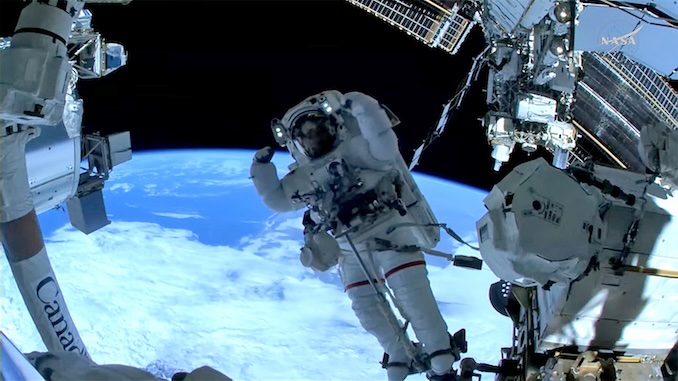
Two NASA astronauts floating outside the International Space Station carried out a bit of orbital surgery Tuesday, successfully replacing a broken 200-pound “wrist” joint near the end of the lab’s 58-foot-long robot arm.
“That is a good install, you guys. I know that was tough. Wonderful work,” Canadian astronaut Jenni Gibbons called up from mission control toward the end of the seven-hour 20-minute excursion.
On May 27, flight controllers at the Johnson Space Center in Houston noticed one of the Canadian-built arm’s seven joints was drawing more current than expected and not moving properly.
After a detailed review of telemetry, NASA managers and experts with the Canadian Space Agency, which supplied the station arm, concluded the joint had failed and needed to be replaced with a spare, one of two mounted on an external stowage platform.
“Systems like Canadarm2 were designed from the beginning with replaceable components and were planned with maintenance in mind,” said ISS operations and integration manager Bill Spetch. “This is no exception.”
Floating in the Quest airlock, astronaut Jessica Meir, making her fifth spacewalk, and crewmate Chris Williams, making his second, switched their spacesuits to battery power at 8:20 a.m. EDT, officially kicking off the year’s third ISS spacewalk and the 280th overall.
After setting up foot restraints near the stowage platform and positioning the spare joint for installation, Williams and Meir detached the arm’s “hand,” known as the latching end effector, or LEE, along with two other healthy joints.
The 900-pound assembly was temporarily mounted on a nearby shelf, clearing the way for removal of joint No. 5, the 200-pound wrist joint that failed. The replacement joint was successfully installed four-and-a-half hours into the spacewalk.
“We’ll remove the failed joint 5, replace it with the spare joint and then once that’s back on the arm, our last major task will be to get that LEE cluster that we temporarily stowed and put it back onto the robotic arm so that we have a fully assembled arm at the end of the spacewalk,” said flight director Fiona Antkowiak.
Five-and-a-half hours after beginning the spacewalk, Williams and Meir were able to re-attach the LEE cluster as planned. Shortly after, flight controllers powered up the arm and verified good electrical connections through the newly installed joint.
“Today we did hear good confirmation that … Canadarm 2 has two good strings of power and data to the arm,” said NASA commentator Sandra Jones. “So today’s wrist surgery was successful.”
Williams and Mier, meanwhile, collected their tools and headed back to the airlock to close out the spacewalk.
Williams also brought the failed joint back into the airlock so it can eventually be returned to Earth for repairs. Once that work is complete, the refurbished joint and one other will be relaunched to the space station for future use as needed.
The robot arm is critical to normal station operations. It is used to capture Northrop Grumman’s Cygnus cargo ships, pulling them in for berthing, while moving other components — and spacewalkers — from point to point during maintenance operations.
NASA plans to retire the space station by the end of 2030, but Spetch said the agency will continue to maintain the arm throughout because it is vital to ISS operations.
“There’s not a time where we say hey, we’re just done repairing the arm,” he said. “Overall, the arm is critical for station operations and continued maintenance of it throughout to the end of life.”
source
