



Subscription Required
Open to all Readers
By Scott Hamilton and Karl Sinclair
May 19, 2026, © Leeham News: Boeing hopes to finally gain certification of the 777X in the coming months. Deliveries should begin next year, the company has repeatedly said.
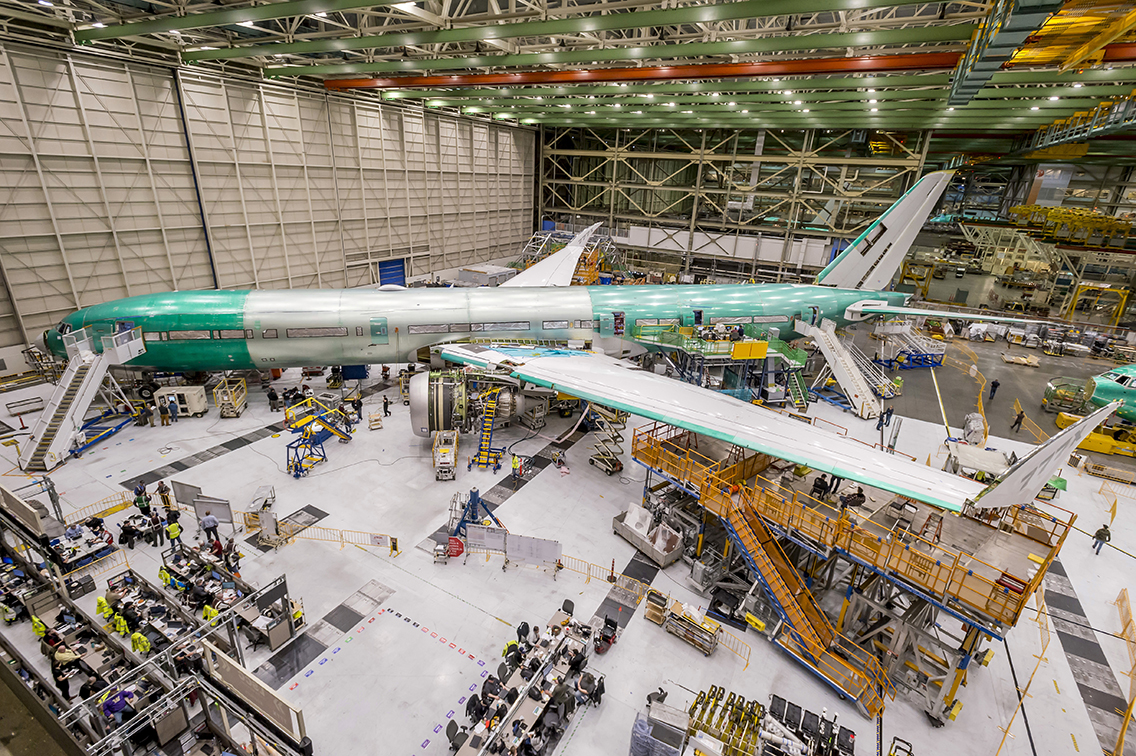
A Boeing 777-9 in final assembly at the Boeing plant in Everett (WA). Credit: Boeing.
On the 1Q2026 earnings call, CEO Kelly Ortberg said it will take years to complete the required change incorporation for an inventory of more than 30 777-9s. Some aircraft date to 2019 and have been stored since, while Boeing deals with a long, drawn-out certification process.
Ortberg said that “Change incorporation is basically for the airplanes that we have built. [We must] incorporate all the changes that have happened since they’ve been built. Things that result from the certification program, and things that happen as a result of productivity improvements or process improvements,” Ortberg said. “We go back in, and we incorporate all those changes before we make the delivery. It is a pretty massive activity that we have underway.”
Ortberg said that there is a dedicated team within BCA focused specifically on incorporating changes into the airplanes.
However, Boeing declines to detail the changes required, how long per airplane these might take, and whether customers intend to refuse delivery of these early airplanes.
LNA has learned that the first deliveries will likely be new production aircraft fresh off the final assembly line, rather than aircraft from inventory. The first production aircraft in testing is line #1781. According to the database Cirium, this is the 55th aircraft, for Lufthansa Airlines. Lufthansa was the first airline to order the 777X. Certification is expected late this year, with the first delivery next year. The first 777-9 was supposed to be delivered in 1Q2020, and perhaps in December 2019. The March 2019 grounding of the 737 MAX prompted the Federal Aviation Administration (FAA) to review the 777X certification program.
Testing reveals flaws
Flight and ground testing for any new airplane program validates designs or reveals flaws. This is normal.
As LNA’s series, completed yesterday, shows, change incorporation is not an unusual part of any development program.
Related Stories
However, the 21-month grounding of the MAX required repairs, the discovery of other issues, and progressive changes in production, which necessitated an unusual amount of change incorporation when the FAA recertified the airplane. It took months to incorporate changes on each of 450 737s that were stored during the grounding. It took years to clear the inventory.
Likewise, when a production flaw was discovered mating the fuselage barrels on the 787, Boeing suspended deliveries for 20 months while a design fix was developed. Then, the change incorporation involved major rework that took 3-4 months per plane and years to complete the incorporation on 110 787s that were stored.
Testing of the 777X over the years revealed a number of flaws and anomalies that must be corrected. Some were major, and some were not.
The failure of the ultimate load stress test on the wing in 2019 was, on its face, the most serious. It certainly was the most spectacular. Federal regulations require Boeing to bend the wing upward to 150% of the design load. On previous airplanes, the wing was usually the part that broke. On the 777X, the fuselage ruptured aft of the wing, and the passenger door blew off the test aircraft, causing decompression.
Almost there
The failure was just shy of reaching 149%. The Seattle Times reported that reinforcements and strengthening in the affected areas would suffice; no new ultimate load test would be required.
In a statement to LNA, Boeing said, “In the final load testing of the static test airplane, our team conducted a test that involves bending the wings of the airplane up to a level far beyond anything expected in commercial service. A testing issue occurred during the final minutes of the test, at approximately 99% of the final test loads, and involved a depressurization of the aft fuselage. The test team followed all safety protocols. As we have said, this will not have a significant impact on the design.”
Boeing added that “We remain fully focused on safety as our highest priority as we subject the 777X to a rigorous test program, and we will continue to work under the oversight of our regulators.”
LNA was told by a source who participated in the immediate post-mortem of the incident that Europe’s regulator, EASA, wanted a new ultimate load test. Boeing did not respond to a request for comment. However, no new ultimate load test has been done in the intervening years.
“The FAA was adamant about not accepting any notional excuses, meaning human error, as they said proof is in the pudding and we want the data,” one participant in the post-mortem told LNA. “In subsequent meetings, this was a continued agenda item as ‘working on the data solution’. EASA requested another wing loading test through the FAA to prove the 150%.”
The number of aircraft built before the redesign was completed and incorporated into following aircraft is not known outside the company and the FAA. LNA is told that Boeing views the failure as a regulatory issue rather than a safety concern. It should be noted that Airbus faced a similar regulatory requirements issue with the A380, for different reasons. Fixes were retrofitted into in-service aircraft and those on the production line.
Software upgrades
Software upgrades are not unusual, as anyone with a home computer can attest. During the MAX grounding, Boeing made software upgrades to the Maneuvering Characteristics Augmentation System (MCAS), which was behind the two crashes that led to the grounding. The company also developed other software upgrades as the crash and certification investigations revealed other issues.
Flight testing for the 777-9 revealed some pitch-control issues traced to the tail’s horizontal tailplanes, which are smaller than those on the predecessor airplane, the 777-300ER. Smaller tailplanes save weight but may compromise flight stability under certain conditions, notably during landing.
McDonnell Douglas designed smaller tailplanes for its MD-11, a stretched derivative of the DC-10. There have been a few landing accidents traced in part of the stability of the plane on final approach and touchdown, related to the smaller tailplanes. A higher landing speed is part of the MD-11’s solution.
For Boeing, advances in computer and software design since the MD-11 have enabled software upgrades to address a similar concern on the 777X.
“We incorporated a software update in 2021 to address the issue. Flight control software is fine-tuned and demonstrated for compliance during flight test,” Boeing said in a statement.
Flight testing also revealed defective thrust links in the engines on the flight test aircraft. The 30+ aircraft in inventory are without engines. Boeing makes the thrust links, not GE, and Boeing redesigned these after the flaw was revealed.
Customers
Changes requested by customers, those required as a normal part of advanced production, may also be required. But any delay for these is on the customer, not Boeing
Ortberg said on the 1Q2026 earnings call on April 28 that it will take “years” to complete the change incorporations.
This means that the first deliveries to customers, when they finally begin next year, will be new production aircraft fresh off the assembly line, not those from inventory. Boeing had no comment about this.
Importantly, and this is still evolving, Boeing may face a situation similar to the “Terrible Teens” of the 787 era. Although the amount of rework on the Terrible Teens earned the nickname is different than what appears will be required on the 777X inventory, at least one airline views the 777X inventory as “impaired” and, as of today, won’t accept delivery of its batch of aircraft that fall within the aircraft that require the rework.
Tim Clark, the president of Emirates Airline, has publicly said he’s not interested in inventory aircraft. Another customer has also decided against accepting any inventory 777-9s, LNA is told. Other 777X customers also express a dislike for taking the inventory aircraft.
Boeing eventually sold all the Terrible Teens, but it took years, and a steep discount was required. Asked about this analogy, Boeing only said that it continues to see “strong demand” for the 777-9.
A new shadow factory
When Boeing had to undertake the change incorporation for the 737 MAX and 787, officials labeled the work sites “shadow factories.”
Boeing hasn’t yet revealed its shadow factory plan for the 777-9, but LNA understands that the former 747 final assembly space at the Everett (WA) factory will be one location. At least one other location will also be used for the rework.
777X Deferred Production Costs Growing Again
Boeing continues to add production costs from the aircraft it is producing into the balances stored in Inventory. This concerning trend is especially relevant to the 777X program, as the company struggles to get the type certified into service and into the hands of airlines.
A Look Back
At the end of FY2025, Boeing had accrued $36.631bn in deferred production costs (DPC), tooling and customer compensation. That amount is squirreled away in the Inventory account – as permitted by program accounting rules.

Boeing reported the following in its FY2025 10-Q report filed with the Securities and Exchange Commission (SEC):
“During the years ended December 31, 2025, and 2024, we determined that estimated costs to complete the 777X program plus the costs already included in 777X inventory exceed estimated revenues from the program. The resulting reach-forward loss of $4.899bn in 2025 was recorded as a reduction of deferred production costs, unamortized tooling, and other non-recurring costs. The reach-forward loss of $3.499bn in 2024 was recorded as a reduction of deferred production costs and other non-recurring costs.”
Boeing has a history of accruing production costs from its commercial programs in Inventory. When it determines that those costs will exceed the estimated revenues over the life of the program, they are written off.
 At the end of FY2025, Boeing wrote off a whopping $47.871bn in losses across three commercial aircraft programs, with $15.729bn of that on the 777X, a program that has yet to be certified for service.
The Current Situation
Boeing ended FY2025 with $36.631bn in DPCs, tooling and customer compensation in Inventory.
 Three short months later, it jumped to $38.631bn, an increase of $2bn.
The 777X program has been a major culprit in the situation, with $8.398bn written off in two years alone.
It is important to note that management zeroed the program’s deferred balance, writing off all expenses accrued in Inventory.
As of 1Q2026, it has now crept back up to $1.104bn.
Making Inventory Look Good
During interviews and earnings calls, management frequently points to the large amounts contained in the Inventory account as evidence of an unwind which will generate large amounts of free-cash-flow (FCF) in the future.

A number in the neighborhood of $80bn+ is often cited as evidence of this, which is reported in its financial reports.
What is not mentioned is the fact that of the $73.068bn in Inventory attributed to Commercial Aircraft Programs, $38.631bn of this are productions costs, tooling and customer compensation.
This would leave $34.437bn as product which can actually be sold to customers. Fifty-three percent of the declared amount is made up of non-revenue generating expenses.
What is driving the DPC accruals?
At the end of FY2025, deferred productions costs alone were $26.287bn. By 1Q2026, it had climbed to $27.963bn, a jump of $1.676bn, with $1.104bn of that due to the 777X program.
The current Bête Noire at Boeing is the 777X program, with write-offs totalling $15.729bn. This surpasses the charges on the 787 program of $10.366bn – a program that has not been profitable with over 1,250 deliveries.
The 777X program has a total order book in the neighbourhood of 625 aircraft, for all types. Certification of the 777-8 passenger model and 777-8F variants are not even on the short-term certification horizon (read: further costs to be incurred).
Boeing struggled to get the 777-9 certified. Given the write-offs, this means that the company will never make a profit on the program. It is to be noted that the $15.729bn in write-offs do not include any monies spent in R&D. Those amounts are strictly related to production (hence the title “deferred production costs”).
Boeing currently has more than 30 aircraft from the type sitting in inventory.
Costs will increase
Costs associated with bringing those stored aircraft up to snuff will only increase in the future.
“It depends on when the airplane was built. The older the airplane, the more change incorporation and the more structural-related changes that are needed, and they’ll take longer,” said CEO Kelly Ortberg, in reference to the 777X program.
This statement alone explains the continual increases in the deferred production costs on the 777X.
With the final aircraft configuration still to be determined, which will happen upon certification sometime in late 2026 (all things being equal), abnormal costs attributed to those aircraft will only continue over time.
It would also be reasonable to expect that there will be further write-offs on the program, even once certification has been achieved, given the timeline to complete traveled work on those jets.
Boeing can only look forward to the cash generated by the final delivery payment and the cessation of costs associated with having those aircraft sit on the tarmac in Everett (WA).
Related
