


The US Department of War published its first batch of declassified records related to Unidentified Anomalous Phenomena (UAP) on May 8, 2026, launching a public archive that the Trump administration says will be updated with new tranches every few weeks.
The initiative, branded Presidential Unsealing and Reporting System for UAP Encounters (PURSUE), is being run with support from the Office of the Director of National Intelligence (ODNI).
The release follows a February 19, 2026, directive issued by President Donald Trump on Truth Social, instructing the Department of War and other federal agencies to identify, review and declassify documents related to extraterrestrial life and unidentified aerial phenomena. According to the Department of War, the effort spans dozens of agencies and tens of millions of records, many of which exist only on paper.
Apollo-era frames and recent infrared captures
The first tranche focuses on cases where the government has been unable to make a definitive determination on the nature of the phenomena observed.
The selection includes archival imagery from the Apollo 12 and Apollo 17 missions, with one frame from Apollo 17 highlighting three small bright lights above the lunar terrain. A transcript of cockpit communications from the same mission, in which an operator describes “a few very bright particles or fragments” drifting past the spacecraft, was also published.
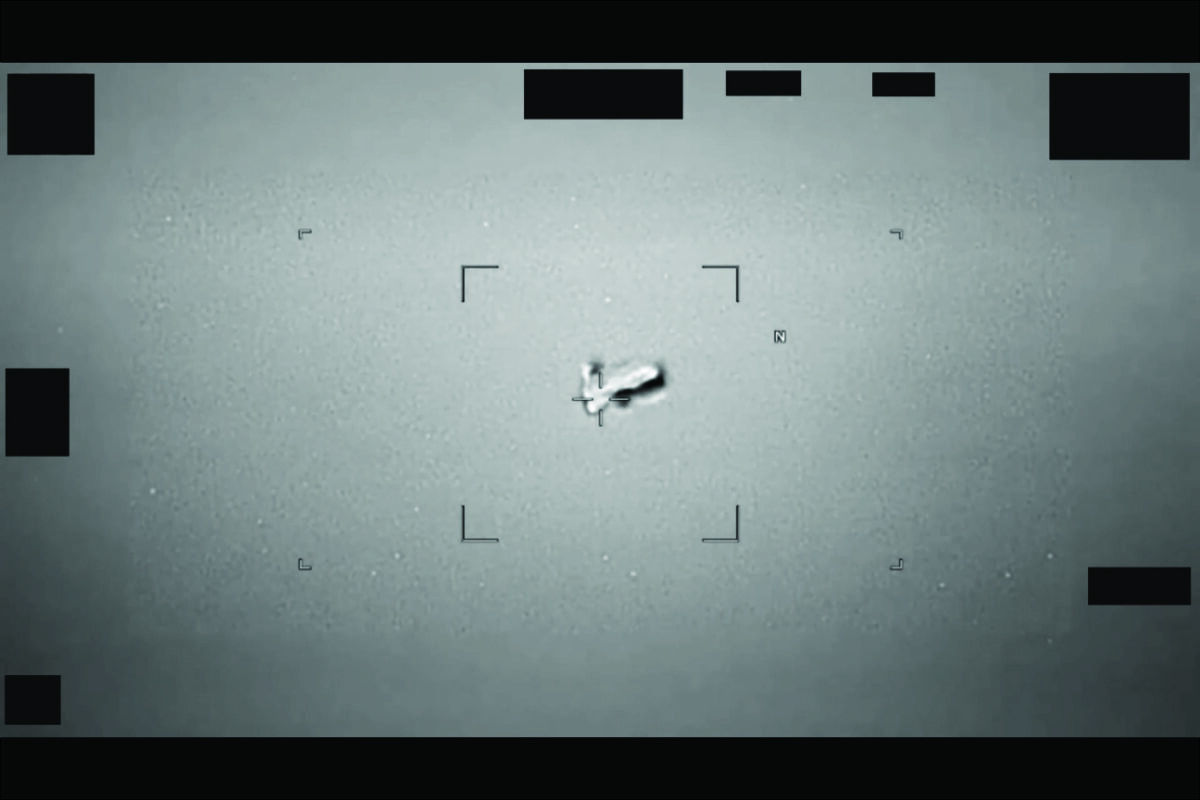
The release also features infrared still images captured by the FBI showing unidentified objects over the western United States in September and December 2025; a recreation sketch of a 2023 sighting in the southeastern US; and stills from US military reports covering incidents off the coast of the United Arab Emirates in October 2023, near Greece in October 2023, in the Middle East in 2013, in African airspace in 2025; plus a INDOPACOM report from 2024 describing a football-shaped object near Japan. A 2026 US Army report covering a North American sighting is also part of the package.
A directive turned interagency archive
FBI Director Kash Patel said on May 6, 2026, that his agency had handed over its first batch of classified UAP documents to the Pentagon-led inter-agency committee organizing the release.
In a statement accompanying the release, Secretary of War Pete Hegseth said the documents had “long fueled justified speculation” and presented the publication as evidence of the administration’s commitment to transparency.
Director of National Intelligence Tulsi Gabbard said that the Intelligence Community’s declassification efforts were being coordinated with the Department of War, adding that the release was the first in an ongoing joint effort.
The Department of War has framed PURSUE as complementary to the work of the All-domain Anomaly Resolution Office (AARO), the office established in 2022 to collect and investigate UAP reports across the US military and intelligence community. AARO’s open caseload exceeded 2,000 incidents earlier this year, and the office is required to continue separate statutory reporting to Congress on resolved cases.
Caveats from former AARO leadership
Sean Kirkpatrick, the physicist and former intelligence officer who led AARO until 2023, has publicly cautioned that the records he reviewed during his tenure contained no evidence of recovered extraterrestrial technology. He has argued that many viral UAP videos can be explained by the way modern infrared sensors handle hot objects such as jet engines, which often appear as long, pill-shaped thermal blooms. Several recordings of that type have been authenticated by the Pentagon after appearing on social media.
The Department of War acknowledged that the unresolved status of the published cases frequently reflects insufficient data rather than evidence of anomalous capability, explicitly inviting private-sector analysis of the material.
PURSUE follows earlier piecemeal declassifications, including the 2020 release of three US Navy infrared videos, and consolidates a public-facing archive for material that until now has moved through fragmented Freedom of Information Act requests, congressional letters and unauthorized leaks. Whether subsequent tranches yield new operational detail on US military encounters, rather than additional Apollo-era curiosities and short infrared clips, will be the test of the initiative’s stated goal.
source
