


Summary:
- This two-part series outlines the threat posed by workforce shortages to the future growth of aviation and aerospace, since industry-wide costs of workforce shortages are unquantified. Estimates suggest the industry is leaving tens of billions on the table as a result
- Technology alone cannot solve the problem as the workforce changes
- Current industry efforts to address the workforce are fragmented and, to elevate aviation/aerospace pathways and careers, must be coordinated with organizations delivering educational and career programs
- The solution is a collaborative, professionally managed Early-Learning-to-Career Pipeline leveraging existing programs and alliances to guide youth to aviation/aerospace careers
- Industry must pivot from relying on government to investing in organizing the army and educational and career assets we already have.
- Success requires industry-wide proactive collaboration, cultural change, and investment.
By Kathryn Creedy
May 5, 2026, © Leeham News: Not one of the numerous studies from every aviation/aerospace policy organization has quantified the costs of not addressing our workforce shortages at an industry-wide level, although concerns are rising at the academic level. And there is little effort in developing a unified career pipeline guiding the kids we are already inspiring into our careers, as other industries have long been doing.
Only a few estimates exist on the cost of workforce shortages:
- Aeronautical Repair Station Association (ARSA): Perhaps ~$14bn for the maintenance industry.
- Boston Consulting Group (BCG): Unavailable aircraft and MRO inefficiencies cost the industry $27bn annually.
- McKinsey & Co: Cost of Attrition for one medium-sized company is ~$300m–$330m
- International Air Transport Assn. (IATA)The additional cost borne by the airline industry from the supply chain was over $11bn in fuel and maintenance.
Aviation and aerospace policy groups in Washington, in their rush to convince policy leaders about the importance of their multi-billion-dollar impact on the economy, might be missing the forest for the trees in not quantifying the costs.

Raisbeck Aviation High School in Seattle is privately funded. Students study to become aerospace engineers. Credit: Raisbeck Aviation High School.
It is clear that the aviation, aerospace, and defense industries contribute billions to the economy, but two important facts are missing.
The total talent forecast for all segments of the industry and the cost of failing to meet workforce needs.
All studies cite rising compensation, higher maintenance, repair and overhaul (MRO) and manufacturing costs, and the costs associated with delays in returning aircraft from maintenance and in delivering new aircraft off the production line. But none quantifies how much those rising costs are.
Nor are they calculating the cost to safety, despite rising concerns over the loss of seasoned aviators and aviation maintenance technicians, and the resulting “juniority” on the flight deck and in the maintenance bay. Exacerbating our shortages is the training pipeline with a shortage of instructors, professors, and teachers.
Technology alone can’t resolve all challenges
While there is no lack of information on how to leverage technology, upskilling, reskilling, retention bonuses, contract staffing or how to create the workplace today’s employees are looking for, most agree:
“Technology alone cannot resolve all challenges consistently, concluded Accelerating progress: Maximizing the return of talent in A&D.
With attrition standing at 15%, few are addressing the fact that work/life balance is more important today than salary or the role of culture in both recruiting and attrition. Restrictive work rules and culture are significant barriers for recruiting Gen Z and Gen Alpha or retaining women and people of color who are the future workforce.
None of these estimates address business aviation, airports, government, commercial space, hangar operations, general aviation, remote operations, military, flight instructing, aviation maintenance training as well as professors, and public-school STEM teachers.
Rather than touting the impact on the economy, the aerospace industry could be talking about the multi-billion dollar contribution it could be making had we the proper workforce in manufacturing, on the flight deck, in the maintenance bay, in the air traffic control tower, and in operations.
“If you don’t measure it, you can’t manage it,” the old saying goes. We aren’t even measuring.
Industry Concerned About Growth
But here’s something the industry just started mentioning against the backdrop of Boeing’s Commercial Market Forecast 2025-2044, showing 43,000 aircraft to be delivered by 2044. Staffing those aircraft and meeting the forecasts for passenger numbers, as well as staffing the growing commercial space industry, is already a problem. We are only now starting to ask if we are risking the forecast growth by not recognizing our workforce shortages have reached crisis proportions.
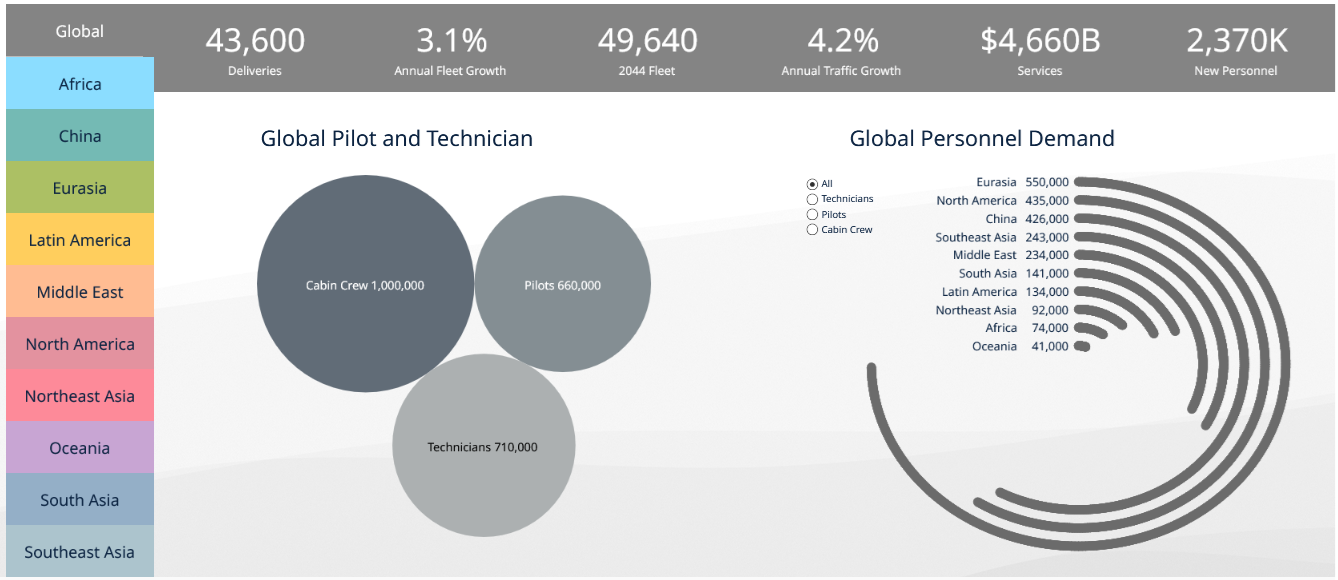
Boeing’s Workforce Forecast for the next 20 years. Credit: Boeing.
Boeing Commercial Market Forecast 2025-2044
The CAE Talent Forecast, by contrast, goes through 2034, only nine years away.
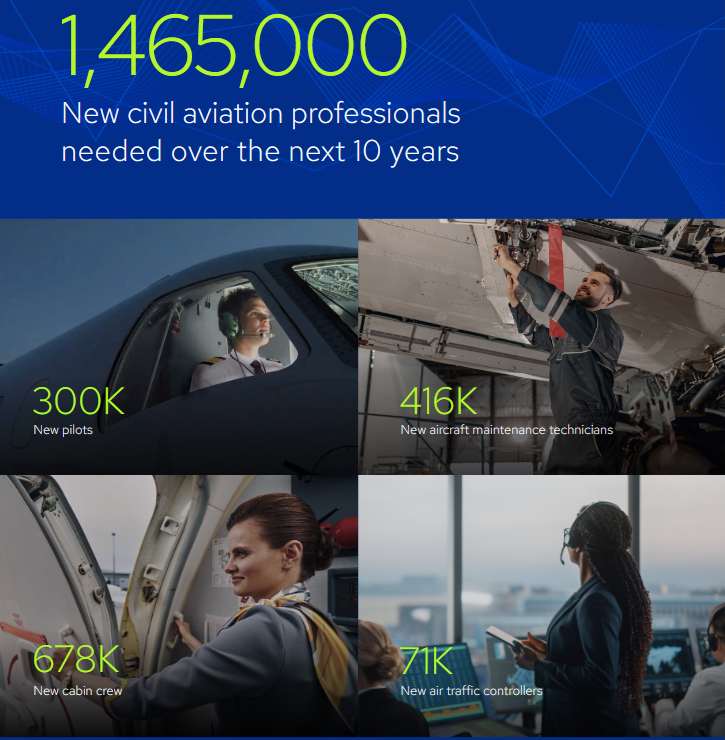
CAE, the simulator company, forecasts for needed workers 2025-2035. Credit: CAE.
CAE: 2025 Talent Forecast – 2034
Industry officials say aviation, aerospace, and defense have always grown, but today, it is fair to question that assumption. To be sure, demand is growing across all fronts, but every region in the world is confronting the same challenges: workforce, supply chain, fragmented training, and workforce development, so the equation may not be as simple as in the past.
Shortages throttling growth
The Aeronautical Repair Station Association has already identified workforce shortages as having a throttling effect on growth.
Acara Solutions reported a “lack of skilled workers is delaying research and development efforts, potentially stagnating technological advancements. Shortages in skilled labor are affecting the industry’s ability to meet growing demands for commercial and military aircraft. The competition for top-tier talent is driving up labor costs, impacting profitability and competitiveness.”
Noble Consulting reported: “Recent roundtables with CEOs, COOs, and senior leaders highlight persistent challenges in talent retention, high costs of entry for youth, demanding work schedules, shift work, and remote postings — factors significantly impacting workforce stability and sector growth.”
Despite United Airlines CEO Scott Kirby saying it is having no trouble raising fares 10% to cover rising fuel, the US Travel Association reported: “For six straight years, American companies have greenlighted fewer domestic business trips and budgeted less money for those trips than they did in 2019.”
The trade group predicts the trend will continue this year, reported the Wall Street Journal last week, adding: “Roughly one-fifth of American workers strongly oppose future business travel. Among those opposed to work trips, 64% are women, who often shoulder most of the household’s parenting responsibilities.”
Limiting flights
We’ve seen numerous moves to limit flights at Newark, Chicago, and San Francisco in the name of safety rather than wholesale accommodation of whatever airlines throw at it. That turns the normal Air Traffic Control (ATC) model on its head.
Is this a genuine safety concern or an overabundance of caution? The Federal Aviation Administration (FAA) took the blame for at least one of the two most recent accidents–the midair at Washington National Airport, which earned scathing criticism of the agency we haven’t seen since the Boeing 737 MAX and ValuJet crashes.
ATC problems are compounded by environmentalist calls to stem the growth of airlines, airports, and general aviation. Passenger caps have been proposed at Dublin, Amsterdam, and other airports.
Space flight
Then there’s the launch industry, which, on the Space Coast and at Arianespace, is already complaining about launcher scarcity owing to “technical glitches, a logjam of launch pads, and workforce shortages.”
In a chilling LinkedIn post, Christopher Peters, founder of Apex Operational Partners, hit the nail on the head when he forecast the demise of small maintenance shops.
“General Aviation is heading straight for a brick wall, and nobody is talking about the real reason why,” wrote Peters. “It’s not just fuel prices. It’s not just insurance. It is the catastrophic collapse of the local maintenance shop.
Here is the math that is about to catch the industry by surprise: Read more.
His math should concern the General Aviation Manufacturers Association, Aircraft Owners and Pilots Association, National Business Aviation Association and National Air Transportation Association and their members.
Indeed, a recent AIA industry report included concerns about the shortage of parts and the decline of parts manufacturers, its two top findings after surveying the industry on which parts were the most difficult to find, what lead times were, and the parts costs.
While all the studies from McKinsey, Deloitte, and Oliver Wyman point to the competition we face from other industries, they say little about what needs to be done to compete, which was covered by lessons learned from other industries at the American School Counselors Conference, including unions paying for training.
We are Promoting Aviation, Aerospace Careers All Wrong
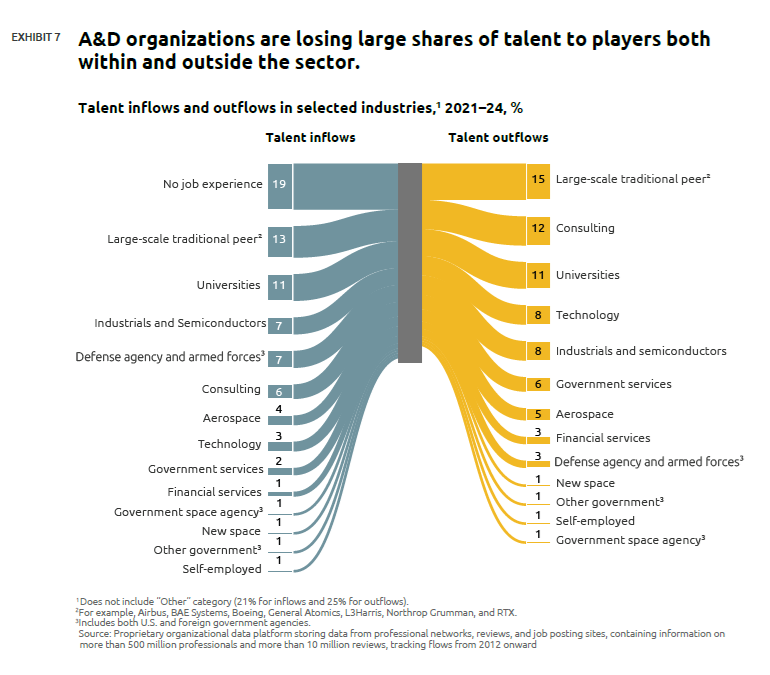
Credit: Accelerating progress: Maximizing the return of talent in A&D
Building the Case
Even without the numbers that aren’t measured, the industry is at a point we haven’t been since World War II, a severe lack of workforce because the men were being shipped overseas to fight. Today, high attrition rates for women and people of color owing to culture are exacerbated by a global population decline and intense competition for labor from all industries.
We solved the WWII problem, but must resurrect those solutions, including what the United Service Organizations did in creating a 24-hour society for childcare, shopping, and entertainment, so women could join the workforce. But such an effort would require the culture change needed to ensure women and people of color are safe on the job.
An AIA study reported that demographics are against the industry, with only 0.2% population growth expected over the next decade. AIA says a declining population means stemming attrition, and a 30% to 40% increase in productivity is key to addressing our workforce needs. Tall orders.
The Washington Post and The Wall Street Journal have increased coverage of workforce issues reporting on many trends that stunt the growth of labor including immigration crackdowns, retirements and falling workforce participation rates which haven’t been this bad since 1977. They also cite the decline of prime-age worker participation and forecasts it will fall another 1.5% over the next decade.
The Post pointed to lack of child care and strong social safety nets as a major issue.
“The U.S. now has fewer immigrants and fewer Americans working as well,” reported The Wall Street Journal. “It doesn’t take a doctorate in economics to see this as a big, big problem.”
Simpleflying narrowed the immigration impact to airlines. “The immigration crackdown has targeted the wider labor pools that aviation relies on…foreign-born workers make up approximately 20% of the US air transportation industry workforce, making it one of the industry sectors that is most exposed to instability caused by immigration crackdowns. This is exacerbated in the non-technical sphere, which has a far higher percentage of foreign-born workers.”
Finally, the Post cited a disconnect between the quest for college and blue-collar roles that “continue to beg for talent. The Bureau of Labor Statistics reported 6.9 million job openings across the economy in February, even as approximately 7.6 million Americans were unemployed and recent college graduates face higher unemployment than in previous years.”
Immigration policies
Silence on new immigration policies follows years of the US Chamber of Commerce calling for serious immigration reform. Instead, we are going backward. New government policies mean the opportunities talent seek are not in the US but overseas.
More hospitable countries are making it easier to to attract our workers by developing opportunities and support. The number of people moving abroad chasing those opportunities is rising.
Given the strains, it is not too far-fetched to expect mainline airlines to experience the same fate as the regional airline industry which lost 800 routes since 2000. The Traveler reported IATA said strong demand was “masking ongoing constraints in aircraft availability and staffing, as carriers navigate delayed aircraft deliveries, maintenance bottlenecks, and network challenges. That tension between full planes and limited seats is central to why analysts caution that operations remain vulnerable when something goes wrong.
“Airports Council International noted global passenger volumes in 2024 and 2025 are at or above 2019 benchmarks while many airports and airlines continue to work through infrastructure and workforce gaps left by the pandemic,” it said. “With load factors high and schedules finely tuned, there is little slack in the system to absorb shocks without cancellations.”
Losing routes
Experts agree that demand for regional services is at an all-time high, and the opportunities to restore lost points are significant. But the industry just doesn’t have the workforce or the aircraft. The expenses of maintaining aging regional jets are rising with no replacements on the drawing board.
The small aircraft now coming into advanced air mobility seats only a handful of passengers. Concepts of battery-powered airliners don’t work, either; the technology simply isn’t here yet to make these feasible. Technology for hybrid-powered airliners isn’t ready, either. That means more service disruption, perhaps at the mainline level.
It’s simple, really. Despite the robust forecasts from Boeing, Airbus, and CAE, and despite our industries’ impact on the economy, it is not beyond the realm of possibility that we may, for the first time, be facing the failure of those growth scenarios.
You can’t grow without the staff.
Flipping the Script
FAA administrator Bryan Bedford said something profound at the Changi Aviation Summit in February. “We didn’t start with the [cost] numbers and how to pay for it,” he said. “We started with what was the cost of not doing it.”
We do not know the cost of workforce shortages for airlines, aviation and aerospace manufacturers, airports, aviation maintenance, or operations. Only the Aeronautical Repair Station Association/BCG report puts a number–$27bn–on that cost of not having the right workforce, and that is still not the entire picture.
We’ve already seen the fatal cost of the hollowing out of the FAA, an issue the industry raised every year. Still, it’s hard to find the cost to manufacturers or anyone else of the FAA’s inability to do its job.
In Congressional hearings following the Boeing 737 MAX crisis in 2019, Acting Administrator Dan Elwell testified the FAA needed 10,000 more employees at a cost of $1.8bn annually to meet the staffing needs demanded by Congress. That’s the cost of fielding the workforce needed. What’s the cost of not doing it? And what is the cost of fielding the appropriate workforce based on the work rules demanded by the new generations coming to work? The question we should be asking is not how many controllers we need, but how many controllers do we need to reduce the stress of the job to a minimum?
Any workforce discussion must include the rebuilding of both the FAA and NASA. The FAA’s workforce reports on hiring plans are unclear about whether hiring is related to what it actually needs, given how the workplace is changing. The industry and government don’t appear to have their eye on that ball, despite the agency’s growing mandate.
We must consider the generational shift in which work/life balance supersedes salary. Work/life balance is not impossible. Other countries have it.
It is not just a numbers game. It is whether strains on the supply chain will prompt retention failures beyond 15%. The question is not what new technology we need, but what is needed to ensure a good work environment for controllers and others to stem attrition and to ensure they have a good work-life balance. That begs the question about FAA workforce plans. Are the FAA analyses what it actually needs or what it thinks it get away with?
The advent of AI is also throwing a wrench into things as regulators lag behind in adoption, according to a recent article in Leeham News & Analysis.
Safety on the job
We must also ensure psychological safety on the job, something the current culture lacks, according to The Washington Post. In pilot and maintenance circles, the lack of psychological safety is a known safety risk. Amending the culture is perhaps the number one thing we can do in aviation and aerospace, as well as society, not because it is nice to have, but it is inextricably linked to safety.
Bedford went on to say the most difficult thing to find is common ground. But here’s the common ground: workforce shortages and the lack of any semblance of a nationwide aviation/aerospace career pipeline. The solution is already in play and will be covered in Part 2.
As a veteran aviation journalist, Kathryn Creedy has been employed by, consulted to, and written about the airline and aerospace industries for 40 years. She has been covering industry workforce issues for over 15 years. She is now the President of the National Coalition for Aviation & Space Education.
Part 2 appears tomorrow.
Related
source
