


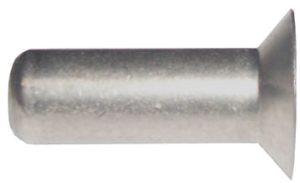
If you’re planning to use solid rivets, you should consider their grip length. Solid rivets are permanent mechanical fasteners that, like other permanent fasteners, are used to join two or more parts.
Solid rivets feature a preformed head connected to a solid shank. After drilling a hole in the parts, you can insert a solid rivet and then deform the tail end of the shank to secure it in place.
Grip Length Explained
Grip length is exactly what it sounds like: the length of a solid rivet that grips and holds the parts with which it’s used. It’s not the total length of a solid rivet. Rather, grip length represents the “working section” of a solid rivet.
Solid rivets come in a wide range of sizes. Some of them are 1/8 inch long, whereas others are several inches long. The total length of a solid rivet, however, will always be greater than the rivet’s grip length. Grip length is simply the length that grips and holds the fastened parts.
How Grip Length Is Calculated
The formula for calculating grip length is simple: it’s the sum of the thickness of the fastened parts. Assuming you are using a solid rivet to fasten two parts, you can calculate the rivet’s grip length by measuring the thickness of the two parts. If the first part is 6 mm thick and the second part is 4 mm thick (when fastened), the solid rivet’s grip length will be 10 mm.
Grip Length vs Maximum Grip Length
While the terms are often used synonymously, grip length isn’t the same as the maximum grip length. As previously mentioned, grip length is simply the length of a solid rivet that grips and holds the fastened parts. Maximum grip length, on the other hand, is the maximum length of a solid rivet that can grip and hold the parts.
The Importance of Grip Length
Why does grip length matter exactly? It plays a key role in the strength of joints. Solid rivets are used to create permanent joints. In many applications, the longer the grip length, the stronger the joint. With that said, if the grip length is too long, the shank may buckle during installation, or the head may form unevenly.
A long grip length also protects solid rivets from loosening. Solid rivets lack the threading of traditional fasteners like bolts and screws, but they can still loosen when exposed to extreme mechanical stress exceeding the limitations for which they are designed. A long grip length helps to protect solid rivets from loosening by maintaining a strong and consistent clamping force on the fastened parts.
source
