


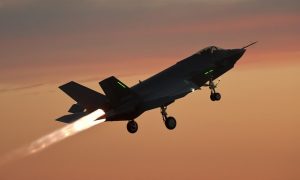
If you’ve seen watched footage of military jets or supersonic jets, you may have noticed a glowing-red flames shooting out the back of the engines. Known as afterburners, they provide a temporary increase in thrust. Pilots can activate the jet’s afterburner to gain additional thrust and, therefore, speed. What are afterburners exactly, and how do they work?
What Are Afterburners?
Afterburners are specialized systems in certain jet engines that deliver a massive, albeit temporary, increase in thrust. They aren’t found in commercial or private aircraft. Rather, afterburners are typically used in military and supersonic aircraft where speed and rapid acceleration are essential.
Military jets with afterburners include the following:
- F-15
- F-16
- F-22
- F-35
- F/A-18
- Eurofighter Typhoon
- B-1
- FB-111
- A-7
The Basics of Jet Engines
To better understand how afterburners work, you must familiarize yourself with the basics of jet engines. Jet engines are designed to generate thrust by burning a mixture of air and fuel, followed by shooting the exhaust gases out the back through a nozzle.
Air enters jet engines through an intake. From there, the air moves to a compressor where it’s squeezed and compacted, thereby increasing its pressure. Fuel is mixed with the air in the engine’s combustion chamber. A spark is then generated to ignite the fuel-air mixture. This process creates hot, pressurized gases that spin the engine’s turbine.
How Afterburners Work
Afterburners work using unspent oxygen. When activated, they add an extra stage to the combustion process. Normally, jet engines inject fuel directly into the combustion chamber where it’s mixed with air. Afterburners don’t eliminate this step. Instead, they add another step in which fuel is sprayed directly into the exhaust gases.
As previously mentioned, jet engines produce exhaust gases that shoot out the back. Afterburners are designed to spray fuel directly into the path of these exhaust gases. This creates a secondary burn that makes the exhaust gases hotter and more voluminous immediately before exiting the exhaust nozzle.
By activating afterburners, pilots can accelerate more quickly. It also allows them to achieve faster speeds, which is why many supersonic jets have afterburners. Furthermore, afterburners offer improved climb rate and maneuverability.
Thrust Increase of Afterburners
Afterburners provide a substantial increase in thrust. Depending on the specific type, as well as the aircraft with which they are used, they can boost thrust by 50% to 80% on average.
It’s important to note that afterburners are temporary. They typically only last for five to 15 minutes. Afterburners also increase fuel consumption by 300% to 600%, further limiting their utility. Nonetheless, they can provide jets with a massive increase in thrust.
source
