


Lockheed Martin confirmed the Government of Peru’s decision to purchase 12 new F-16 Block 70 fighter aircraft, closing a protracted competition that saw Lima reverse an earlier preference for Saab’s Gripen E/F and culminating in a signing process marked by two ministerial resignations and a canceled public ceremony.
The US manufacturer said in a statement issued on April 23, 2026, that Peru would join 29 other countries operating the type.
Mike Shoemaker, vice president of Lockheed Martin’s Integrated Fighter Group, said the selection reflected the aircraft’s “operational performance and combat record,” adding that the program would strengthen industrial ties between the two countries.
The public statement caps more than eighteen months of politically volatile procurement activity. Peru initially announced in July 2025 that it had selected the Saab Gripen E/F over the F-16 Block 70 and the Dassault Rafale F4, citing lower unit cost and a shorter delivery timeline. That decision, made under President Dina Boluarte, was never formalized before her impeachment in October 2025. A state evaluation committee under interim President José María Balcázar reversed the outcome in February 2026, citing technical and geopolitical criteria.
Package structure
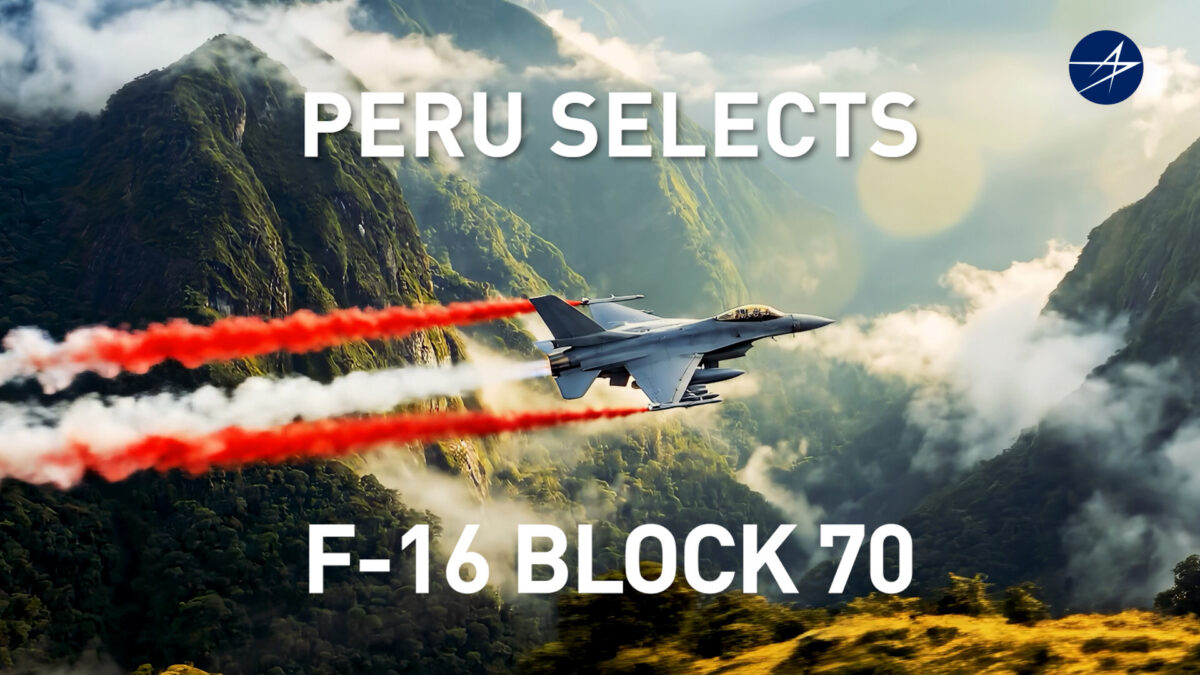
According to the US Defense Security Cooperation Agency notification published on September 16, 2025, the $3.42 billion Foreign Military Sale covers 10 F-16C and two F-16D Block 70 aircraft. The package also includes 14 F110-GE-129 engines, AN/APG-83 active electronically scanned array (AESA) radars, AN/AAQ-28 Litening targeting pods, M61A1 20mm cannons, AIM-120C-8 AMRAAM and AIM-9X Block II air-to-air missiles, electronic warfare systems, spare parts, logistics support, and pilot training.
Peruvian budget documents cited by regional defense publications value the initial direct aircraft purchase at $1.54 billion within a broader $2 billion envelope, financed through domestic borrowing. A follow-on batch of 12 further aircraft remains under consideration, supported by $1.5 billion earmarked in Peru’s 2026 national budget. US Ambassador to Peru Bernardo Navarro said on April 22, 2026, that Lima plans “two squadrons of 12 F-16 fighter jets,” with first deliveries scheduled for 2029.
The Peruvian Air Force operates aging Mirage 2000P and MiG-29 fleets that the F-16s are intended to replace. Peru would become the only Latin American operator of the new-build Block 70 variant. Chile and Venezuela fly earlier F-16 configurations, and Argentina is introducing secondhand F-16AM/BM aircraft acquired from Denmark.
A contested signature
A statement published by the US embassy in Lima on April 22, 2026, detailed the closing week of the process. Lockheed Martin was informed of its selection in writing on April 14, 2026, with a technical signing scheduled for the morning of April 17, 2026, and a ceremonial signing planned for the same afternoon at the Presidential Palace.
The ceremony was canceled hours before it was due to take place, with Balcázar stating that the next elected administration should take responsibility for the commitment. The US delegation learned of the postponement through Peruvian national radio, according to Navarro.
A technical signing ultimately took place at Las Palmas Air Base on April 20, 2026, conducted by Defense Minister Carlos Díaz Dañino. Two days later, on April 22, 2026, Díaz Dañino and Foreign Minister Hugo de Zela both resigned, citing disagreement with Balcázar’s attempt to defer the decision. Peru’s Ministry of Economy and Finance confirmed on the same day that it had transferred $462 million as a first payment under the contract.
Balcázar, appointed by Congress in February 2026 after a succession of impeachments, is expected to leave office in July following the second round of Peru’s presidential election scheduled for June 2026.
Regional implications
The outcome marks the second major Latin American fighter competition in two years, where Saab had appeared positioned to win before a late reversal. Colombia’s government selected the Gripen E/F in April 2025, a decision that has been shadowed by potential US restrictions on the aircraft’s F414 engine.
Responding to an analyst question during Saab’s first-quarter earnings call on April 23, 2026, chief executive Micael Johansson said the company still believed it had presented “a better, cost-efficient offer,” while respecting Peru’s decision.
The F-16 Block 70 agreement also arrives alongside Washington’s offer to designate Peru as a Major Non-NATO Ally, a status that, if formalized, would expand Lima’s access to US defense financing and advanced systems.
source
