


The U.S. Navy has demonstrated the new JDAM Long Range variant which, powered by a small turbojet engine, traveled approximately 200 nautical miles during two test events.
The U.S. Naval Air Systems Command (NAVAIR) and Naval Air Warfare Center Aircraft Division (NAWCAD) announced the recent demonstration of the Joint Direct Attack Munition’s (JDAM) latest variant, the JDAM Long Range (LR). The service has described the new variant as a game-changer.
The tests
The service said the tests were conducted in early April, with the data of the photos on the DVIDS network identifying the date of capture as Apr. 1, 2026. The testing was conducted off the coast of California with the involvement of Naval Air Weapons Station China Lake.
A New Era for Precision Strike: JDAM LR Completes Milestone Test Flights
The U.S. Navy has successfully demonstrated the new JDAM Long Range variant, marking a huge step in bringing affordable, long-range standoff capabilities to the Carrier Air Wing.https://t.co/GvMomaPnSp pic.twitter.com/cNgEgnZGXy
— NAVAIR (@NAVAIRNews) April 20, 2026
The photos show an F/A-18E Super Hornet and an F/A-18F from Air Test and Evaluation Squadron (VX) 31, each loaded with one bomb. Both weapons, which appears to be using 500 lb warheads, were inert.
According to the statement, the two test events demonstrated the weapon’s safe separation; the ability to use existing aircraft interfaces; and controlled, powered free-flight and navigation. Each demonstration traveled approximately 200 nautical miles, says the service, while maintaining consistent guidance directly to its target.
“As Naval Air Forces in theater continue to rely heavily on JDAM systems, the program recognizes a critical need to provide the fleet with greater standoff range,” said Capt. Sarah Abbott, Precision Strike Weapons (PMA-201) program manager. “This new capability allows pilots to engage targets from significantly safer distances, maintaining a tactical advantage in contested environments.”
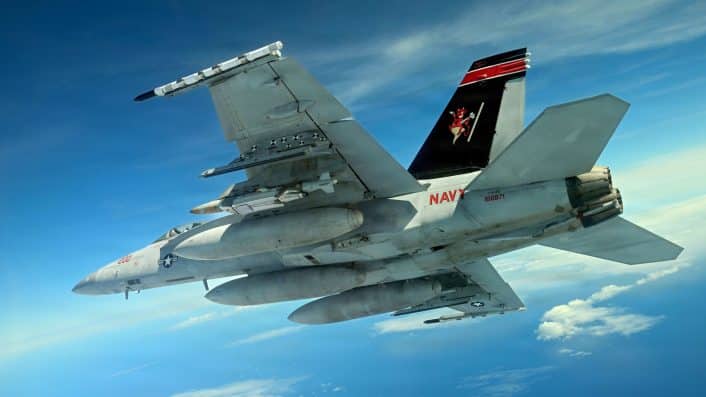
The service says the next phase of qualification will focus on shipboard integration in order to quickly bring this high-priority strike capability to the fleet. It is unclear if the new weapon will supplement or replace any existing weapons, although it is worth noting that the Navy ended in 2022 the JSOW-ER program, which would have provided a weapon with a range similar to the JDAM-LR.
The JDAM-LR
The JDAM Long Range was initially known as Powered JDAM (PJDAM), with reports about the weapon’s development going as far back as 2010. The weapon has surfaced again in 2020 as a possible low-cost stand-off weapon.
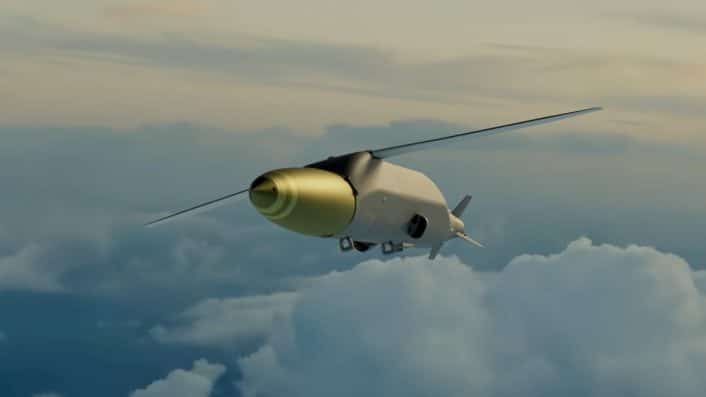
The Navy explained in a short video on social media that the addition of a small turbojet engine transforms the standard JDAM in a low-cost, high-precision cruise missile. In a recent product card, Boeing confirmed the engine as the TDI J85 by Kratos Defense already announced for the PJDAM.
The company says that the weapon could be able to reach a 300+ NM range, or 700+ NM if the Mk-82 500 lb bomb is replaced by a “low-cost decoy fuel tank.” Quickstrike and Maritime Strike variants are also shown during wind tunnel testing.
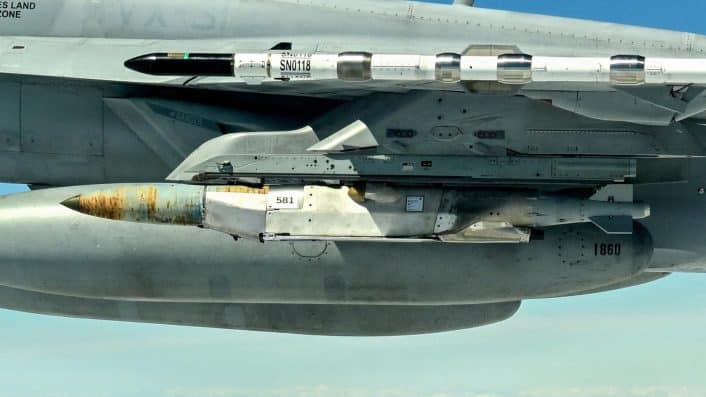
Compared to the JDAM Extended Range (ER), the new weapon uses a different body which includes the standard JDAM tail kit, the ER’s wing kit and the turbojet engine. The warhead is also partially enclosed in the new body, with approximately half of it protruding in the front.
The JDAM-LR uses the existing aircraft interface and In-Weapon Launch Acceptable Region (LAR) of the standard JDAM, allowing for a quicker integration. This would allow for the aircraft which were already cleared to employ the standard JDAM to use also the new variant.
It is unclear if the new weapon has already received its military designation.
The JDAM Extended Range
The standard JDAM kit consists of a tail section that contains a Global Positioning System/Inertial Navigation System (GPS/INS) and body strakes for additional stability and lift. The JDAM Extended Range (JDAM ER) further adds a low-cost wing set to extend the JDAM’s standoff range to greater than 40 miles.
The development of the kit benefited from the GBU-39 Small Diameter Bomb (SDB), according to Boeing’s officials. “The JDAM ER wing kit takes advantage of the conventional JDAM aircraft interface and Small Diameter Bomb glide technology,” said in 2015 Beth Kluba, then vice president of Boeing Weapons and Missile Systems.
The JDAM-ER originates in the 2006/2008 time frame, when Boeing and the Australian DSTO (Defence Science and Technology Organisation) jointly developed and tested a wing-kit for the 500 lb GBU-38/B JDAM. The resulting glide bomb triples the range of JDAM, with some sources stating it can reach up to 50 miles when launched from high altitude. The GBU-62 JDAM-ER entered service with the Royal Australian Air Force in 2016.
In 2009, a similar effort was launched by Boeing and the South Korean company Times Aerospace Korea (TAK) developed a JDAM-ER wing-kit for the 2000 lb GBU-31/B JDAM. The development was expected to last 40 months, but the fielding date of the weapon has not been disclosed.
The only confirmed U.S. military application of JDAM-ER is part of the Quickstrike mines, specifically the Quickstrike ER. The designations GBU-62(V)1/B and GBU-64(V)1/B, in fact, refer to 500 lb MK 62 and 2000 lb MK 64 mines equipped with a JDAM-ER kit, respectively.
source
