


A General Atomics YFQ-42A Collaborative Combat Aircraft prototype crashed shortly after takeoff in the California desert on April 6, 2026, dealing the US Air Force’s flagship drone-wingman program its first known flight mishap.
General Atomics Aeronautical Systems (GA-ASI) said the incident occurred at approximately 13:00 Pacific time at a company-owned airport. No one was injured. The company has temporarily paused flight test operations while it investigates the root cause.
“Safety is our top priority, for our people and the public. In this case, established procedures and safeguards worked as intended, and there were no injuries,” said company spokesman C. Mark Brinkley. GA-ASI described the mishap as occurring “following takeoff” but declined to elaborate on the circumstances, calling speculation premature.
The aircraft involved is one of at least three production-representative YFQ-42A airframes that GA-ASI has been flying as part of the CCA program’s technical maturation and risk reduction phase. GA-ASI has not said whether the airframe is recoverable.
What is the YFQ-42A?
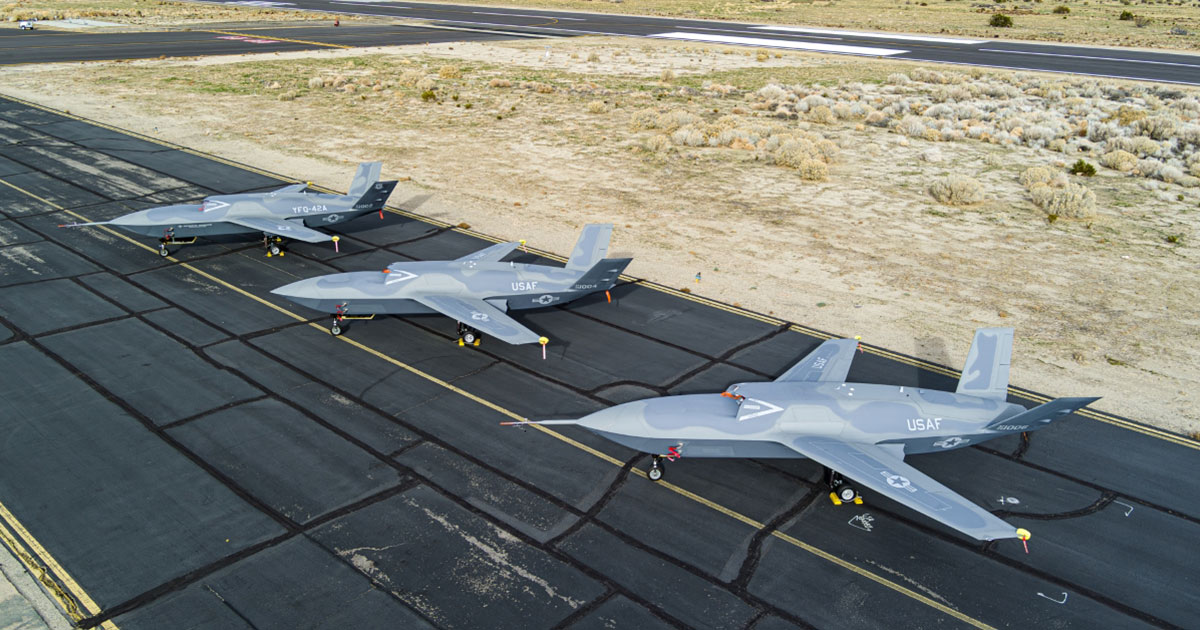
The YFQ-42A, which GA-ASI internally calls Dark Merlin, is one of two Increment 1 CCA designs competing for what the Air Force envisions as a fleet of more than 1,000 autonomous wingmen. The other is Anduril Industries’ YFQ-44A Fury, which made its own maiden flight in October 2025. Both are air-to-air-focused uncrewed fighters designed to fly alongside the F-22, F-35, and the planned Boeing F-47.
The US Air Force selected GA-ASI and Anduril in April 2024 to build production-representative prototypes, and GA-ASI achieved first flight in August 2025, just 16 months after contract award.
Since then, the program has moved quickly. GA-ASI flew a second YFQ-42A airframe in late 2025 and revealed a third. The company has also been integrating Collins Aerospace’s Sidekick autonomy software through the Air Force’s Government Reference Architecture, part of a broader effort to ensure multiple vendors can supply the AI that controls CCA behavior in flight.
GA-ASI’s CCA is derived from the XQ-67A Off-Board Sensing Station, part of the company’s modular Gambit family of drones that share a common chassis, engine, and landing gear.
GA-ASI has also been positioning the YFQ-42A for European export, with final assembly planned in Germany, as European air forces are actively evaluating CCA options, including a Rheinmetall-Boeing partnership to offer the MQ-28 Ghost Bat to Germany.
Crash comes at critical moment for CCA competition
The mishap comes at a sensitive moment for the CCA program. A production decision for Increment 1 is expected in fiscal year 2026, and both competitors have been racing to demonstrate technical maturity. Anduril began production of the YFQ-44A at its Arsenal-1 factory in Ohio on March 23, 2026, and has already completed captive carry tests with an AIM-120 AMRAAM.
Meanwhile, nine companies have won early design deals for a second round of CCA contracts, and Northrop Grumman has entered the competition with Project Talon, a rapid-build alternative developed with Scaled Composites.
The crash is unlikely to be fatal to GA-ASI’s bid. Flight test mishaps are not uncommon during developmental programs, particularly for new aircraft types pushing the boundaries of autonomous flight.
But the timing adds pressure on the company to demonstrate that the YFQ-42A’s design and production quality can support the high-rate manufacturing the US Air Force demands.
The company said flight operations will resume when deemed appropriate.
source
