


Long-range JASSM strikes still continue on Iranian targets, particularly against missile and drone production facilities.
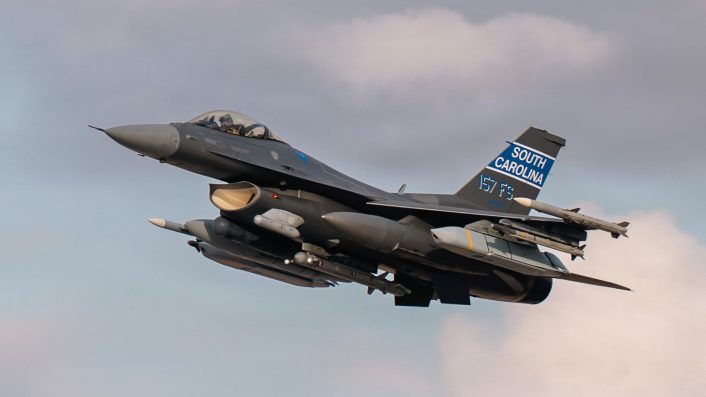
U.S. Air Force F-16s currently deployed in support of Operation Epic Fury have been shown in official photos carrying the AGM-158 Joint-Air-to-Surface Standoff Missile (JASSM) while departing for missions over Iran. The images, captured on Mar. 29, 2026, were uploaded on the DVIDS network on Apr. 4.
The images showed two F-16CM Block 52s from the South Carolina Air National Guard’s (SCANG) 169th Fighter Wing, as identified by the “South Carolina” and “Swamp Foxes” markings emblazoned on their vertical stabilizers. The aircraft were flying with two AGM-158s JASSMs, one on each wing.
Additionally, the payload included two AIM-9X Sidewinder short-range air-to-air missile, two AIM-120 Advanced Medium Range Air-to-Air Missile (AMRAAM), an Angry Kitten Electronic Warfare (EW) pod on the centerline, a Litening targeting pod, and High-speed Anti-Radiation Missile Targeting System (HTS) pod.
SCANG Wild Weasels lugging JASSMs and Angry Kittens in support of Epic Fury. Once again circling back to just how quintessentially multirole the F-16 is. The best to ever do it. Even more ridiculous that a fighter can look this good carrying so much hurt on any given day. https://t.co/VlEXq9IozQ pic.twitter.com/VUetBzRLxx
— Abd (@blocksixtynine) April 4, 2026
Interestingly, the Angry Kitten pod made its combat debut in this war. The system was first spotted on the SCANG’s F-16s in images that emerged on Feb. 19, while the jets were transiting Lajes Airport in Portugal on their way to the CENTCOM’s AOR.
We then reported about the Angry Kitten pod appearing in an actual combat, when an image showed an F-16s carrying the system together with a mixed load of AGM-88C HARM and a GBU-31(V)3 Joint Direct Attack Munition (JDAM), the bunker busting variant of the 2,000 lb guided bomb.
This was a change from the opening days of the war, when the F-16s were flying with a HARM-only loadout. Another interesting payload has been seen on F-16CM Block 40s from Aviano Air Base, Italy, carrying four cluster bombs.
Aviano Vipers supporting Iran Ops loaded with 4x CBU/SFWs each. Again, this could be the CBU-89/B GATOR if not a different sensor fuzed variant. https://t.co/Tnhdg0zuGL pic.twitter.com/sKo6L6g6b9
— Abd (@blocksixtynine) April 3, 2026
JASSMs on F-16s
As can be seen, all the munitions on the F-16s are live, going by the yellow bands on them. The mix of long-range surface-strike, air-to-air loadouts and electro-magnetic sensing pods, like the HTS and the Angry Kitten, suggests the F-16s are primarily flying standoff land-strike missions, while being prepared for air-to-air engagements.
Just noticed that all 12 SCANG Block 52 Vipers transiting LPLA were carrying Angry Kitten EA/EW pods en route to the Middle East. Fairly noteworthy for a lot of reasons. Can’t ever recall seeing EKs on jets potentially heading into ops, likely the first instance? 📸 Kurt Mendonça pic.twitter.com/JQWZlCN31A
— Abd (@blocksixtynine) February 19, 2026
These ‘swing-role’ loadouts, allowing an aircraft to switch between anti-land and anti-air mission sets either as pre-planned mission objective or unplanned tasking, have been a common sight even among multirole aircraft. It is unclear whether the close attempts on the F-35 and the F/A-18 Super Hornet prompted a switch to stand-off strikes instead of the relatively riskier stand-in attacks under localized air superiority.
Angry Kitten carrying SCANG Wild Weasels on Iran ops with a mixed loadout of HARMs and GBU-31s fitted with BLU-109 penetrators, plus HTS pods and LITENING LAs. Three AIM-120C/Ds (up from the standard two), and one AIM-9X rounding it out. Few do multirole like the Viper can. pic.twitter.com/RrH32aNKFL
— Abd (@blocksixtynine) March 17, 2026
AGM-158 JASSMs were initially spotted on B-52s in night-time visuals earlier in March, followed by the visuals from RAF Fairford and CENTCOM’s photos later in the month. The remains of crashed JASSMs were also found early in March and April, although the causes are unclear.
Another wreckage of AGM-158 JASSM in Markazi Province, Iran pic.twitter.com/WVYYknih0Q
— 🕳️ (@Flanker30MKI) April 4, 2026
Use in Iran
While standoff strikes require pre-planning with heavy reconnaissance and imagery analysis, leaving little scope for dynamic targeting, they are safer since they keep the aircraft out of harm’s way from enemy missiles. Stand-in strikes meanwhile are riskier, given the small window and being closer to defended airspaces, but allow hitting targets of opportunity.
In case you wanted a closer look at the 12 AGM-158 JASSM (Joint Air-to-Surface Standoff Missile) on wing pylons of the B-52 departing RAF Fairford on Mar. 20, here it is, courtesy of our friend and contributor @TallGlenn85
More details here: https://t.co/oSAIuhBcvM pic.twitter.com/n3zvigAwGu
— The Aviationist (@TheAviationist) March 21, 2026
Recent battlefield developments suggest the U.S. might have changed targeting priorities. Reports say only half of Iran’s missile capability has been destroyed.
An E-3 Sentry AWACS was also lost at Saudi Arabia’s Prince Sultan Air Base, reportedly to an Iranian Shahed-136 One-Way Attack (OWA) drone. Thus, the U.S. might want to hit Iran’s missile and drone production centers from a distance.
At least 6 AGM-158 JASSM (Joint Air-to-Surface Standoff Missile) as well as a Sniper pod can be see on wing pylons of the B-52 in the CENTCOM post. https://t.co/Gb0Bzk6IwW pic.twitter.com/LFRrY9iV49
— Mehdi H. (@mhmiranusa) March 24, 2026
The HTS pod, while it is primarily intended for the targeting of the AGM-88 HARM missiles, can also be used to detect hostile ground radars, like the Iranian Sevom Khordad, Raad, the more sophisticated Bavar-373, and the Russian S-300 and Chinese HQ-9Bs. Sources claim Iran has used its unconventional Product 358 anti-aircraft loitering drone to target U.S. aircraft.
🚨🇮🇷 Iran’s Bavar-373 air defence system looks GREAT! pic.twitter.com/bGuv82HmFE
— Jackson Hinkle 🇺🇸 (@jacksonhinklle) February 5, 2025
The small, concealment-friendly design that can be mounted on indistinguishable civilian vehicles, using optical seekers instead of radio frequency-emitting systems, allows conducting ‘pop-out’ attacks, giving little time for a target jet’s onboard radar and missile warning sensors to react. The video of the attempt on the F-35 showed the aircraft flying in level flight, with the missile suddenly nearly striking it, forcing it to make an emergency landing at a friendly base.
C’est ton moment, missile 358 ! pic.twitter.com/TCpojwahgQ
— كريم (@KarimBecc) April 4, 2026
This suggests that the pilot was unaware that a missile was heading towards him, who would have otherwise taken evasive maneuvers, releasing flares/chaff. The infrared seeker on the Product 358 also has limitations in terms of guaranteeing a hit, and Iran might just out of desperation take a chance by using its conventional air defense platforms to further deter standoff strikes.
source
