


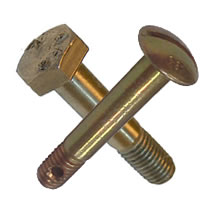
Airframe bolts play an important role in aerospace engineering. Like all bolts, they are used to fasten parts. You can secure two or more parts together by running a bolt through them. Installing a nut onto the end of the bolt will apply a clamping force, thereby holding the parts together.
Airframe bolts, however, are specialized threaded fasteners designed for use with airframe structures. They typically adhere to strict manufacturing standards, including Army-Navy (AN) standards. Some airframe bolts even have a hole in the shank. What’s the purpose of this hole exactly?
Identifying Airframe Bolts With a Shank Hole
You can identify airframe bolts with a shank hole by inspecting the bottom of the body. Some airframe bolts have a solid body consisting entirely or partially of threads. Other airframe bolts have a threaded body with a hole near the bottom.
The hole is typically small, measuring about 0.076 to 0.094 inches. It runs perpendicular to the shank itself. To make the hole, manufacturers use a precision drilling machine, such as a drill press.
Supports for Locking Mechanism
The hole at the bottom of airframe bolts allows for a separate locking mechanism. Airframe bolts are used to secure the mechanical body parts of airplanes and other types of aircraft. Therefore, they are exposed to strong vibrations.
Turbulent air, as well as running jet engines, produce vibrations that physically shake airplanes during flight. Over time, vibrations such as this can loosen threaded fasteners. Fortunately, locking mechanisms are available to protect threaded fasteners from loosening. Airframe bolts with a hole in the shank support a locking mechanism so that they don’t loosen from vibrations or external forces.
How Airframe Bolts Work With a Locking Mechanism
The hole at the bottom of certain airframe bolts acts as a receptacle for a castellated nut or locking wire. Castellated nuts are threaded nuts with equally spaced notches on the bottom — similar to a castle’s battlements. Locking wire, also known as safety wire, is stainless steel wire that’s designed specifically for use with fasteners.
If a castellated nut is used, it’s tightened until the the notches are aligned with the hole. A cotter pin is then placed through the hole and bent to prevent it from falling out. The cotter pin will essentially prevent the castellated nut from rotating.
Safety wire follows a similar concept. It’s inserted through the airframe bolt’s hole and wrapped around an adjacent fixed point. Even if the airframe bolt shakes, the safety wire will hold it in place.
In Conclusion
Engineers do not rely on torque alone to secure airframe bolts; they often use castellated nuts and safety wire as well. Airframe bolts with a hole in the shank support these locking mechanisms.
source
