


As airlines across the globe grapple with a serious jet fuel price crisis that has sent costs soaring and pushed many to cut capacity and raise fares, a new fear is emerging: that the shock could spiral into a full-blown supply emergency if disruption in the Strait of Hormuz continues for much longer.
As a doubling in jet fuel prices threatens what had been a record-profit outlook for the airline industry in 2026, airline CEOs worry about what could come next as the Iran war chokes off the supply of oil through the vital Strait of Hormuz.
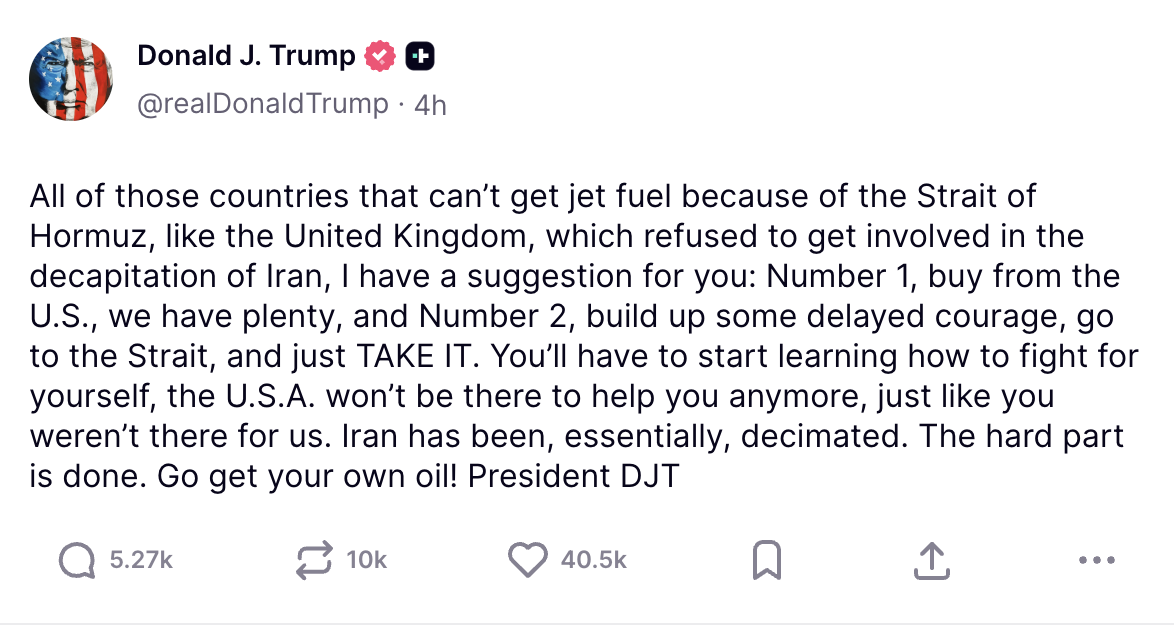
On March 31, 2026, US President Donald Trump put those concerns into unusually blunt terms. In a Truth Social post, Trump said countries such as the United Kingdom “can’t get jet fuel because of the Strait of Hormuz” and told them to “go get your own oil.” He further urged countries that had stayed out of the war to buy from the US or “go to the Strait, and just TAKE IT.”
Jet fuel has surged from about $85 per barrel to roughly $150 to $200 per barrel in recent weeks, a punishing price move for an industry in which fuel typically accounts for about 20% to 25% of total operating costs. Reuters reported on March 17 that Delta Air Lines Chief Executive Ed Bastian said jet fuel prices had “almost doubled since the start of the year,” adding hundreds of millions of dollars to the airline’s fuel bill in March alone.
Airlines are reacting to the crisis with measures meant to blunt the impact of rising jet fuel costs. Air New Zealand raised ticket prices on March 10 and suspended its full-year earnings forecast because of fuel volatility. Air France-KLM said it would raise long-haul fares by 50 euros per round trip. Cathay Pacific said it would raise fuel surcharges twice in March, with some routes including Sydney-London carrying an $800 surcharge, and warned its 10% passenger-capacity growth plan could change if fuel prices stay high. United Airlines said it is cutting unprofitable flying over the next two quarters, while SAS has also moved to trim capacity.
The pressure is also widening in Asia. Reuters reported on March 31 that Korean Air will shift into emergency management mode in April because of the fuel shock, with April jet fuel costs projected at about $4.50 per gallon, more than double the $2.20 built into its business plan. Other South Korean carriers including Asiana and T’way have also taken emergency measures, while fuel surcharges on key long-haul routes have jumped sharply.
US carriers are also exposed to jet fuel price shocks because most do not hedge fuel costs. Reuters reported that American Airlines expects a $400 million increase in first-quarter expenses from higher fuel prices, while Delta said the March spike added about $400 million to its fuel bill. Reuters also reported that United has warned of a multibillion-dollar increase in annual fuel costs and has already shown a willingness to cut weaker flying rather than keep marginal routes in the schedule.
So far, this is primarily a fuel price story, but the first signs of a physical supply squeeze are already showing up in Asia, where the problem could turn more serious.
Vietnam imports more than two-thirds of its jet fuel, with more than 60% of those imports coming from China and Thailand. The Civil Aviation Authority of Vietnam warned of shortages beginning in early April and told airlines to review schedules, especially on domestic routes. Reuters reported that Vietnam had seen reduced supplies from Singapore and that major importers Petrolimex and Skypec said they could guarantee fuel only through the end of March.
In response, Vietnam Airlines said it will suspend seven domestic routes beginning on April 1 and cancel 23 flights a week to conserve fuel. Separate Reuters reporting said Vietnamese carriers including VietJet and Bamboo Airways were also preparing capacity reductions as supply tightened and prices stayed elevated.
Trump now appears reluctant to let the war continue much beyond the original four- to six-week timeline set out by his administration at the start of hostilities on February 28, raising the possibility that he could seek to end the bombing and claim victory without first reopening the Strait of Hormuz. Defense Secretary Pete Hegseth on March 31 said other countries need to “step up” to reopen the Straight of Hormuz.
If that becomes Washington’s position, the burden would shift to Europe and other allies to take the lead in restoring access through the strait. But European officials are explicitly pushing diplomacy, not a military response, with EU foreign policy chief Kaja Kallas saying “nobody is ready to put their people in harm’s way” in the strait and that diplomatic means must be found to keep it open.
source
