


U.S. Air Force A-10s in maritime attack role are hunting small Iranian fast attack boats that could threaten shipping or naval forces in the Strait of Hormuz.
The U.S. Air Force A-10 Thundebolt II jets supporting operation Epic Fury have started flying a different type of mission. As explained by General Dan Caine, Chairman of the Joint Chiefs of Staff, during the Press Briefing at the Pentagon on Mar. 19, 2026, the Warthogs are now engaged across the southern flank, targeting fast attack watercraft in the Strait of Hormuz.
LIVE: @SecWar, Chairman of the Joint Chiefs of Staff, Air Force Gen. Dan Caine hold a press briefing at the Pentagon. https://t.co/h5YoEfU8xH
— Department of War 🇺🇸 (@DeptofWar) March 19, 2026
The fact that the iconic jet was actively supporting Operation Epic Fury in Iran was not a secret, since their participation had been confirmed in writing by CENTCOM during the first 48 hours of the conflict.
Recent images released by the U.S. Central Command, showed A-10C Thunderbolt II outfitted with dedicated anti-air as well as dedicated anti-surface weaponry; a loadout that included a LITENING targeting pod, two AGM-65 Maverick air-to-surface guided missile, a centerline standard 600 gallon drop tank for extended range and loiter time, as well as two AIM-9M Sidewinder air-to-air missiles, and a single LAU-131 seven round rocket pod loaded with Advanced Precision Kill Weapon System II (APKWS II) guidance kit-equipped Hydra 70 rockets.
As we explained commenting those images:
A-10s have routinely been equipped with Sidewinders as a last layer of self defence against hostile aircraft, but with the increased use of small uncrewed aerial vehicles (UAVs) like the Shahed 136 as attack munitions, the A-10 can now use them in a more offensive role.
Flying over Iraq and Jordan, A-10s armed with Sidewinders and APKWS rockets can ably intercept hostile drones bound for friendly bases. It should be noted though, as the A-10 lacks its own radar, unless the drones are spotted visually or with infrared optics the pilots would most likely rely upon external means to be directed towards such targets.
Until now, A-10s had not been confirmed to have taken part in any missions over Iran itself.
Deployed to Muwaffaq Salti Air Base in Jordan, the Hogs had reportedly been involved in operations against Iran-backed Popular Mobilization Forces (PMF) in Iraq, where they have operated in the quite traditional CAS (Close Air Support) role for several time.
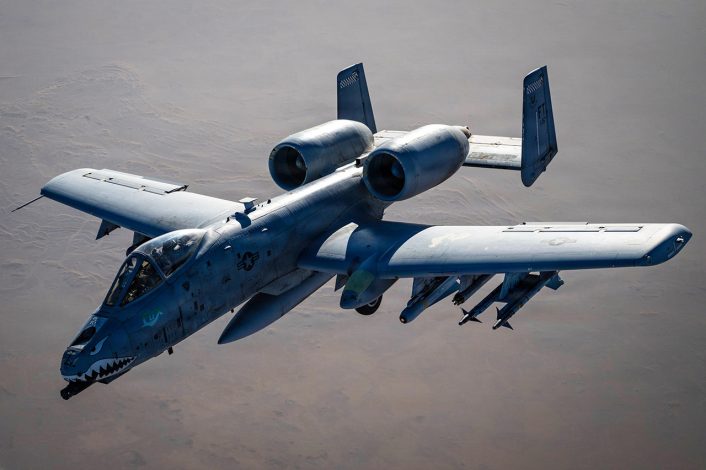
However, we now know that the attack aircraft are directly involved in Epic War, although on the naval front. The shift to the maritime domain, whether from Jordan or another forward operating base in the region, makes a lot of sense, considering the type has regularly taken part in U.S. submarine escort and live-fire exercises in recent years. Moreover, the U.S. Air Force had released images of its A-10s deployed to the region escorting U.S. warships in the 5th Fleet Area of Operations last month.
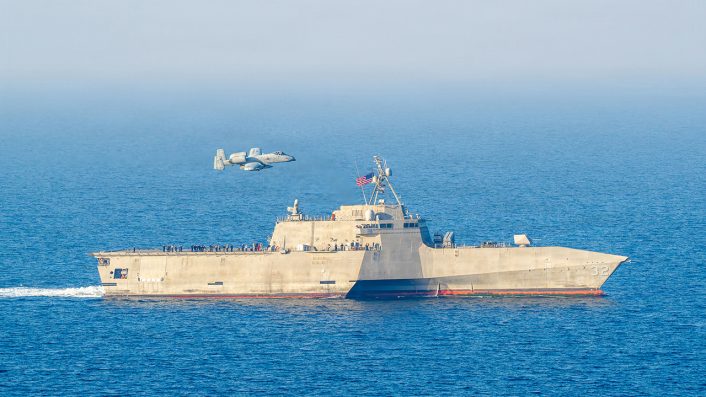
In 2024, we reported about Warthogs practicing overwatch of a U.S. nuclear submarine during one of the most vulnerable phases of its navigation through the Strait of San Juan de Fuca, on the Pacific Northwest coast, between the state of Washington and Vancouver Island, British Columbia, Canada.
Few months later, a formation of six A-10Cs, assigned to Moody Air Force Base, escorted an Ohio-class ballistic missile submarine, the USS Wyoming (SSBN 742). The aircraft, were also involved in a live fire exercise with their GAU-8 30 mm gun and 70 mm rockets.
Born as a pure Close Air Support and anti-tank platform, the A-10 has rarely been employed in the maritime domain until roughly 15 years ago. In 2011, during Operation Unified Protector, when an A-10 and a P-3C Orion engaged together a patrol boat and several small attack craft in the port of Misrata, Libya.
More recently, following the renewed attention towards these types of asymmetric threats caused by the attacks in the Red Sea or the skirmishes between the Ukrainian USVs (Unmanned Surface Vehicles) and the Russian Navy in the Black Sea, the type has been used to target swarms of boats and strike small vessels in several training scenarios.
In the 2020s, the Warthog took part in multiple Maritime Surface Warfare exercises and conducted unit defense training. One of the exercises saw, in Sept. 2023, two A-10s engage simulated surface threats in the Gulf of Oman with the Arleigh Burke-class guided-missile destroyer USS Stethem.
High Value Targets, like U.S. warships and civilian ships and tankers could be attacked and overwhelmed by coordinated swarms of USVs, challenging the traditional naval defense strategies. The A-10’s maneuverability at low airspeeds and altitude, flexible armament, highly accurate weapons-delivery capabilities, and extended loiter time are all key attributes that make it highly effective at against fast naval targets in the Persian Gulf and beyond.
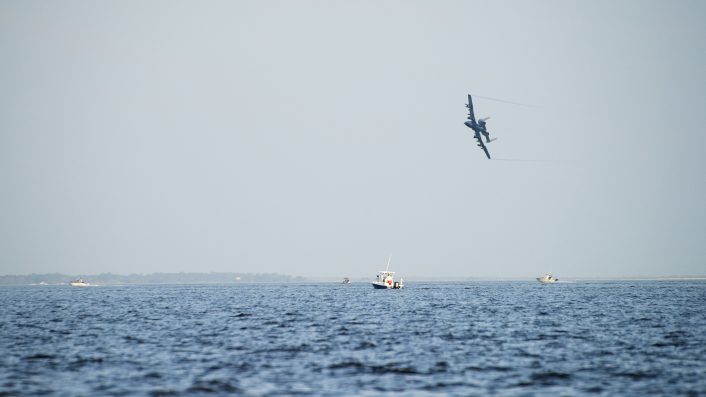
As previously reported, the type’s retirement timeline continues to be postponed. While the Air Force most recently aimed to withdraw all 162 remaining A-10s from service by fiscal year 2026, accelerating an earlier plan that would have phased the fleet out through 2029, Congress once again intervened. The most recent National Defense Authorization Act authorizes the retirement of only 59 aircraft, effectively slowing the divestment and keeping a portion of the fleet in service beyond the Air Force’s preferred schedule.
That decision, however, came with trade-offs: the Air Force did not include funding for A-10 sustainment in its FY2026 budget request, estimating that maintaining the fleet would have required roughly 423 million USD, resources it intended to redirect toward other modernization efforts.
Meanwhile, U.S. decision-makers continue to rely on the type, which has also been upgraded with the addition of Link 16, to keep the aircraft operationally relevant and interoperable in modern, networked combat environments for as long as it remains in service.
source
